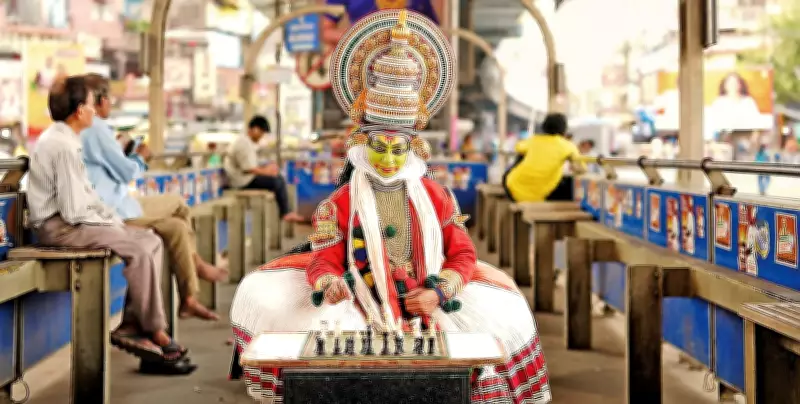
Busy streets, crowds, and routine – four city-based dancers across Indian classical genres carry their form, instinctively returning to rhythm in ordinary moments. This World Dance Day, the artistes show how performance never truly ends.
Dance Is Not Just Movement, It Is a Way of Life
In Kolkata, dance is not confined to rehearsal rooms or proscenium stages. For most practitioners, the art does not switch off once the performance ends; it lingers in instinct, posture, and breath, revealing itself in the smallest gestures. At city landmarks and street corners, between errands and routines, four dancers across classical Indian genres reveal how deeply their form is embedded in their lives. Whether in a fleeting pause, a passing movement, or the turn of a wrist or foot, dance continues to surface. This World Dance Day, their stories come together as a reminder that dance is not merely practised, but lived – constantly, instinctively, and inseparably, shaping both presence and perception.
Oishanee Bhattacharjee: Odissi
Specialises in: Odissi. Started learning dance at the age of 7.

Oishanee believes her passion for dance is not a reflection of her attachment, but one of identity. She says, “A dancer embodies the dance form they practise.” In everyday life, it reveals itself in the most ordinary moments: “While walking through a crowded street, my body instinctively aligns with rhythm. While reaching out for something, there is a trace of intention and grace. Even in stillness, there is an awareness of posture, breath, and presence, as Odissi seamlessly integrates into my life,” she adds.
“Dance is something I live with, not just something I do. My body instinctively responds to my environment, and in the simplest gestures, I find intention and grace,” says Oishanee.
Sohini Maity: Kathak
Specialises in: Kathak. Started learning dance at the age of 4.
What began as a learning experience for Sohini gradually transformed into passion and purpose, with Kathak shaping her discipline, expression, and identity over the years. For her, “the ghungroo is not just an ornament – it is a voice,” each tiny bell carrying rhythm, memory, and years of practice. Dance, then, becomes “not just movement, but a way of life,” an eternal presence she carries within, resonating through everything she is and does.
“Even when the stage is empty, dance never leaves me; it lingers in my breath, in my being. As long as I breathe, it will remain my constant companion. Today, I want to celebrate the rhythm that lives within me,” says Sohini.
Sharanya Mukherjee: Bharatanatyam
Specialises in: Bharatanatyam. Started learning dance at the age of 3.
According to Sharanya, dance is a form of expression that connects people. Knowingly or unknowingly, we move with a celestial, cosmic rhythm. From morning to night, this rhythm plays around us in different forms and activities. “Dance, to me, is my existence – rather, I would say, I live to dance. The rhythm of life that throbs within me is the ultimate form of dance that I celebrate every day as a dancer. Life is beautiful with dance, and I am blessed to be a part of such a divine journey.”
“World Dance Day, to me, is not just about celebrating an art form. It is a celebration of an emotion and a constant companion,” says Sharanya.
Harikamal Mazumdar: Kathakali
Specialises in: Kathakali. Started learning dance at the age of 5.
Harikamal believes dance was so much a part of his DNA that he had never had to pursue it or arrive at it. He says, “Kathakali teaches control over one’s body and mind.” Over time, however, he has come to the realisation that “dance is not something external to master. It is already a part of an individual.” When he performs on stage, it feels “less like stepping into a role and more like allowing something within to emerge – whether it is in the stillness of Shiva, the playfulness of Krishna, or the intensity of Duryodhana.”
“After a performance ends and the costume comes off, the movement still lingers in my breath and awareness. I want to celebrate dance as a presence I carry, even beyond the stage,” says Harikamal.
Pix: Anindya Saha