

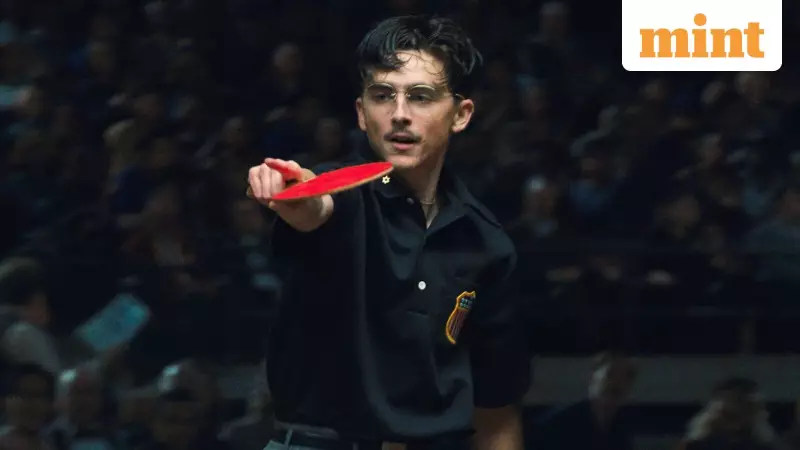
In a desperate bid for cash, Marty Mauser, portrayed by Timothée Chalamet, recruits his friend Rachel, played by Odessa A’zion. Rachel is married but likely pregnant with Marty's child, and together they embark on yet another hopeless long shot in an endless series of risky ventures. She contacts the shady character Ezra, brought to life by Abel Ferrara, whose dog Marty had previously lost and then miraculously tracked down. When Rachel demands a finder's fee of $2,000 for the dog's return, Ezra hesitates, arguing that he originally acquired the dog for free. In a moment of quick-witted improvisation, Rachel retorts with a hypothetical scenario: "What if I was a doctor operating on your mother? Would you refuse the surgery because you got your mother for free?" Ezra dismisses this as "the stupidest thing I ever heard," to which Rachel immediately counters, "Well, then I guess you don't know anything about love." This exchange encapsulates the film's central theme of love and desperation intertwined in the hustle.
The Unending Hustle in Josh Safdie's Cinematic World
The relentless hustle is a hallmark of Josh Safdie's films, including his four collaborations with his brother Benny and now his solo feature, Marty Supreme. It presents a constant dance of deception, yet there's a strange purity to it. The instigators of chaos are so deeply invested in their own schemes that they fully believe in their own narratives. For instance, Rachel can sincerely tell the man being resold his own dog that it's all about love because she genuinely believes it. Similarly, Marty is convinced he has a purpose, describing it as "an obligation to see a very specific thing through." This unwavering self-belief drives the characters forward, even as their plans spiral out of control.
Marty's Grand Ambition and Financial Struggles
Loosely based on Marty Reisman, a flamboyant US men's singles table tennis champion, Marty Mauser is a character whose financial needs are as chaotic as his life. While it's challenging to keep track of all his monetary demands at any given moment, his overarching goal is clear: to compete in the world championship in Japan. A defeat to Japan's Koto Endo, played by Koto Kawaguchi, in the finals of the 1952 British Open shatters his grand plans of becoming the first US celebrity in the sport. Suddenly, the bills he's accumulated at The Ritz must be settled before the federation approves his participation. Compounding his woes, he can't afford a ticket to Japan after rejecting an offer from pen manufacturer Milton Rockwell, portrayed by Kevin O'Leary, to throw an exhibition match against Endo before the championship. This refusal sets off a chain of increasingly desperate schemes.

The Spiral of Problems and Failed Endeavors
In typical Safdie fashion, protagonists don't so much solve problems as they parlay them into new, more complex issues until the original sin is obscured. No sooner does Marty return to New York than he becomes a blur of mad plans and broken promises. Cinematographer Darius Khondji captures this frenzy perfectly, at one point showing Marty as a literal blur racing through the streets. Every failed endeavor begets—or as Marty would argue, necessitates—another, riskier scheme. He orchestrates a table tennis hustle with his friend Wally, played by Tyler Okonma, but it inevitably unravels. He attempts to pawn a necklace from Rockwell's wife, the semi-retired actress Kay Stone, portrayed by Gwyneth Paltrow, with whom he's having an affair, only to discover it's costume jewellery. Even a simple task like taking Ezra's dog to the vet for a fee mutates into a surreal situation, with Marty peeking into a house reminiscent of The Texas Chainsaw Massacre.
Audience Engagement and Character Dynamics
Safdie has a unique ability to elicit reactions from audiences that are typically reserved for horror films. During screenings, viewers often find themselves talking to the screen, groaning, cheering, offering advice, and admonishing characters for their terrible decisions or outrageous statements. For example, an Auschwitz joke is thrown in so casually that it prompts a unified reaction from the audience a second later. This immersive experience highlights the film's power to engage viewers on an emotional level.

Marty Mauser is a memorable slimeball, brought to life by Chalamet as a whirlwind of smug confidence and entrepreneurial invention. While he shares similarities with Adam Sandler's jeweler-gambler in Uncut Gems, a crucial difference is that Marty is actually skilled at something besides hustling. He embodies the hustle itself—a talented, dogged table tennis player who has the misfortune of facing an innovator in Koto Endo. Endo, who uses sponge rackets and a pencil grip, both novelties in the game, serves as a natural foil to Marty. Deaf, undemonstrative, and patriotic, Endo's character contrasts sharply with Marty's casually cruel motormouth persona. Their final showdown is exhilarating yet confusing, as viewers grapple with not wanting the American to beat the modest champion, yet fearing that all Marty's efforts would be in vain if he loses.
The Safdie Brothers' Solo Ventures and Collaborative Efforts
It's tempting to infer from the Safdie brothers' first solo projects last year that Josh was the primary shaper of their four collaborative films. However, while Marty Supreme feels cut from the same cloth as the equally frantic Good Time and Uncut Gems, it's important to note that Benny's The Smashing Machine is designed as a very different film, albeit also centered on a troubled athlete in a growing sport seeking glory in Japan. Benny sought new collaborators for that project, whereas Josh works on Marty Supreme with Ronald Bronstein, who co-wrote and co-edited all their previous films, and composer Daniel Lopatin, who scored their last two films together. Both Safdie solo films benefit from the expertise of casting director Jennifer Venditti, whose work on Marty Supreme is particularly striking. She surrounds Chalamet and Paltrow with unconventional choices like Abel Ferrara, Pico Iyer, and Penn Jillette, adding depth and uniqueness to the ensemble.
Precision in Chaos: Music and Themes
Despite Marty Mauser's chaotic life, Marty Supreme is an extremely precise film. The first needle drop in the opening credits is Alphaville's 'Forever Young', one of several new wave tracks that complement Lopatin's chunky synths. The film poses a poignant question: "Do you really want to live forever?" This is visualized through the abstractly beautiful sight of a shoal of sperm swimming to an egg cell, which transforms into a table tennis ball. At the film's conclusion, Rockwell warns Marty, "I’m a vampire. I’ve been around forever… You go out and win that game, you’re gonna be here forever too. And you’ll never be happy." This warning underscores the film's exploration of legacy and happiness. Although Safdie closes on a rare moment of stillness and happiness, the music subtly pulls Marty towards another scheme, with the lyrics "Everybody wants to rule the world…" hinting at the never-ending cycle of ambition and hustle.
Marty Supreme is currently in theatres, offering audiences a gripping look at the highs and lows of a hustler's journey in the world of competitive table tennis.
