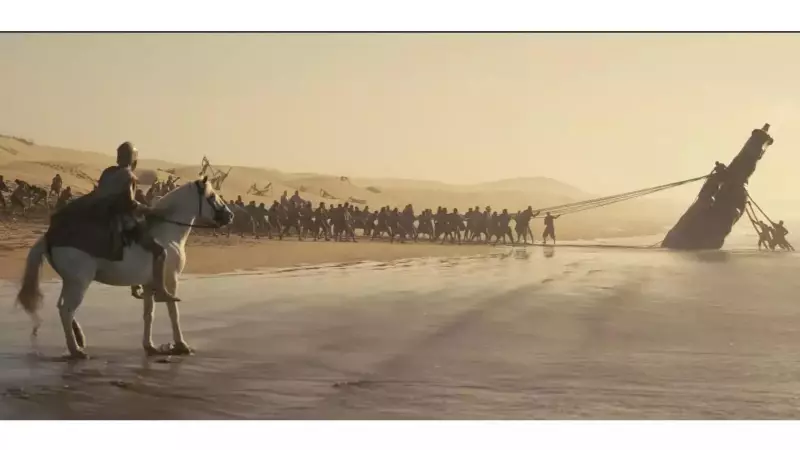
The latest trailer for Christopher Nolan's upcoming epic, The Odyssey, offers a visual feast of deserts, forests, and battlefields. Yet, one understated moment stands out: a wide beach where exhausted soldiers strain against thick ropes, hauling a massive, rough-hewn object from the sea. The shape slowly clarifies into the legendary Trojan Horse, presented not as a gleaming spectacle but as a raw, almost unfinished wooden structure.
The Deliberate Design: A Horse Dragged from Myth
In Nolan's cinematic world, visual choices are never accidental. The Trojan Horse here looks crude and heavy, its weight palpable through the soldiers' effort. This deliberate design suggests the horse is meant to feel like a natural, if ominous, part of the story's world, not a detached showpiece. The emphasis is on physical tension and believable effort, making the iconic moment more immersive and memorable.
The Trojan Horse, as per ancient Greek history, is not a recorded factual event. It originates from epic literature like Homer's The Odyssey and Virgil's Aeneid, composed centuries after the presumed era of the Trojan War. While archaeology confirms a Bronze Age city at the site of Troy and episodes of destruction, no evidence points to a giant wooden horse or such a specific ruse. Historians, therefore, classify the Trojan Horse as mythology, not history.

Two Competing Explanations of the Legend
As a myth, the story of the Trojan Horse has spawned multiple interpretations over time. Two primary explanations have endured.
The first is a practical, militaristic theory. Some scholars suggest the "horse" might symbolize leftover ships, ship timbers repurposed into a siege engine, or a type of battering ram. This view stems from the fact that ships were sometimes poetically called "horses of the sea" in ancient texts, and dismantling ships after a campaign was common practice. This interpretation attempts to ground the fantastical tale in realistic military logistics.
The second, and more widely preserved explanation, is deeply rooted in religious and mythological logic. In this version, the horse is constructed as a votive offering to the goddess Athena. Its purpose is not to look clever or impressive but to serve as a sacred gift. Within the ancient mindset, rejecting an offering to a deity was perilous, while accepting it seemed the safer course. This logic makes the Trojans' fateful decision to bring the horse inside their walls tragically understandable, not merely foolish.
The Odyssey Embraces the Myth, Not the Machine
Nolan's The Odyssey clearly adopts the second interpretation—the horse as an offering to Athena. The trailer shows a plain, rough object, more like an ugly chunk of timber than a decorated monument or a sleek machine of war. Scenes preview Greek warriors hiding inside as it is laboriously dragged ashore, focusing on the raw physicality of the act.
By choosing this mythological path over the practical "ship-timbers" theory, the film allows the story to operate on its own legendary terms. The Trojans' actions are framed by faith and ritual, making the narrative more psychologically coherent and thematically rich. This is why Nolan's unadorned, sea-drenched Trojan Horse ultimately feels more believable within the grand, timeless myth he is seeking to tell.