Celebrated music composer AR Rahman received a prestigious international honour in Chennai on Monday, using the occasion to share profound insights on the ever-evolving nature of music and art.
A Prestigious Honour for Global Contributions
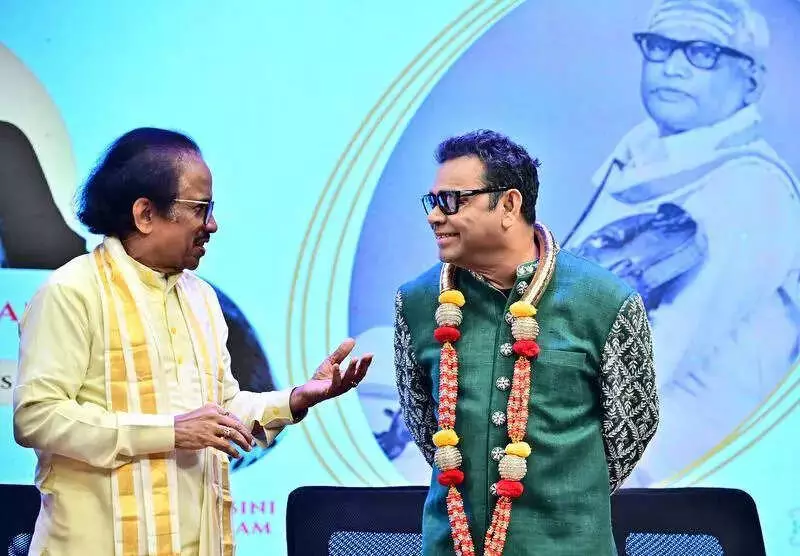
The iconic composer was conferred the Lakshminarayana International Award by renowned violinist Dr L Subramaniam. The ceremony took place at the Rasika Ranjani Sabha in Mylapore as part of the Lakshminarayana Global Music Festival, held in association with The Times of India.
The award, instituted in memory of Dr Subramaniam's father, Professor V Lakshminarayana, recognised Rahman's monumental contribution to music on a worldwide scale. Presenting the award, Subramaniam highlighted Rahman's revolutionary impact, stating, "Rahman changed the way film music was perceived overnight when ‘Roja' was released in 1992."

Fireside Chat: Evolution, Unlearning, and Inspiration
The event featured a captivating fireside conversation between the two maestros, moderated by singer-songwriter Bindu Subramaniam. Rahman, in his characteristic thoughtful style, drew a powerful analogy for artistic growth. "Music must be like flowing water; if it stagnates, it will be unusable," he remarked.
Elaborating on this philosophy of constant renewal, Rahman expressed his belief that the mind "should evolve and unlearn." He revealed a humble source for his ongoing inspiration: "My inspiration are my students." In a nod to his enduring creative partnership, he also quipped, "I still go to Mani Ratnam today, not ChatGPT," referring to the director of 'Roja', who was the chief guest for the evening.
A Vision for Tamil Nadu's Cultural Infrastructure
Rahman also turned his attention to the future of performing arts in India. He pointed out a significant gap in the country's cultural landscape, noting that India lacks dedicated musical theatre. He observed that enthusiasts often travel to destinations like London or Germany to watch classics like 'The Phantom of the Opera'.
Asserting the need and the capability to bridge this gap, Rahman made a compelling case for Tamil Nadu. "We need to build that infrastructure in TN. We have the money. We are the second richest state," he stated, calling for investment in world-class theatrical facilities.
The award ceremony was preceded by a dance performance by SaPa, choreographed to Rahman's music, and an instrumental piece by the festival's violin ensemble. Dr Subramaniam shared a personal connection, recalling that he used to live near Rahman's father, the late composer R K Shekhar, who would warmly invite him to join orchestra sessions and encourage him by pushing him to the front.
Reflecting on the award's legacy, Subramaniam said, "It was my father Lakshminarayana's dream to see the violin used as a solo instrument, and I have tried to fulfil it." The evening stood as a testament to that fulfilled dream and the continuing evolution of Indian music on the global stage.