

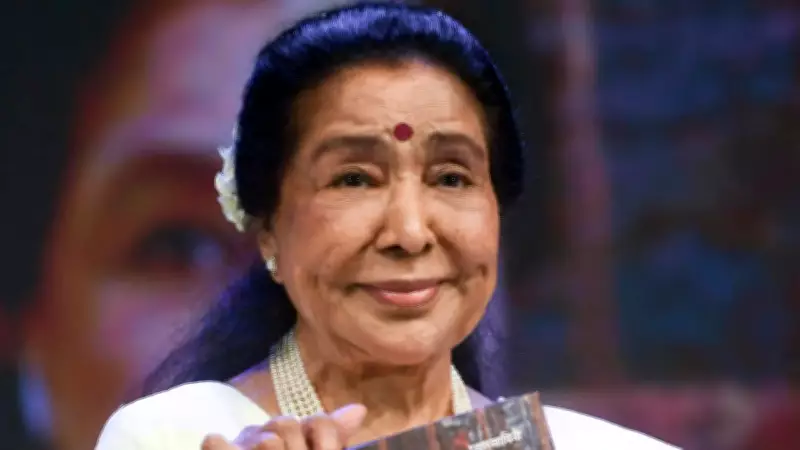
Asha Bhosle: The Vocal Chameleon Who Redefined Indian Music Across Decades
While some singers belong to a specific era, Asha Bhosle treated entire decades as passing trends she would explore and then masterfully transcend. A true vocal sponge, Bhosle absorbed influences from global pop and jazz legends long before the internet made such cross-cultural exploration commonplace.
Early Influences and Musical Foundations
"I used to watch Carmen Miranda a lot and try to imitate her style," she revealed in an interview, "like I did later with Shirley Bassey." This early fascination with international performers hinted at the boundary-breaking career that would follow. The same woman who perfected traditional recipes like 'Maa ki Dal' and jaggery kheer also watched Bill Haley's 'Rock Around the Clock' three consecutive times just to capture the precise phrasing for 'Eena Meena Deeka.'
Her remarkable versatility earned her recognition from unexpected quarters, including a letter of appreciation from the Vatican for her rendition of 'Ave Maria.' In the 1980s, she made history as the first Indian singer to form an overseas pop group in Britain called the West India Company.

Breaking Conventional Boundaries
During an era when playback voices in India were rigidly categorized as classical, romantic, or devotional, Bhosle fluidly moved between all these styles and beyond. Despite her training in Hindustani classical music, she believed "If you have the desire and riyaz... you can sing anything." She ventured into cabaret, jazz, rock 'n' roll, and global pop long before the industry had established terminology for such genre-blending.
The turning point in her career came through her collaborations with the Burmans. S.D. Burman first encouraged her to add personal 'inputs' to tracks, but it was with R.D. Burman that her experimental approach truly flourished. The duo would stay up until 4 a.m. listening to jazz and rock recordings, absorbing international sounds that would influence their work.
Mastering Westernized Sounds
When R.D. Burman presented her with 'Aaja Aaja' for Teesri Manzil, Bhosle initially hesitated at its Westernized swagger. This wasn't a composition that could be approached like a traditional ghazal—it demanded breathless phrasing and a relaxed, almost casual delivery. After ten days of intensive rehearsal, she not only mastered the song but made it so completely her own that it now sounds as if it was always meant for her voice.
This became a defining pattern throughout her career. Whether delivering the smoky, rhythmic breathing of 'Piya Tu Ab Toh Aaja' or the pop-ballad ease of 'Chura Liya Hai,' Bhosle demonstrated an extraordinary ability to adapt her vocal cords to match any musical mood or style.
Pioneering Crossover Collaborations
By the 1990s, when 'crossover' became an industry buzzword, Bhosle had already been living that reality for decades. "I told my son Anand, I've sung in practically every Indian language but I haven't done English," she explained about her decision to join the West India Company. This leap into unfamiliar territory would have intimidated lesser artists, but Bhosle embraced the challenge.
"Although the music was ready, there was no fixed tune to sing. I had created my own tune and melody," she said about merging Indian vocals with Western club rhythms and electronic music. This improvisational skill enabled her to record 'Bow Down Mister' with Boy George, where Indian devotional strains met synth-heavy pop in what could have been a gimmick but instead sounded like a natural extension of her artistic evolution.
Embracing New Platforms and Audiences
At age 64, she stepped confidently into the MTV era, teaming up with Code Red for the ballad 'We Can Make It' and appearing in a music video where her silk sari and traditional alaaps complemented the boy band's R&B groove. Soon after, she collaborated with R.E.M.'s Michael Stipe on 'The Way You Dream' for his '1 Giant Leap' project, a track that later featured in the 2003 action-comedy film 'Bulletproof Monk.'

Bhosle didn't merely cross over from East to West—she met Western music on equal terms. Cornershop's 'Brimful of Asha' turned her into a cultural reference point, later remixed by Fatboy Slim. Black Eyed Peas sampled her voice in 'Don't Phunk with My Heart,' integrating her sound into 2000s hip-hop. Sarah Brightman transformed 'Dil Cheez Kya Hai' into operatic pop. In 2005, the Kronos Quartet built an entire album around her titled 'You've Stolen My Heart.'
Later Career and Legacy
She recorded R.D. Burman classics with such remarkable velocity—three to four songs per day—that the quartet struggled to keep pace with her productivity. This collaboration earned her a Grammy nomination, further cementing her international recognition. Even in her later years, she remained open to unlikely pairings, from a duet with cricketer Brett Lee to collaborations with Pakistani pop singer Jawad Ahmed that transcended political tensions.
This brings us to 2026, when Bhosle, well into her nineties, recorded 'The Shadowy Light' from her Pedder Road home for the genre-blurring British virtual band Gorillaz. Her voice intertwined with swirling hip-hop, dub, and electronica, accompanied by an old harmonium in what would become her final collaboration—a fitting conclusion to a career defined by fearless experimentation and boundless musical curiosity.
