

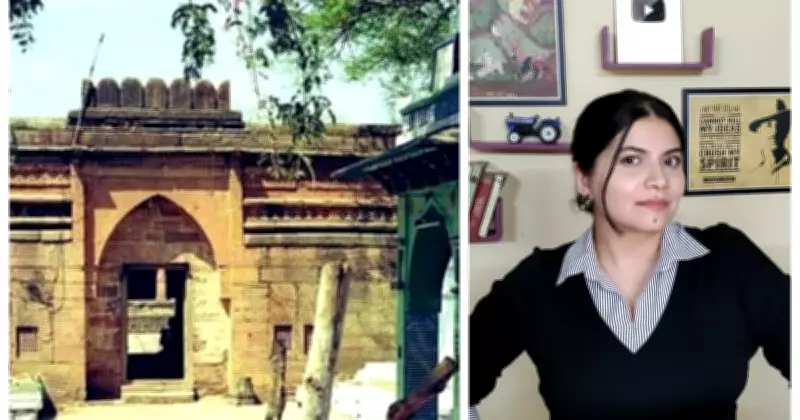
Historian Ruchika Sharma has challenged the prevailing narrative surrounding the Bhojshala site in Dhar, Madhya Pradesh, describing it as a colonial-era rebranding with no archival backing. In an interview, she explained how a 14th-century mosque, built with materials from Jain temples, was transformed into a nationalist flashpoint, and why the Archaeological Survey of India's (ASI) theory of a Saraswati temple is fundamentally flawed.
The Name Bhojshala: A Colonial Invention
Sharma traced the term 'Bhojshala' back only to 1903, when K. K. Lele, then in charge of the archaeological department at Dhar, coined it. She argued that the name is a misnomer: Lele intended it to mean 'King Bhoja's school,' but 'shala' simply means 'place,' not 'school.' A school would be called 'vidyalay,' 'vidyapeeth,' or 'gyanpeeth.' She emphasized that a 120-year-old name is being given undue legal weight, overshadowing the site's longer history as a mosque.
Flawed Saraswati Temple Theory
Sharma criticized the ASI's claim that the site was once a Saraswati temple, calling it 'ridiculous.' She pointed to a sculpture found by former ASI director K. N. Dixit in the British Museum, which he identified as Saraswati. However, the sculpture bears an inscription stating it is a statue of the Jain goddess Ambika (or Amba), made by a person named Vararuchi. 'The remains used to build the Kamal Maula mosque are basically Jain temple remains, not from a Saraswati temple,' she said.

She also dismissed the court's reasoning that Jainism is part of Hinduism, noting that historically the two religions have often been in conflict. Moreover, Saraswati is not a Jain deity, making the claim irrelevant.
Architectural Evidence of a Mosque
Sharma described the site as a 'palimpsest of reused materials,' a common practice in medieval construction. She explained that the Kamal Maula mosque is a hypostyle mosque, with pillars stacked one on top of another to achieve height—a feature not found in temples. 'No temple has a mihrab, no temple has a minbar, no temple has such height,' she stated. The pillars, she noted, may have come from multiple sources, including palaces, not necessarily a single temple.
An inscription on the mosque records that it was first repaired by Dilawar Khan Ghori, governor of Malwa, in 1392-93, indicating it was already old then. It served as the first jama masjid of Dhar. Sharma lamented that this 700-year history is being erased.
Inscriptions and Jain Connections
The Sanskrit inscriptions inside the mosque, often claimed as 'Hindu inscriptions' with grammatical sutras, actually have Jain connections. Sharma cited Indologist Michael Willis's study, which shows that the inscriptions refer to a play by a disciple of a Jain scholar. Lele had incorrectly asserted they were grammatical sutras of King Bhoja's school. 'Those inscriptions have nothing to do with any of this,' she said.
Role of the ASI
Sharma contrasted the British-era ASI, which correctly identified the structure as a mosque made of reused material, with later interpretations. The turning point, she said, was Lele in 1903 and then Dixit in 1917, who radically changed the narrative to a Saraswati temple. She questioned whether the ASI has the archival data to manage the site as a 'Sanskrit center,' suggesting it is being asked to curate a 'carefully manufactured myth.'
Erasing Shared History
On the court's suggestion to move Muslim worship to 'alternative land,' Sharma argued that this effectively erases 700 years of the site's history as a mosque and replaces it with a myth. 'The Jain history associated with it does not mean it suddenly becomes a Jain temple, because it never served as that,' she said.
The Historian's Role
Sharma concluded that historians must both document and explain the past, and create public awareness. 'More than erasing 700 years of history, the repercussions on the ground are problematic,' she warned.

