India’s Last Surviving Family-Run Touring Repertory
Surabhi, India’s last large-scale, family-run touring theatre company, has been captivating audiences for over 140 years with its blend of mythological tales and manual stagecraft. Founded in 1885 in the village of Surabhi Reddivaripalli, Andhra Pradesh, by brothers Vanarasa Govinda Rao and Vanarasa Chinna Ramaiah, the troupe evolved from traditional leather shadow puppetry (tholu bommalata) to live human spectacle, heavily influenced by the grand, illusionist aesthetic of touring Parsi theatre companies.
Their debut performance of ‘Keechaka Vadha’ broke societal taboos by casting women in female roles. As the family expanded, daughters and sons-in-law established branches, peaking in the mid-20th century with nearly 50 to 60 distinct mobile troupes comprising thousands of artists. These troupes would enter a town, erect massive temporary thatched-roof amphitheatres, and perform classical padya natakam (verse drama) from the Ramayana and Mahabharata for months at a time.
Manual Engineering Behind the Magic
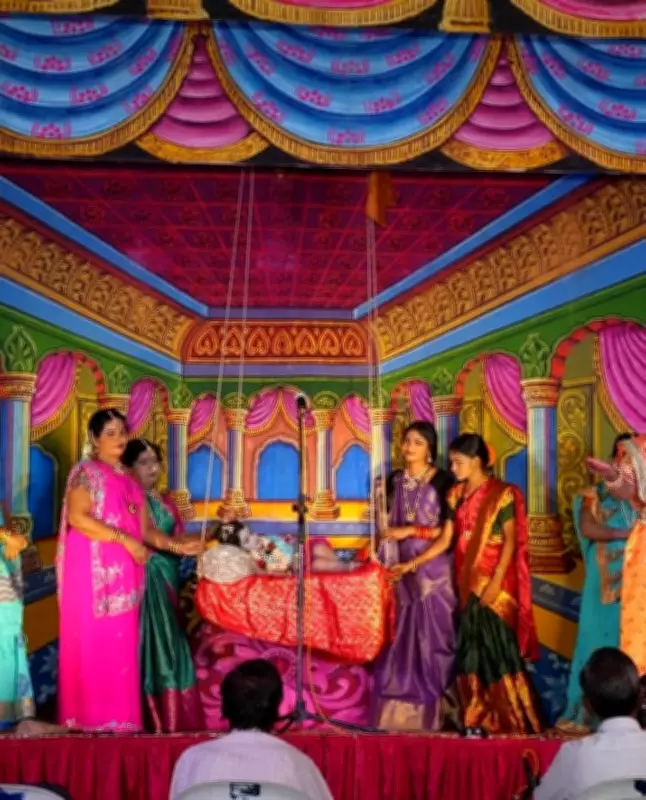
The defining characteristic of Surabhi is its self-managed production: the community acts as carpenters, painters, lighting technicians, costume designers, and musicians. The troupe pioneered sophisticated stage illusions through manual engineering. A complex network of hand-operated ropes and wooden pulleys hidden in the rafters allows actors portraying gods to fly seamlessly across the proscenium. Chemical flashes and hidden smoke devices simulate fire-breathing monsters, creating a grand magic show.

The most dramatic device is the many-layered, hand-painted canvas curtains that drop simultaneously to execute instant scene changes before a live audience. Theatre director Anuradha Kapur describes the Surabhi stage as a “floating space” meticulously assembled yet illusionary, a “place without a place”.
Adaptability and Collaboration with Modern Theatre
In the late 1990s, legendary director BV Karanth collaborated with the Surabhi family to direct a Telugu adaptation of Bertolt Brecht’s ‘The Good Woman of Szechwan’ (titled ‘Basthi Devatha Yaadamma’). Karanth fused Brechtian Marxist alienation with Surabhi’s hyper-immersive style, using their signature flying pulleys for Brecht’s descending gods and traditional padya natakam singing for socio-political commentary. This collaboration demonstrated that Surabhi’s old-school stagecraft is not a rigid relic but a highly adaptive vocabulary capable of handling modern avant-garde drama.
Economic Precarity and Transition to Sedentary Life
Despite its cultural prestige, Surabhi faces severe economic precarity. The classical nomadic model of moving from village to village and living in makeshift tents has become financially and logistically unviable due to soaring real estate costs and changing civic regulations. Today, the core tradition is anchored by the Sri Venkateswara Surabhi Theatre under sixth-generation artists like Surabhi Jayachandra Varma. The community has largely transitioned to a sedentary life centred around Surabhi Colony in Serilingampally, Hyderabad, where approximately 60 to 70 family members live communally, maintaining a shared kitchen, workshop, and rehearsal space.
In an era dominated by hyper-realistic digital visual effects and streaming algorithms, the survival of a 19th-century theatre company seems anachronistic. Yet, travelling across India to national platforms like the Bharat Rang Mahotsav and the International Theatre Festival of Kerala (ITFOK), Surabhi continues to evoke a rare, communal sense of wonder. As Neelam Mansingh Chowdhry, the article’s author and a theatre director, notes: “What we are looking at is the original, low-tech VFX — an extraordinary marriage of physics and imagination. There are no green screens here.”

A Call for Institutional Support
Chowdhry urges drama schools to incorporate Surabhi’s illusion techniques into their syllabi, and calls on corporate entities and premier drama schools to inject capital, curriculum validation, and modern infrastructure to ensure Surabhi remains a living, self-sustaining genre. “It cannot rely on nostalgia alone,” she writes. The magic of Surabhi—where gods fly on ropes and painted curtains rewrite geography—proves that as long as a group of people can gather in the dark to watch a painted cloth rise and a human being fly, the magic of theatre remains undefeated.