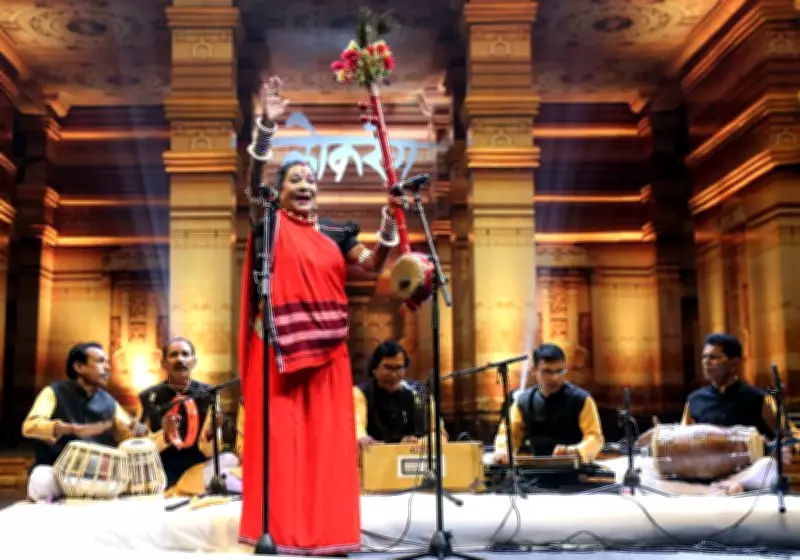
Teejan Bai, the legendary Pandavani performer who revolutionised the narrative art of the Mahabharata with her earthy, folk-infused style, died on July 5 at the age of 70. Her career spanned over five decades, during which she rose from performing on small chabutaras and under trees in rural Chhattisgarh to hallowed halls in India and abroad.
The Art of Pandavani and Teejan Bai's Unique Approach
Pandavani is a popular folk form of Chhattisgarh that involves narrating tales of the Pandavas from the Mahabharata. Teejan Bai, born into low social and economic circumstances, almost single-handedly transformed this art into a vehicle not only for epic episodes but also for social and moral critique. She was nearly the first woman performer in an exclusively male-dominated genre. According to Hindi poet-critic Ashok Vajpeyi, who as Secretary of Culture in Madhya Pradesh in the 1980s helped bring her to international prominence, Teejan Bai's performances required no stage set, no complicated light arrangement, not even a public address system.
Her art brought the grand epic to the utterly ordinary, infusing it with the earthiness of Chhattisgarh. In her narrative, the classical became folk, and grandeur and heroics were teased into everyday occurrences. Teejan creatively transformed the distant and inaccessible narrative into its inevitable everydayness, pulling down the living and grand into the mundane and messy reality of daily life.

Global Recognition and a Parisian Scandal
Teejan Bai's fame extended far beyond India. In the mid-1980s, during her first visit to Paris, she created a stir among Parisian high society. Vajpeyi recalls that the French daily Le Monde published an interview in which Teejan Bai remarked, "French women are beautiful, but they are so flat-chested!" The comment became a scandal among the elite. Despite such controversies, her performances were in high demand. She was scheduled to give about a dozen concerts in Paris but ended up performing twice that number due to public demand.
Mastery of the Mahabharata and Contemporary Relevance
Teejan Bai's performances were marked by her ability to handle a variety of emotions and experiences—love, longing, grief, tenderness, waiting, wonder, shock, challenge, resolve to fight, retaliation, contemplation, moral dilemma, and burning questions. She smoothly moved from one emotion to another, enacting characters such as Krishna, Duryodhana, Karna, Bheema, Arjuna, Draupadi, and Gandhari, each with a distinct persona. She spoke, sang, whispered, shouted, wailed, laughed, and wove them together in unending episodes from the great epic. Between narrations, she punctuated the performance with humour and sarcasm, commenting sharply on contemporary happenings.
Vajpeyi notes that Teejan Bai's performances transported audiences to an epical time where past and present seamlessly merged. She spoke to the Mahabharata but also addressed the clumsy, chaotic, clueless 'Mahabharata' of current times. The irony of a low-caste woman making a foundational text of Hinduism come alive was not lost on her audience, nor was its contemporary relevance underestimated.
Honours and Legacy
Teejan Bai received numerous accolades, including the Rajya Shikhar Samman of the Madhya Pradesh government, the Sangeet Natak Akademi Award, the Padma Shri, the Padma Bhushan, and the Padma Vibhushan. She emerged as the most admired and awarded folk performing female artiste in India. Despite her fame, she remained unchanged—always narrating and singing in Chhattisgarhi, in a sari, with an ektara in her hand.
Vajpeyi reflects that Teejan Bai had a troubled personal life and a depressing ethos of social stigma, but she fiercely protected her art from being soiled by it, refusing to carry suffering visibly. She became a human voice, a human presence, a human oracle, reaffirming that we are all human beings with much to share: songs, stories, strengths, foibles, dignity, and arrogance—all markers of irrepressible humanity.