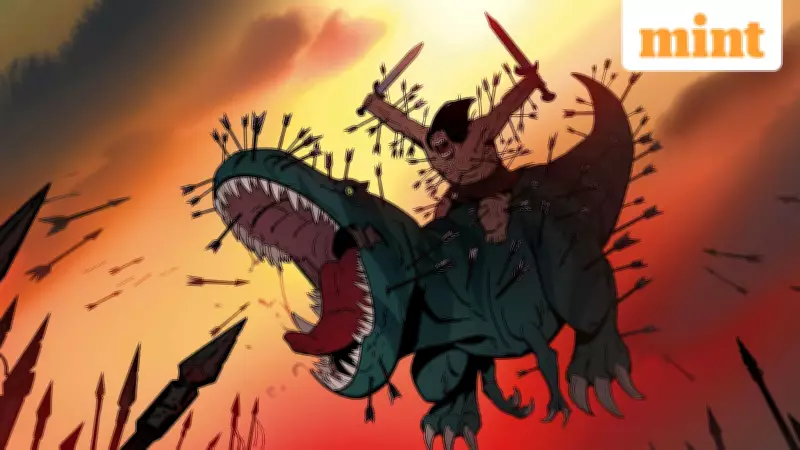
The action horror series Primal, created by Russian-American animator Genndy Tartakovsky, recently aired its latest episode titled Feast of Flesh. This installment is the third episode of the ongoing third season, broadcast on Adult Swim, Cartoon Network's nighttime programming block. The show, which is largely wordless, is set in a fantastical version of ancient history where Jurassic-era dinosaurs coexist with Neanderthals, Iron Age humans, hominids, Ice Age mammals, and various other prehistoric creatures.
The Visual and Narrative World of Primal
The overall aesthetic of Primal draws inspiration from the prolific American fantasy illustrator Frank Frazetta and the Conan stories by fantasy writer Robert E. Howard. The series follows the adventures of Spear, a brutally strong and fierce Neanderthal man, and Fang, an unusually smart and resourceful female T-Rex. Forced into an odd-couple pairing after losing their respective families, they become inseparable, hunting as a team and battling extreme weather and prehistoric predators.
Feast of Flesh: A Testament to Tartakovsky's Mastery
Feast of Flesh serves as another reminder of Tartakovsky's mastery over the animation medium and explains why Primal has been consistently highly rated since its debut. In this episode, a newly reanimated Spear encounters a grasshopper with a distinctive teal color that reminds him of his best friend Fang, from whom he was separated a few episodes earlier.

For approximately two minutes, viewers follow a soft-eyed Spear as he tracks the grasshopper. The insect scurries up a tree, munches on a blade of grass, stops by a brook, and finally settles on Spear's hand, unafraid of the hulking man's gaze. When the grasshopper flies away again, a chameleon swallows it whole, prompting a furious Spear to force the reptile's jaws open and allow the grasshopper to escape.
This brilliantly animated sequence demonstrates the possibilities of Primal, where the absence of dialogue amplifies the technical virtuosity on display. The show features high-contrast colors, cinematic lighting, a heavy metal fantasy art style, and visceral, intensely rhythmic chase and combat sequences.
Genndy Tartakovsky: A Trusted Animator for Cartoon Network
At 56 years old, Genndy Tartakovsky is perhaps the animator Cartoon Network trusts the most. He is the creator of iconic shows such as Samurai Jack (2001-2004; 2017 reprisal) and Dexter's Laboratory (1996-2003), and was a pivotal crew member on The Powerpuff Girls (1998-2005). These tone-setting shows laid the foundations for Cartoon Network's programming in the 1990s.
In the 2000s, Tartakovsky's profile grew significantly when George Lucas hired him to develop Star Wars: Clone Wars (2003-05), an animated series set between the prequel trilogy films Attack of the Clones (2002) and Revenge of the Sith (2005). He later directed the first three feature films and wrote the fourth in the popular animated comic franchise Hotel Transylvania (2012-22).
Elements of Tartakovsky's Style
The key elements of Tartakovsky's style can be understood through two early-career works: Dexter's Laboratory and Samurai Jack. The latter represents distilled Tartakovsky in terms of animation technique, while the former showcases his writing style.
In the retro-futuristic Samurai Jack, the protagonist is sent hurtling into the future by the malevolent, shape-shifting demon Aku. Aku's elegant, hand-drawn character design emphasizes shadows and negative space, hinting at his dark magic. Tartakovsky's command over these elements is evident in combat scenes, such as one from season 5 where Jack battles the daughters of Aku.
The economy and impeccable timing of this sequence are remarkable, as is the delicate interplay of light and shadow. These elements are key to the magic of Looney Tunes characters, especially Wile E. Coyote, whom Tartakovsky adored. The sound design keeps viewers on the edge of their seats, with every swish of the sword and clang of metal given extra resonance, influenced by Popeye and Max Fleischer's Superman.

Tartakovsky uses falling snow in the backdrop to create a stunning visual transition mid-fight, and the closing moments of the episode even include a musical reference to The Good, the Bad and the Ugly. While not entirely wordless like the first season of Primal, Samurai Jack featured minimal dialogue, with most episodes having only about 2-3 minutes of spoken lines in their 20-minute runtime.
Dexter's Laboratory: A Personal Work
In comparison, Dexter's Laboratory started airing in 1996 when Tartakovsky was just 26 years old. Thematically, it is his most personal work. The show follows the adventures of the indefatigable, endlessly inventive boy-genius Dexter, who has a secret science laboratory hidden in his bedroom. Dexter is socially awkward and speaks with an unspecified accent, contrasting sharply with his extroverted elder sister Dee Dee, a popular ballerina who discovers his secret in the first episode.
Tartakovsky based the siblings' dynamic on his own relationship with his computer scientist brother Alex, with his self-portrait being the creative, effervescent Dee Dee. At age 16, Tartakovsky lost his father to a heart attack, and in his mid-20s, while working in Spain on Batman: The Animated Series (1992-95), his mother died of cancer back home. Themes of parental loss and replacement are prevalent throughout Dexter's Laboratory.
Tartakovsky's Immigrant Influences and Sincerity in Animation
Tartakovsky moved to America from Russia when he was just seven years old. He desperately wanted to fit into the all-American high school hierarchy of jocks, nerds, cheerleaders, and wallflowers. Underneath the gadgets and highfalutin inventions in Dexter's Laboratory, this desire is reflected in Dexter's character as well.
In one memorable episode, Dexter keeps getting hit while playing dodge-ball and builds an Armored Cyber-Sonic Exo-Jock Jumpsuit to retaliate, embodying American absolutism similar to characters like Dirty Harry and RoboCop. Tartakovsky's style exists in a state of tension with Americana, a focal point in Kwasu David Tembo's 2022 book Genndy Tartakovsky: Sincerity in Animation.
In Tembo's framing, Tartakovsky's career shows the influence of being an immigrant and a Third Culture Kid (TCK). The first culture is Russia, the second is America, and the third is the hybrid culture Tartakovsky internalized during his formative years, shaped by diverse pop cultural influences.
As Tembo notes, the sincerity of Tartakovsky's approach is ideally suited to animation, aiming to make viewers feel everything with a child's wide-eyed intensity. This sincerity is a key reason for Tartakovsky's success and influence over the past 30 years.