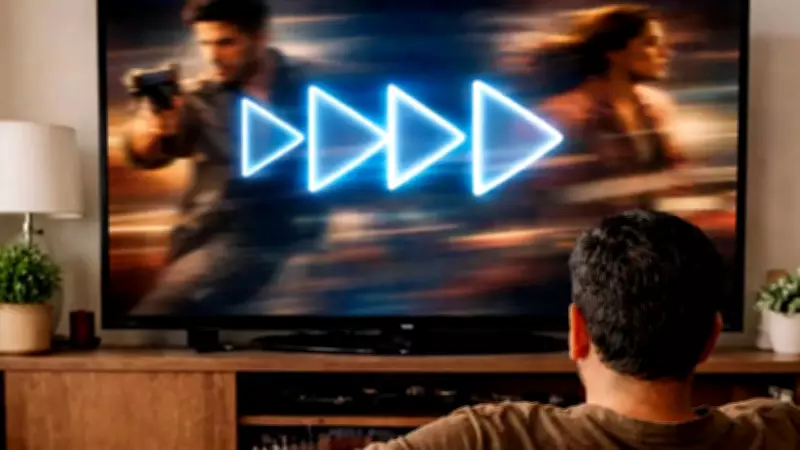
From Lectures to Thrillers: The Rise of 2x Viewing in Streaming Culture
What began as a practical tool for speeding through educational lectures, lengthy podcasts, and cooking tutorials during the pandemic has evolved into a widespread viewing habit. Today, audiences are reaching for the playback speed controls even during suspenseful thrillers, romantic dramas, and critically-acclaimed prestige series.
The Time-Crunched Viewer's Dilemma
With overflowing watchlists and limited hours, many viewers see accelerated playback as a necessary survival strategy. Slow-burning narratives are being fast-tracked. Extended silences are shortened. Even emotional heartbreak scenes are sped through in the race to consume more content.
For some, watching at 1.5x or 2x speed is a practical response to social pressure – a way to stay current with popular shows and avoid missing out on cultural conversations. For others, this practice represents nothing short of cinematic blasphemy, fundamentally disrespecting the artistic intentions of directors and writers.

The Artistic Integrity Debate
If a filmmaker deliberately crafted a meaningful pause, extended a long take for emotional impact, or used silence to build tension before a dramatic revelation, was that artistic choice meant to be hurried past? This question lies at the heart of the growing controversy.
Nishi Joshi, a psychotherapist and Social-Emotional Learning counselor, observes that this trend reflects deeper cultural shifts. "We are becoming less comfortable with pauses, silence, and gradual emotional build-up – elements that are central to deep storytelling," she explains. "Our relationship with time has shifted from experiencing it to optimizing it."
Industry Resistance and Viewer Perspectives
When streaming platforms first introduced variable playback speeds in 2019, prominent filmmakers voiced strong opposition. Brad Bird, director of The Incredibles, criticized it as "another cut to the already bleeding-out cinema experience." Judd Apatow, filmmaker behind Knocked Up, called the feature "ridiculous and insulting," while Ant-Man director Peyton Reed dismissed it as "a terrible idea."
Some viewers echo these concerns. "What is the point in writers, directors, and actors carefully considering scene pacing, joke delivery, or beautiful lingering shots if viewers are just watching on fast-forward?" questions Ellie Harrison, TV editor at the Independent. "Isn't a huge part of why we watch TV and film to relax and slow down?"
Bharat, a 37-year-old crime thriller enthusiast, acknowledges that while some films might deserve accelerated viewing, he prefers normal speed. "The essence of a movie gets lost otherwise. The dramatics and slowed-down pace that focus on storytelling are important to the plot," he says, citing Mare of Easttown as an example where deliberate pacing builds character and mood.
Sameeksha, in her late twenties, would rather break a film into thirty-minute installments over several days than rush through it. "There is so much drama in those quiet pauses and silences. Characters reveal themselves through their dialogue delivery," she argues. "Imagine rushing past the monologue in Gone Girl or the restaurant scene in Inglourious Basterds. Real movies can't be watched in 2x. It's blasphemy."
The Efficiency Argument
Despite these criticisms, many viewers embrace accelerated viewing for practical reasons. Kirti Shinde, in her early twenties, began using 1.5x speed during extended scenes to maintain engagement. "It kept things moving. I didn't zone out as much," she explains, particularly for Korean dramas with subtitles. "I can read faster than they speak, so 2x doesn't bother me. Watching at 2x saves time, and I can finish more shows and movies."
Prachi Saini, a media student, admits the habit started as an academic shortcut when required to watch unenjoyable content for coursework. Now it's routine. "If I'm not fully invested in what I'm watching, I watch passively or on 2x," she says. "I think about the sunk cost fallacy. I care enough to know what happens next, but not enough to give it more time than it deserves."

Viraj Raundal, 23, acknowledges that music suffers most at accelerated speeds. "I do feel like I miss out on listening to it how the creator meant for it to be," he admits. "But the counter thesis to watching series at 2x isn't me watching them at 1x. It's that I won't watch it at all."
Industry Adaptation and Psychological Implications
Raghavendra Hunsur, Chief Content Officer at ZEEL, interprets this trend differently. "The rise of 2x viewing reflects a time-conscious consumer who values control and flexibility," he observes. "It's less about impatience and more about optimization. Our response is not to dilute storytelling, but to sharpen it. Creative teams are focusing on tighter pacing and stronger hooks to ensure stories remain immersive across formats."
Nishi Joshi sees both practical benefits and psychological risks. "Speeding up content can be a practical adaptation to information overload," she acknowledges. "But if speed becomes the default, we risk losing patience for nuance, silence, and emotional depth – the very qualities that allow art to move us. It mirrors the same reward-driven patterns as social media scrolling. We begin to prioritize novelty and speed over depth. The risk isn't faster consumption, it's a more superficial relationship with stories."
The Growing Statistical Reality
This practice has gained significant traction according to recent data. A 2023 YouGov study found that 27 percent of respondents stream television at higher playback speeds, while 13 percent of podcast listeners periodically boost audio to super-speed. The practice is significantly more common among those under 25 – nearly twice as many compared to those over 25.
Even industry professionals aren't immune. Actor Rajkummar Rao once admitted to watching OTT content at 1.5x speed, sometimes due to pacing issues or what he described as lazy dialogue delivery.
Platforms continue to refine these features. Last year, YouTube introduced more granular speed controls, allowing increments of 0.05 instead of 0.25. Premium users can now watch content at up to 3x speed.
As media libraries expand and time remains finite, the fundamental question persists: In our rush to consume everything, are we still allowing anything to truly sink in? Or are stories becoming just another box to tick off an endless watchlist? The answer may determine not just how we watch, but what we ultimately take away from the stories we consume.