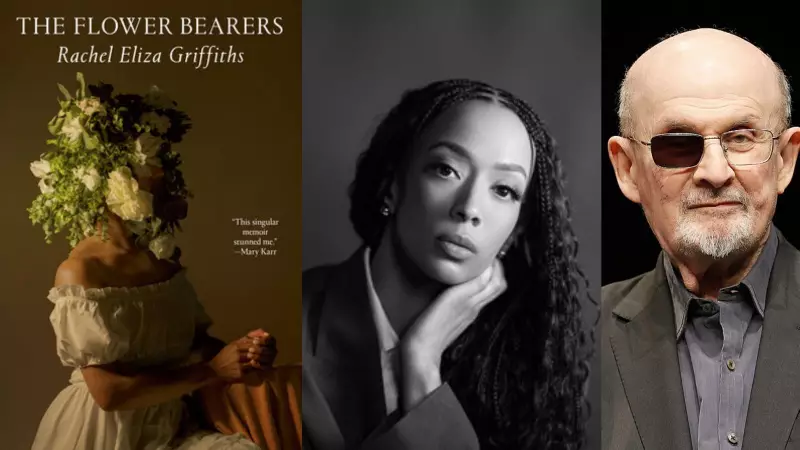
Rachel Eliza Griffiths' Memoir 'The Flower Bearers' Reveals the Personal Side of Salman Rushdie
In a deeply moving and personal account, poet and novelist Rachel Eliza Griffiths' new memoir, 'The Flower Bearers', published by John Murray Press in 2026, traces the intricate tapestry of love, friendship, and grief alongside her husband Sir Salman Rushdie's harrowing experience of the 2022 knife attack. This work is not merely a recounting of Rushdie's famed literary and political battles but a poignant exploration of selfhood and resilience in the face of catastrophic violence.
A Marriage Begun in Grief and Shadowed by Violence
When Rachel Eliza Griffiths married Salman Rushdie in September 2021, her joy was bifurcated by an invisible horror. Unbeknownst to her as she exchanged vows, her closest friend and chosen sister, the poet Kamilah Aisha Moon, had died suddenly that morning. Griffiths writes, "This is how our marriage begins, hushed in the aura of raw grief." This personal tragedy foreshadowed a far more public and violent event almost a year later, when Rushdie was stabbed multiple times on a New York stage, an incident that would profoundly shape their lives.
Falling in Love with the Man, Not the Monument
Griffiths and Rushdie first met in 2017 at a PEN World Voices Festival event in New York. At the time, Rushdie was 70 and had lived for years under police protection following the 1989 fatwa issued against him. Griffiths, in her early forties and based in New York, was a poet and photographer. Their initial encounter was marked by a humorous yet caring moment when Rushdie mistook a plate-glass door for an exit, resulting in a fall that left him injured. Griffiths accompanied him home, teasing, "People are going to think I beat you up." This act of care established a poignant motif that runs through the memoir: the nursing of Rushdie through illness and the devastating aftermath of his stabbing.

Griffiths makes it clear that she fell in love with the man, not the literary icon. She recalls that Rushdie's name occasionally surfaced in popular culture, such as in Jeopardy and Law and Order episodes, but did not influence her artistic world. In a central episode, she describes Rushdie meeting her father, a former corporate lawyer who knew little about Rushdie's literary standing or the fatwa. Her father's practical concern was simply, "Where would I find some of these books you say you've written? Would they know your name at Barnes & Noble?"
Navigating Public History and Personal Identity
Entering the relationship, Griffiths was cautious due to the substantial age difference and Rushdie's four previous marriages. More significantly, his public history intruded into their private life. She writes, "Salman's past was something he'd assured me was behind him. But that wasn't true. I'd observed how much his past appeared when we went out together. People brought it up." To maintain their independence, they agreed on separate professional identities, with Griffiths emphasizing, "Elsewhere, he may be Sir Salman Rushdie. To me, he is always Salman."
The Aftermath of the Knife Attack: A Dual Perspective
In August 2022, almost a year after their marriage, Rushdie was stabbed onstage in New York state. Griffiths' memoir records the immediate aftermath from her perspective as someone waiting for news, arranging transport, and confronting the possibility of widowhood. She describes entering the hospital trauma ward and seeing her husband's injuries in detail: the damaged eye, the stitched face, and the hand pierced by the knife. When reporters approached her, one asked, "What is your relationship to the Indian novelist Sir Salman Rushdie? Can you confirm that he is dead?"

Rushdie's own memoir, "Knife: Meditations After an Attempted Murder" (Jonathan Cape, 2024), recounts the attack from his perspective, noting the limits of his memory and characterizing it as a rupture in ordinary behavior and perception. Griffiths' account begins where Rushdie's cannot, in the hospital after the attack, focusing on the outward facts of care: surgery, security protocols, rehabilitation, and constant supervision. She writes that when Rushdie regained consciousness, he apologized repeatedly, fearing he had ruined her life by dragging her into his "marvellous and dangerous existence." He asked her directly, "Are you afraid? Will you stay with me?"
Living with the Consequences of Violence
As recovery gave way to routine, Griffiths documents the long-term realities of living with a partner whose body has been permanently altered by violence and whose public identity continues to attract attention and risk. She writes, "Each morning I kiss my husband's face, looking at the single blacked-out lens of the glasses he wears." Alongside this physical change runs an awareness that safety cannot be promised. "I want to promise him that no one will ever hurt him again," she adds, "but I know that is a lie."
Rushdie frames survival as a confrontation with the return of history, describing the assailant as "a murderous ghost from the past" and noting that it had been thirty-three and a half years since the Ayatollah Ruhollah Khomeini's death order against him. In this sense, Knife treats the attack as the reassertion of an unfinished narrative, while The Flower Bearers records what it means to live inside that narrative after the fact, when violence must be accommodated rather than resisted.
Through her memoir, Rachel Eliza Griffiths not only reclaims Salman Rushdie from the icon but also offers a powerful testament to the resilience of love and the human spirit in the face of unimaginable adversity.