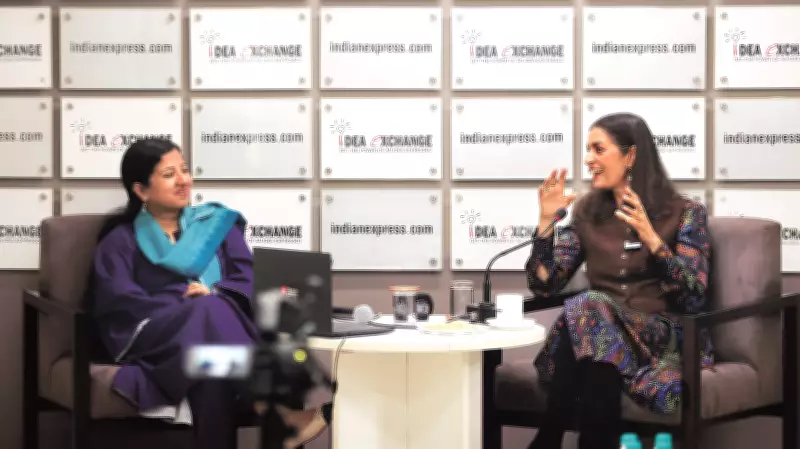
Jhumpa Lahiri Explores Identity, Language, and the Quest for Belonging
In a profound conversation, Pulitzer Prize-winning author Jhumpa Lahiri delves into the complexities of identity, migration, and the intimate ruptures that define contemporary life. From her acclaimed debut Interpreter of Maladies (1999) to recent works like Whereabouts (2018) and Roman Stories (2023), Lahiri continues to challenge conventional notions of language and belonging.
The Liberation of Language and Imperfection
Lahiri reveals that her journey into Italian, a language she learned later in life, unlocked new dimensions of her inner self. "Something about being able to work and think in Italian enabled me to isolate aspects of my deeper inner self that the English language had not allowed me to access," she explains. This exploration highlights a recurring theme of imperfection in her relationship with language.
She describes feeling "at fault" for not fully mastering Bangla, her first language, or English, which she learned without a detectable accent. "I always find the languages I don’t fully understand more exciting than the languages I do," Lahiri notes, driving her lifelong quest to learn other tongues.

Multilingual Identities and Personality Registers
Lahiri acknowledges distinct personas tied to each language she speaks. "Bengali is the language of home, family and being a child. I’m a little more guarded in English because that’s how I felt when I first went out into the world," she shares. However, Italian offered a unique liberation. "In Italian, I have a little bit more confidence and lightness. I’m not weighted down by the timid English side of me or the eager to please Bangla side of me."
She criticizes the homogenization of language, calling it "terrible and dangerous." "Linguistic difference is one of the most beautiful aspects of the human race. It’s criminal to force people to speak a certain language, especially in inherently multilingual places," Lahiri asserts.
Challenging the Concept of Mother Tongue
Lahiri rejects the notion of a single mother tongue, describing it as a forced construct. "In my case, I can’t point to a specific mother tongue. It tries to be an airtight container for language, ethnicity, identity, spirit and soul," she argues. She compares some individuals to sailors, "we want to go out into the sea. We want to see what’s beyond our own borders."
Identity Politics and Assimilation
Reflecting on the rise of identity politics, Lahiri observes both positive and dangerous consequences. "When I was young, Indian-American was not even a word. Now, people are quite proud of their mixed identities," she says, citing examples like Zohran Mamdani’s mayoral campaign in New York City. However, she warns that identity can create boundaries between "us and them."
On assimilation, Lahiri describes it as a complex interplay of choice and circumstance. "A lot of assimilation has to do with physical appearance and assumptions. The question ‘where are you from?’ is often triggered by that," she notes. While places like New York City embrace difference, other regions present challenges.
The Elusive Search for Home
Lahiri redefines home as a feeling rather than a place. "I don’t search for home, I search for the feeling of home. Being around books is home. Finding myself in a library is home," she shares. She recalls her upbringing in the U.S., where her family felt like guests, a sentiment that resonates amid today’s anti-immigrant strains.
In a poignant reflection, Lahiri imagines a room for all who struggle to answer "where are you from?" "I wish the answer could be: ‘I’m from that room where none of us can answer the question. That’s where I’m from,’" she says.

Translation, AI, and Literary Labor
Lahiri discusses the nuances of translating her own work, a process she finds disorienting yet revealing. "What interests me most about translating myself is the strange blind spots we have in our own languages," she explains. On AI’s impact on literature, she urges young writers to keep it at a distance. "Writing is akin to labour, that carving, working with words... this manuality is something AI can’t do," she emphasizes, expressing concern over AI’s potential to replace human translators.
Navigating Criticism and Recognition
Lahiri admits to being affected by both praise and harsh criticism. "I started writing to push back against expectations. With recognition came expectations—when are you going to write about us?" she recalls. She clarifies that her writing is not about representing groups but telling individual stories.
Through her insights, Jhumpa Lahiri offers a compelling exploration of what it means to belong in a world increasingly defined by borders—both linguistic and cultural. Her words resonate as a testament to the power of language to both divide and unite, and the enduring human quest for identity and home.