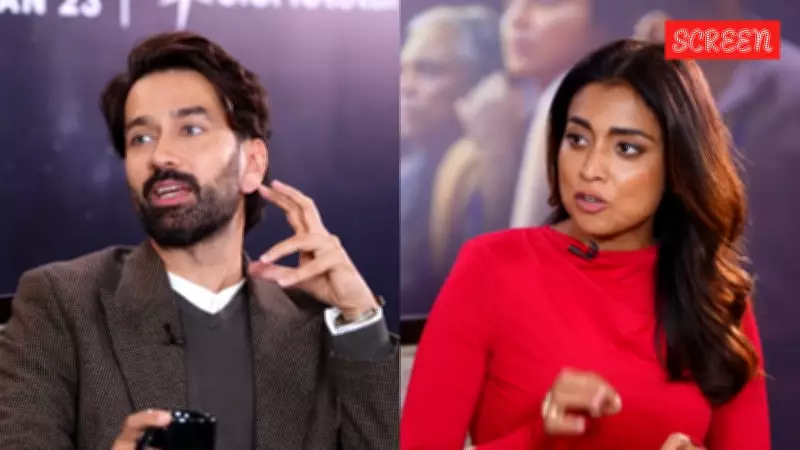
Nakuul Mehta and Shriya Saran Open Up About Television Industry Challenges and Stereotypes
In an exclusive and revealing conversation, actors Nakuul Mehta and Shriya Saran have candidly discussed the persistent labels and demanding realities faced by television actors in India. Both stars, currently seen in the web series Space Gen: Chandrayaan on JioHotstar, shared their perspectives on navigating multiple entertainment mediums while addressing the often-overlooked contributions of the TV fraternity.
'TV Actor' Label and the Need for Fraternity Pride
Nakuul Mehta spoke extensively about the 'TV actor' label that many performers encounter when venturing into OTT platforms or films. He emphasized that creative evolution should transcend medium-based categorization. "As a creative person, you keep evolving, whilst the world will keep giving you labels of being a TV actor or film actor," Mehta stated.
He highlighted that talent, not the medium, defines an actor's caliber. "I feel there are two kinds of actors. One is a good actor, and the other one is hopefully trying to be better. It doesn't matter which medium you work in," he added, pointing to successful examples like Vikrant Massey and Shah Rukh Khan, both of whom originated from Indian television.

Mehta expressed concern that the television industry itself lacks sufficient self-pride. "I don't think we take enough pride in television ourselves as a fraternity. Some of the best talent we have today came from TV," he remarked, citing actors like Mona Singh, Surveen Chawla, Mrunal Thakur, Sakshi Tanwar, Ayushmann Khurrana, and Aparshakti Khurrana as prime examples of television's talent pool.
Insane Working Hours and Actor Evolution
Shriya Saran shifted the conversation to the grueling working hours that television actors routinely endure. She described the intense commitment required for long-running TV shows. "What happens with TV is, you live with the character for so many months. Their working hours are insane. They literally work for 20 hours, so from the time they get to the set to the time they leave, it's insane. 16-17 hours is normal," Saran revealed.
When asked if he had experienced similar demands, Nakuul Mehta acknowledged his fortunate position. "Luckily it's not happened to me. I made my contracts really tight. I care about my life. But that's true, the biggest of actors on TV put those kinds of hours," he admitted.
Saran further praised television actors for their resilience and skill development under such conditions. "If you are working for so many hours, and they manage to hold on to their audience for so long, it means they are such evolved actors. TV actors are super evolved in terms of the work they put in," she asserted.
Breaking Medium Barriers and Early OTT Ventures
Nakuul Mehta concluded the discussion by advocating for artistic experimentation beyond medium constraints. "There are good and bad actors in all mediums, so to generalize is hard. But it is also up to you to be able to try different things. You wouldn't know if you belong to a certain medium until you try," he advised.
In a fascinating aside, Mehta shared his early foray into the OTT space, producing a web show in 2016, several years before the digital streaming boom in India. He described this leap as driven by a desire to create his own opportunities. "When I started doing TV, after my first show, I said I really love this medium. I love how audiences get to sample your work, but I also wanted to do other work. But then people would not necessarily see you as a material for other work, so I thought I was going to create something that is my own," he explained.
Mehta recounted reaching out to producer Ronnie Screwvala with a "mad idea" via social media, which eventually led to a production opportunity. "That's also got to do with being young, stupid and courageous," he joked, emphasizing the importance of dreaming big and seizing initiative in a rapidly evolving entertainment landscape.

The interview, conducted by seasoned entertainment journalist Nawaz Javed Kochra, provides a rare glimpse into the professional challenges and personal reflections of two actors bridging television and digital platforms. Their insights underscore the need for greater recognition of television's artistic contributions and the extraordinary dedication of its performers.