

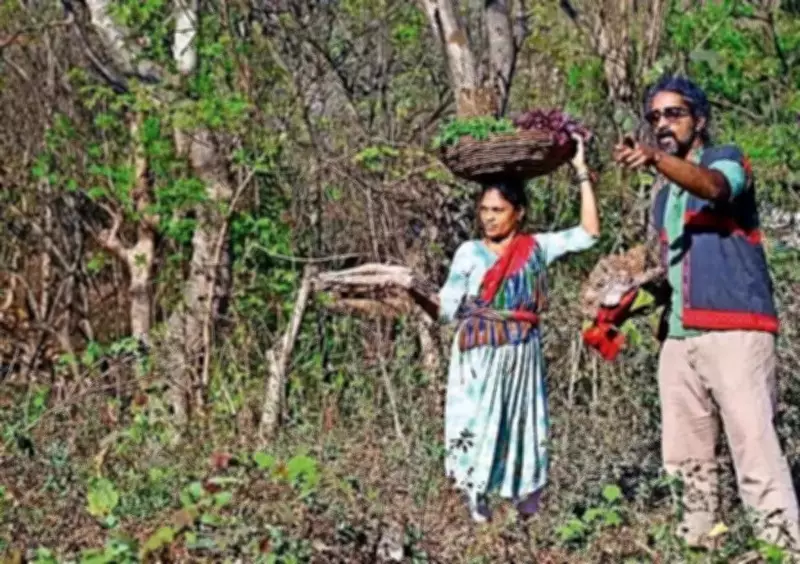
Forest Pharmacist: How Vanita Thakre Uses Aarey's Plants as Medicine
When illness strikes her family, Vanita Thakre, like most people, sends out for medicine. Only her pharmacy is not a store but the lush expanse of Aarey Forest. "Some plants, like ambe, neeli and peeli halad (white, blue and yellow turmeric), are a permanent fixture in my home," says Vanita, detailing their therapeutic benefits with practiced ease. Blue turmeric, she explains, is effective for treating asthma, white turmeric eases joint pains, and yellow turmeric serves as a powerful antiseptic.
An Oral Tradition of Healing
Drawing on an oral pharmacopeia committed to memory since childhood, Vanita transforms roots, stems, and leaves into salves, poultices, and tonics. Her work gains special significance on World Wildlife Day (March 3), which highlights the botanical bedrock of traditional healthcare systems. In India, medicinal plants account for approximately 15,000 of the country's 45,000 plant species, according to the ICAR-Directorate of Medicinal and Aromatic Plants Research. These plants form the foundation of India's traditional healing systems—Ayurveda, Unani, Siddha, Naturopathy, and Homeopathy.
A 2023 survey by the Ministry of AYUSH revealed that 46% of rural respondents and 53% of urban respondents reported using at least one of these systems for the prevention and treatment of ailments. Yet, few individuals, like Thakre, go directly to the source—the forest itself. The plants themselves are becoming increasingly difficult to find. "Mumbai and the surrounding region once grew several medicinal species," notes naturalist and author Vijaya Chakravarty. "Species such as Chlorophytum borivilianum (Safed musli), a tonic, Tinospora cordifolia (Giloy), an immunity booster, and Helicteres isora (Murud Sheng, or the screw fruit), which treated colic, are hardly seen today."

Conserving Knowledge and Ecology
This scarcity is precisely what makes Thakre's work so vital. Thakre—a Warli resident of Khambachapada, an adivasi hamlet in Aarey Forest—collaborates with Sanjiv Valsan, founder of the Waghoba Habitat Foundation. Together, they work to conserve traditional ecological knowledge through curated wild food foraging walks, cookouts, and planting exercises. Their objective is to cultivate an affinity for all plants in the forest, fostering a deeper connection between urban residents and their natural environment.
When city dwellers understand the ecology of Aarey, they are more likely to lend their voices to conservation protests, participate in paid events, and purchase forest produce. By creating a market for these plants, the nonprofit has generated income for adivasi communities and reopened forest routes that had begun to close due to a growing dependence on store-bought foods. "Foraging for both medicine and food declined," explains Valsan. "When people do not use plants, they lose that ecological knowledge and the will to protect it. Eventually, they stand to lose the forest."
The Challenge of Plant Blindness
Categorizing plants as medicinal and aromatic can be complex, admits Vinita Gowda, an associate professor at the Indian Institute of Science Education and Research Bhopal. "The definition of what constitutes a medicinal or aromatic plant needs clarification," she says, pointing out that every plant can be medicinal when consumed in the right dosage, but beyond that threshold, it may turn toxic. However, these semantics do not deter Thakre or Valsan, who focus on practical conservation and education.

By 2018, Mumbai had lost 77% of its green cover, according to a 2021 study published in a Springer journal. As green cover depletes, people often fail to notice what remains—a phenomenon known as tree or plant blindness, which can expose 'unseen' specimens to various threats. Abhishek Khan, a research-based artist on weekdays and a "storyteller for botany" on weekends, works to combat this blindness. His Theatre of Botany series of themed tree walks—with intriguing titles such as ‘Botany of Alcohol’ and ‘Botany of Nightmares and Dreams’—is part of his Mumbai Vann project, which casts trees and plants as dramatis personae of the city. "Trees have to grow in two fertile places to survive," says Khan, "the soil, and a person's imagination."
Through the efforts of individuals like Vanita Thakre, Sanjiv Valsan, and Abhishek Khan, the vital link between medicinal plants, traditional knowledge, and forest conservation is being strengthened, offering hope for the preservation of India's rich botanical heritage.





