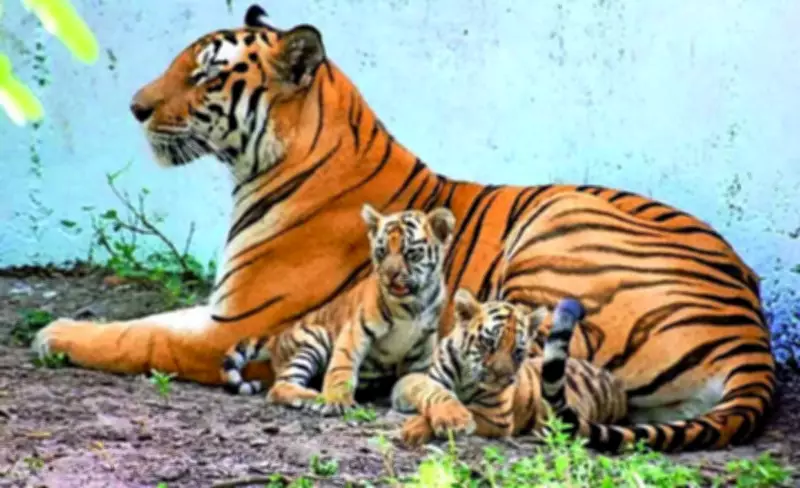
Tiger Cub Killed by Crocodile in West Champaran Wetland
A tragic wildlife incident unfolded in West Champaran district on Wednesday morning when a tiger cub was killed in a crocodile attack. The event occurred in a wetland area near the Manguraha forest range, sending shockwaves through the local community and forest authorities.
Discovery and Initial Investigation
Forest officials received urgent information about a tiger carcass found in the Don canal's wetland area near Meghauli Chowk. A specialized team immediately rushed to the location to assess the situation. Upon arrival, they discovered the remains of what appeared to be a young tiger cub, estimated to be between seven and eight months old.
Gaurav Ojha, conservator and field director of the Valmiki Tiger Reserve (VTR), provided crucial insights into the incident. "The cub may have strayed from its mother while searching for water and accidentally entered the wetland," Ojha explained. "It was likely attacked by a crocodile in this vulnerable moment. Our examination revealed that approximately 60–70% of the carcass had been consumed by the predator."

The forest officials conducted a thorough preliminary investigation, finding definitive evidence of a crocodile attack through distinct teeth marks on the cub's body. This confirmation helped establish the cause of death despite the extensive damage to the remains.
Post-Mortem and Forensic Analysis
The cub's remains were carefully transported to the Manguraha range office for a detailed post-mortem examination. Ojha emphasized the importance of scientific analysis in such cases. "We have preserved viscera samples from the carcass," he stated. "These samples will be sent to the Wildlife Institute of India (WII) in Dehradun for comprehensive forensic and DNA analysis. The exact circumstances and precise cause of death will be determined only after we receive the analysis report."
Eyewitness Accounts from Villagers
Local villagers provided chilling accounts of the incident, describing a prolonged struggle between the two animals that lasted nearly thirty minutes. One villager recounted, "We heard loud roars coming from a distance but didn't realize it was a tiger cub fighting for its life against a crocodile. In the morning, we discovered the cub's body and immediately informed the forest department."
These eyewitness testimonies add a dramatic dimension to the tragedy, highlighting the intense nature of the encounter between the young tiger and the aquatic predator.
Crocodile Population and Habitat Dynamics
The incident sheds light on the complex wildlife dynamics in the region. Official data reveals that the Gandak river, which flows through West Champaran, serves as the country's second-largest habitat for crocodiles and gharials, surpassed only by the Chambal river.
Sameer Sinha, joint director of the Wildlife Trust of India, provided context about the crocodile population in the area. "Improved conservation and management efforts have led to a steady increase in crocodile populations in the Gandak river system," Sinha noted. "These reptiles often move from the main river into auxiliary canals such as Tirhut, Triveni, and Don, increasing potential encounters with other wildlife."
Sinha further explained the behavioral differences between crocodile species. "Alligators tend to be more reclusive and less aggressive, while crocodiles are notably more territorial and aggressive. This makes crocodiles particularly dangerous to other animals and humans in shared waterways, especially during territorial disputes or hunting situations."
Conservation Implications and Future Concerns
This tragic event raises important questions about wildlife management in areas where predator habitats overlap. The Valmiki Tiger Reserve, known for its significant tiger population, now faces the challenge of managing interspecies conflicts in wetland areas bordering the reserve.
Forest authorities are likely to review monitoring protocols in wetland areas frequented by both tigers and crocodiles. The incident serves as a stark reminder of the natural dangers young animals face when separated from their mothers, especially in environments shared with other apex predators.

As the investigation continues with forensic analysis at the Wildlife Institute of India, conservationists and forest officials will be closely examining the results to better understand predator interactions in this ecologically sensitive region. The findings may influence future conservation strategies and habitat management approaches in West Champaran's unique wetland ecosystems.