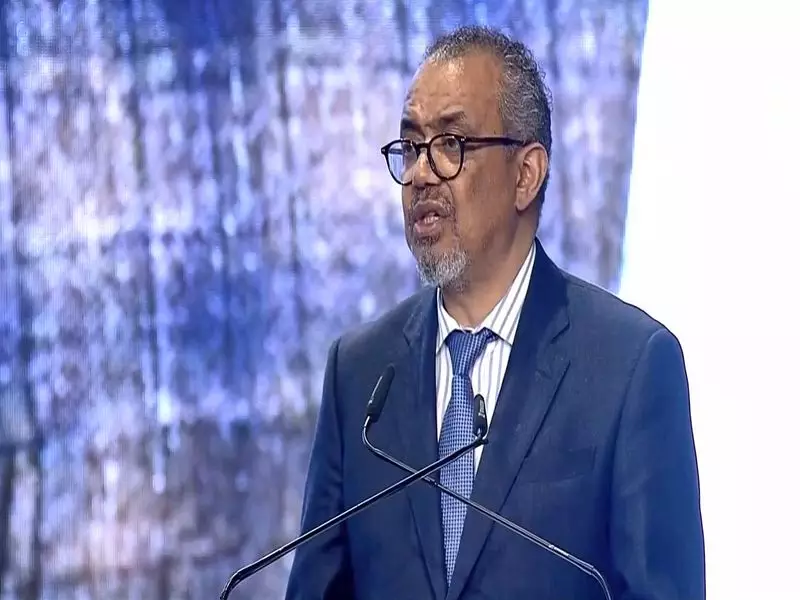
India has received high praise from the World Health Organization's top official for its exemplary role in demonstrating how ancient wisdom and cutting-edge science can work hand-in-hand. WHO Director-General Dr Tedros Adhanom Ghebreyesus singled out India's approach as a global model during a major international conference.
Global Spotlight on India's Integrative Model
Dr Tedros made these significant remarks while addressing the inaugural Global Summit on Traditional Medicine, co-hosted by the World Health Organization (WHO) and the Government of India. The high-profile event took place in Gandhinagar, Gujarat, on August 17 and 18, 2023. The summit served as a pivotal platform for global health leaders to discuss the future of traditional healing systems.
The WHO chief explicitly commended India for its leadership in creating a harmonious synergy between traditional practices and contemporary scientific research. He emphasized that India's journey provides a powerful blueprint for other nations to follow. This integration, he noted, is crucial for achieving the global goal of universal health coverage and advancing the Sustainable Development Goals (SDGs) related to health and well-being.

AYUSH and WHO: A Strategic Partnership
The summit was not just a talking shop but a milestone in formalizing global collaboration. A key outcome was the signing of a Host Country Agreement between the Ministry of AYUSH and the WHO to establish the WHO Global Centre for Traditional Medicine (GCTM) in Jamnagar, India. This centre is a first-of-its-kind global knowledge hub dedicated to traditional medicine.
Dr Tedros highlighted the centre's mission to harness the power of science and innovation to strengthen the evidence base for traditional medicine. This includes critical work on clinical practices, data analytics, sustainability, and equity. The establishment of the GCTM in India underscores the country's central role in this global movement.
Union Health Minister Mansukh Mandaviya, who also spoke at the summit, reinforced the government's commitment. He stated that under Prime Minister Narendra Modi's leadership, India is committed to preserving and promoting its rich heritage of traditional medicine systems like Ayurveda, Yoga, and Naturopathy. Mandaviya pointed to the operationalization of the GCTM as a testament to this commitment and to the strong partnership between India and the WHO.
Setting a Global Agenda for Health
The two-day summit convened over 150 international participants, including health ministers, academics, and practitioners. The discussions focused on several strategic areas:
- Building a robust evidence base for traditional medicine through research.
- Integrating traditional medicine resources into national health systems.
- Regulating products, practices, and practitioners to ensure safety and quality.
- Promoting sustainable practices and biodiversity conservation.
The consensus was clear: traditional medicine is not an alternative to modern science but a valuable complement. When properly researched, regulated, and integrated, it can significantly expand the toolkit available for global health challenges. India's proactive policies, its established AYUSH ministry, and its investment in institutions like the GCTM position it as a natural leader in this field.
The event concluded with a forward-looking vision where ancient knowledge, validated by modern scientific rigor, contributes to a healthier, more equitable world. India's model, as applauded by the WHO chief, is now at the forefront of making this vision a tangible reality for all nations to learn from and adopt.