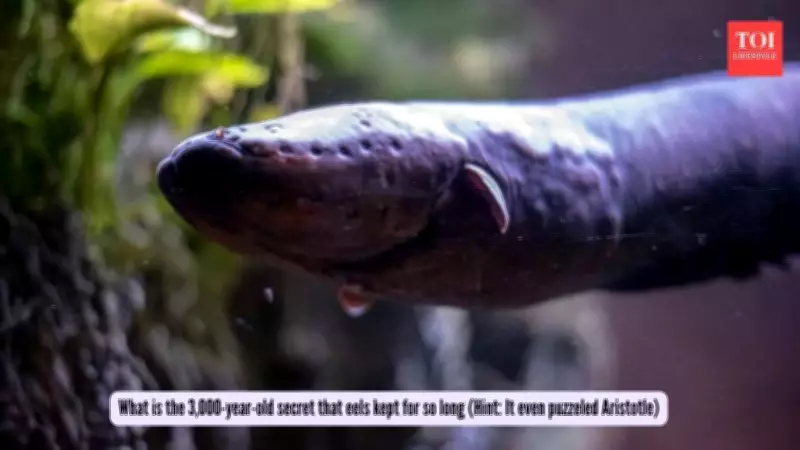
The 3,000-Year Eel Mystery: From Aristotle to Modern Science
Nature is brimming with enigmas that captivate human curiosity for generations, presenting puzzles that seem perpetually just beyond our grasp. Among these enduring mysteries, the reproduction of European eels stands out as a conundrum that perplexed scientists for over three millennia, weaving a tale of scientific intrigue from ancient philosophers to contemporary researchers.
Ancient Theories and Early Misconceptions
European eels, consumed since Roman times and famously abundant in Britain's Thames River during the 17th and 18th centuries, appeared mysteriously in freshwater systems without any visible means of reproduction. Scientists could not identify reproductive organs in adult eels, leading to a plethora of imaginative explanations.
- Aristotle's Hypothesis: Around the 4th century BCE, the Greek philosopher Aristotle proposed that eels emerged spontaneously from "the entrails of the earth," reflecting the limited biological understanding of his era.
- Egyptian Beliefs: Ancient Egyptians associated eels with the sun-warmed waters of the Nile River, attributing their origins to natural elements.
- Folklore Tales: Other popular myths suggested eels grew from horse hairs or shed skin, showcasing the creative attempts to explain their elusive life cycle.
The breakthrough began in the late 18th century when anatomist Carlo Mondini discovered gonads in a mature female eel, initiating a focused scientific hunt to uncover the truth.

Freud's Failed Quest and Biological Revelations
In 1876, a young Sigmund Freud joined a laboratory in Trieste, dissecting approximately 400 male eels in search of testes. His efforts proved fruitless, with no reproductive organs found, prompting his eventual shift to psychoanalysis and leaving the eel puzzle unresolved.
Modern biology has since revealed that eels reach sexual maturity only when preparing to breed, after which they embark on a one-way journey across the Atlantic Ocean and perish. Their complex life cycle involves several metamorphoses:
- Leptocephalus Larvae: The initial stage, once mistaken for a distinct species.
- Glass Eels: Transparent juveniles that transform from larvae.
- Yellow Eels: The familiar adult form found in freshwater habitats.
Schmidt's Pioneering Research and Final Confirmation
Starting in 1904, Danish scientist Johannes Schmidt embarked on extensive explorations of the Mediterranean and North Atlantic. He observed that eel larvae decreased in size as he traveled westward, leading him to hypothesize their origin in the Sargasso Sea. Schmidt described his decades-long research as "years rich in excitement and suspense: disappointment alternating with encouraging discoveries and periods of rapid progress with others during which the solution of the problem seemed wrapped in deeper darkness than ever."
Although Schmidt's theory gained traction in the 1920s, definitive confirmation arrived nearly a century later. In 2022, teams from the UK Environment Agency tagged eels near the Azores and tracked them directly to the Sargasso Sea, using satellite technology to validate the long-held hypothesis.
Conservation Implications and Modern Significance
Today, European eels are critically endangered due to overfishing and man-made barriers like dams. Solving this 3,000-year-old mystery is not merely an academic triumph; it provides crucial insights for conservation efforts. By mapping their migratory routes, scientists can develop strategies to protect these ancient wanderers and ensure their survival.
This remarkable journey from Aristotle's speculations to satellite tracking exemplifies how science thrives on persistent curiosity and collaborative effort. The eel mystery teaches us that even the most "impossible" questions can yield answers with time, dedication, and technological advancement, reminding us of the endless wonders awaiting discovery in the natural world.