

Decades After Independence, Bastar Village Lacks Basic Road Access for Medical Emergencies
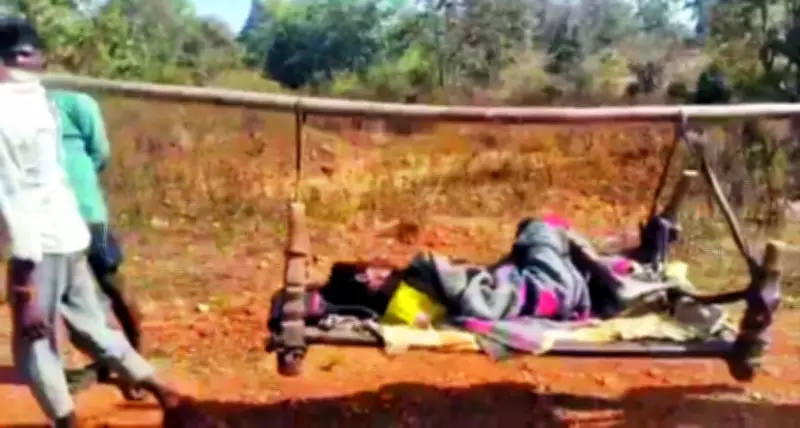
The persistent and glaring absence of fundamental infrastructure in the remote interior regions of Bastar has been exposed once again in a distressing incident from Porohidma village, located in the Dantewada district of the Bastar division. A critically ill tribal man had to be transported manually over a grueling distance of 10 kilometers on a makeshift cot because an ambulance was completely unable to reach the village due to the non-existence of a motorable road.
A Week-Long Illness Leads to Desperate Measures
The patient, identified as Muchaki Joga, had been suffering from illness for nearly a week. As his health condition rapidly deteriorated, his family members urgently attempted to contact the state-operated ambulance service for emergency medical assistance. However, their efforts were thwarted when it became clear that the ambulance vehicle could not physically access Porohidma village because there is no proper road connecting it to the broader transportation network.
Faced with this dire situation and left with absolutely no alternative options, Joga's relatives and fellow villagers quickly improvised a solution. They fashioned a rudimentary stretcher using a simple wooden cot and some ropes. In a display of community solidarity and physical endurance, they took turns carrying Joga on their shoulders across extremely challenging terrain.

A Harrowing Journey Across Rocky and Uneven Ground
The group navigated rocky, uneven pathways and dense forest tracks for approximately 10 kilometers. This arduous journey was necessary to finally reach the nearest road point that was accessible by motor vehicles. Only from that location could they arrange further transport to a proper healthcare facility or hospital for Muchaki Joga.
Local residents have emphasized that this traumatic ordeal is not an isolated incident but rather a recurring and commonplace reality for the villagers. They repeatedly face such life-threatening challenges whenever medical emergencies arise.
Villagers Voice Frustration Over Unheeded Appeals
Sunil Sodhi, a resident of the village, voiced the community's deep frustration and anguish. He alleged that despite numerous and persistent pleas to the authorities, Porohidma village still lacks a basic, properly constructed road. "No road has been built in our village till date," Sodhi stated. "Whenever someone falls seriously sick or a pregnant woman needs to be taken to a hospital, we are forced to carry them manually on a cot like this. We are utterly tired of appealing to the authorities, but absolutely nothing has changed for us."
This incident starkly contrasts with the official narratives and government reports that often highlight digital expansion initiatives and development outreach programs in Maoist-affected districts like Bastar. However, villagers and local observers note that on many occasions, critical information about such ground-level crises and infrastructure failures does not effectively reach the administrative headquarters or result in tangible action.
In response to this specific case, officials have stated that they will conduct a probe into the matter to understand the circumstances and the systemic failures that led to this humanitarian crisis. The incident underscores the urgent need for substantive infrastructure development in India's most marginalized and remote tribal regions to ensure basic rights and access to emergency services.






