

Gujarat Witnesses Alarming Surge in Dialysis Procedures as Kidney Disease Cases Escalate
In the financial year 2021-22, Gujarat, like much of the world, was grappling with the aftermath of the COVID-19 pandemic. However, for individuals suffering from chronic kidney disease (CKD) or renal failure, the need for life-sustaining dialysis treatment remained urgent and constant. Patients across the state relied heavily on the government-run dialysis network to access this critical medical procedure.
Dramatic Increase in Dialysis Numbers Over Five Years
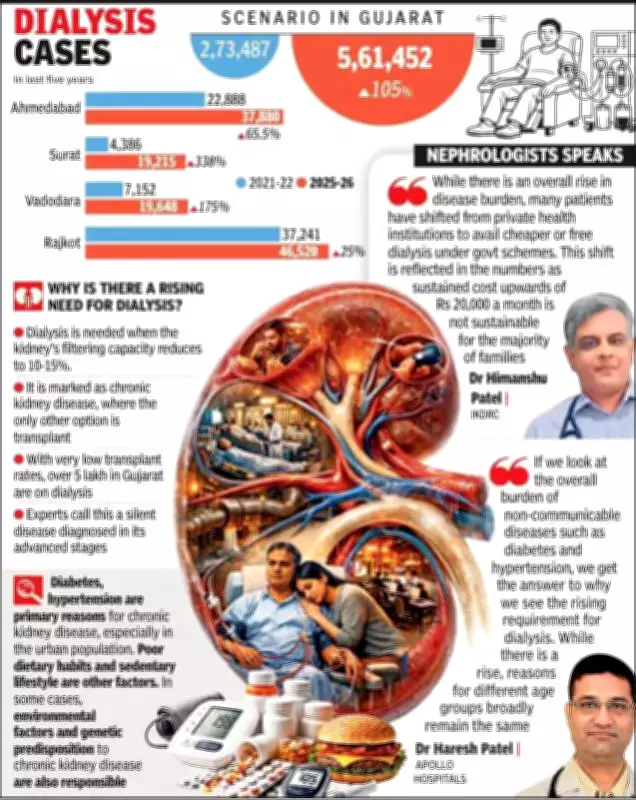
The Institute of Kidney Diseases and Research Centre (IKDRC), which serves as the nodal agency for Gujarat's government dialysis centers, has released revealing statistics. During 2021-22, the network recorded approximately 2.73 lakh dialysis procedures, averaging about 750 procedures per day. Fast forward to the current financial year, and the numbers present a stark contrast. Even with March data still pending, the count has already reached 5.61 lakh procedures, translating to roughly 1,680 procedures daily.
This represents a more than doubling of dialysis procedures within just five years, highlighting a significant and troubling trend in public health. The only permanent solution to free patients from dialysis, which typically requires sessions two or three times weekly, is a kidney transplant from either a cadaver or a living donor.

Expansion of Healthcare Infrastructure and Patient Accessibility
Dr. Pranjal Modi, Director of IKDRC, explained that Gujarat now operates a network of 280 dialysis centers providing treatment under various government schemes. "Over the years, we have strategically expanded this network to reach the taluka level, ensuring that patients no longer have to endure long and arduous journeys to receive essential care," Dr. Modi stated.
According to nephrologists at IKDRC, the current financial year has seen 64,109 patients availing dialysis services so far. Dr. Himanshu Patel, a senior nephrologist at the institute, provided insight into the factors driving this increase. "The rise in absolute patient numbers can be attributed to several key factors. Firstly, there is a growing prevalence of non-communicable diseases such as diabetes and hypertension, which are major contributors to CKD. Secondly, dialysis is an expensive procedure, and over time, many families are transitioning from costly private hospitals to more affordable public hospital services," Dr. Patel elaborated.
Regional Disparities and the Broader Healthcare Picture
An analysis of dialysis trends across Gujarat reveals interesting regional patterns. The four major districts—Ahmedabad, Surat, Vadodara, and Rajkot—collectively experienced a 72% rise in dialysis procedures. In contrast, the rest of the state witnessed a much sharper increase of 117%. Several smaller centers now report serving more than 1,000 patients each.
Healthcare experts caution that the overall number of procedures and patients is likely even higher when considering services obtained at private facilities, which are not captured in the government data.
Expert Insights on Prevention and Early Detection
Dr. Mayank Shah, a nephrologist at Shalby Hospitals, emphasized the importance of early detection and intervention. "Approximately one in every ten kidney patients we consult presents with CKD requiring long-term management. A concerning pattern we observe is that the majority of these patients arrive at our clinics already in advanced Stages 4 or 5 of the disease. Therefore, it is crucial for patients with long-term conditions like diabetes and hypertension, as well as their physicians, to prioritize regular checks for renal health," Dr. Shah advised.
The data from Gujarat underscores a silent but growing public health challenge. The dramatic increase in dialysis dependency points to an urgent need for enhanced preventive healthcare measures, greater awareness about kidney disease, and continued expansion of affordable treatment options to manage this escalating crisis effectively.






