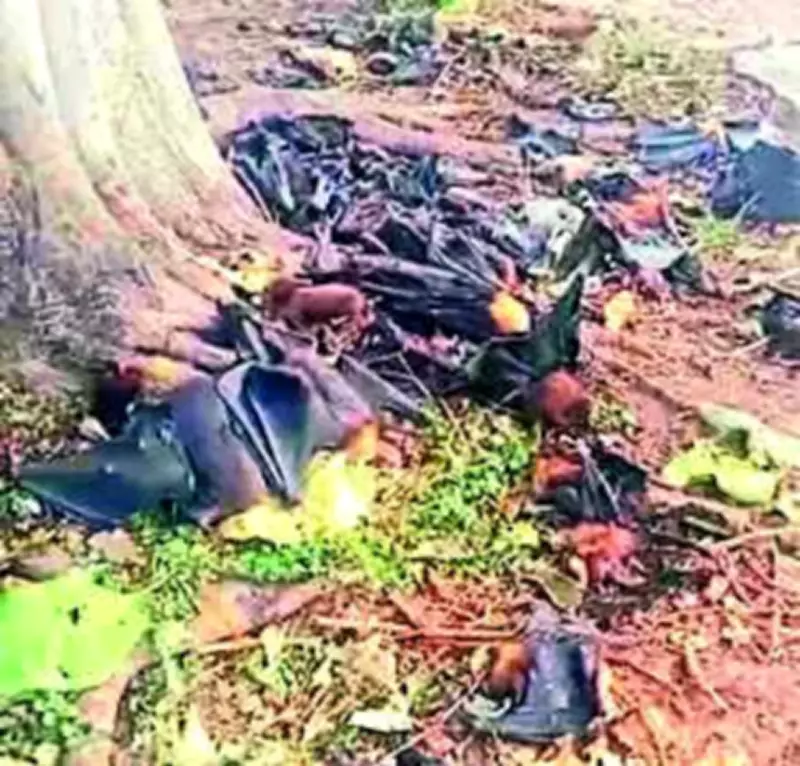
In Chhattisgarh's Balod district, mornings have turned grim under the trees. Hundreds of bats are being found dead every day as temperatures in Dallirajhara hover around 44-45 degrees Celsius during nautapa, leaving sanitation workers struggling to clear carcasses and residents battling an unbearable stench. This is the third incident reported in the past four days about hundreds of bats dying in Korba and Kanker districts.
Wildlife Expert Raises Concerns
Wildlife expert Nitin Singhvi in Raipur has raised concerns over the deaths, stating that birds are more vulnerable to heat and bats are dying because they hang together in bunches on the trees, causing their body temperatures to increase enough to kill them. Locals said nearly 400 to 500 bats are dying every day in the area, where large colonies roost on trees around the industrial township. Municipal teams have been collecting and disposing of the dead bats, but the deaths are so numerous that several carcasses remain scattered, adding to public health concerns and panic.
Climate Stress Warning
Singhvi emphasized that the deaths must not be seen as an isolated heatwave tragedy but as a warning of how climate stress is beginning to hit wildlife habitats. "Wildlife animals are vulnerable to extreme heat, but mammals like bats are even more exposed because they cling closely together while roosting, which traps additional body heat," he said. He noted that accurate local heat mapping is missing in most such areas. "Where deaths are being reported, there is no micro-level weather or heat mapping. In places with poor air circulation, heat-dome-like conditions can develop," he added, referring to similar conditions suspected in Khairagarh, where several animals were recently found dead in a forest patch surrounded by hills.

Earlier Warnings and Wider Impact
In a note to the forest department, Singhvi had earlier warned that climate change, rising temperatures, drought-like conditions, and shrinking resources would increase stress on wildlife and heighten human-animal conflict. He pointed out that heatwaves are expected to become more frequent and intense, forcing wild animals to move out of forests in search of water, food, and shade. The Balod deaths come amid a string of heat-linked wildlife casualties across Chhattisgarh. Hundreds of bats were earlier reported dead in Kanker and Korba, while peacocks and palm civets were found dead in Khairagarh forests.
Urgent Measures Needed
Experts said immediate steps such as local heat mapping, protection of roosting trees, artificial water points, shade conservation, and monitoring of vulnerable wildlife pockets are needed before extreme heat turns into a recurring mass mortality event.