Hyderabad Faces Alarming Fatty Liver Disease Prevalence at 40.9%
Nearly two out of every five adults in Hyderabad are currently living with fatty liver disease, a condition increasingly driven by lifestyle factors rather than alcohol consumption. According to a comprehensive pan-India study published in 'The Lancet Regional Health', the city's prevalence of metabolic dysfunction-associated steatotic liver disease (MASLD) stands at 40.9%, slightly exceeding the national average of 38.9%. This data highlights the rapid spread of metabolic disorders within urban populations across India.
Study Details and Gender-Specific Findings
The research, led by the Council of Scientific and Industrial Research (CSIR), surveyed over 10,000 adults across 27 cities. In Hyderabad, the findings reveal that nearly half of men (46%) and over a third of women (36.2%) are affected by fatty liver disease. Medical experts attribute this surge to a combination of sedentary lifestyles, irregular eating habits, high consumption of processed foods, and the rising incidence of metabolic disorders, all closely tied to urban living patterns.
Comparative Analysis with Other Major Cities
Among India's major metropolitan areas, Delhi recorded the highest prevalence at 41.3%, followed closely by Chennai at 41.2%. Bengaluru reported a rate of 40.6%, positioning Hyderabad among the most impacted large cities. The study identified obesity as the strongest risk factor, with individuals classified as having class-2 obesity facing nearly 14 times higher risk of developing MASLD compared to those with normal weight. Diabetes was found to double the risk, while hypertension and abnormal cholesterol levels further increased vulnerability.

Emergence of 'Lean Fatty Liver' and Broader Trends
Doctors are also cautioning about 'lean fatty liver,' where individuals with normal body weight develop the disease due to hidden metabolic risks such as diabetes or excess abdominal fat. This challenges the common belief that only overweight people are susceptible. A 2025 survey by the Asian Institute of Gastroenterology underscores the scale of the problem, revealing fatty liver disease in over 25% of urban residents and about 20% in rural populations. Notably, prevalence among IT employees, characterized by prolonged sitting and high stress, soared to 84%.
Health Consequences and Rising Liver Cancer Cases
Specialists in Hyderabad report that the fallout from fatty liver disease is already evident in oncology wards. Cases of hepatocellular carcinoma (HCC), the most common primary liver cancer, are rising sharply, with weekly diagnoses nearly doubling in recent years. Dr. Mukta Srinivasulu, former director of MNJ Cancer Hospital, explained, "HCC is caused by cirrhosis, alcohol abuse, viral infections like hepatitis B and C, and increasingly by fatty liver diseases linked to obesity and diabetes. The obesity epidemic, sedentary lifestyle, and poor diet are now major contributors."
Dr. Anand Kulkarni, senior consultant hepatologist at AIG Hospitals, noted a shift in disease patterns, stating, "We are seeing that nearly 40–50% of our liver cancer patients are relatively young. Many come late, often with large tumours and sudden severe abdominal pain. Diabetes is a common underlying factor. MASLD, obesity, and diabetes are closely linked, while alcohol remains another significant cause." He added that fatty liver has overtaken viral hepatitis as a major driver of serious liver complications.
Reversibility and Healthcare System Strain
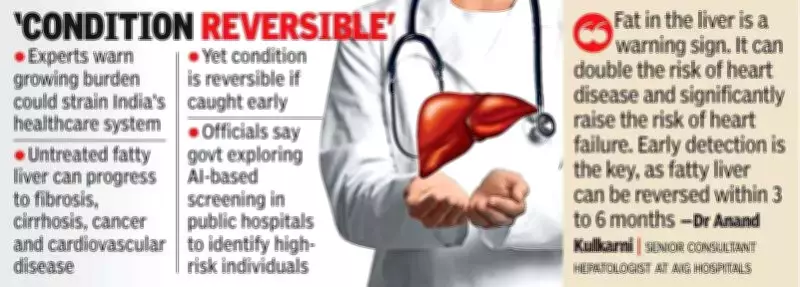
Experts warn that the growing burden of fatty liver disease could strain India's healthcare system. Untreated, it can progress to fibrosis, cirrhosis, cancer, and cardiovascular disease. However, the condition is reversible if detected early. Dr. Kulkarni emphasized, "Fat in the liver is a warning sign. It can double the risk of heart disease and significantly raise the risk of heart failure. Early detection is key, as fatty liver can be reversed within 3 to 6 months. Even early fibrosis can improve within 8 to 10 months with proper treatment and lifestyle changes."

Government Initiatives and AI-Based Screening
Health officials indicate that the government is exploring artificial intelligence-based screening in public hospitals to identify high-risk individuals earlier. An official stated, "It is being discussed to deploy AI-enabled screening tools in public healthcare institutions that can quickly analyse routine health data to identify people at high risk of fatty liver, so they can be referred for further evaluation and care, making screening more accessible, affordable, and scalable alongside other non-communicable disease interventions."
Conclusion: A Growing Public Health Threat
The message from medical professionals is unequivocal: Fatty liver is no longer a silent, harmless condition but a fast-growing public health threat deeply rooted in everyday lifestyle choices. With urban centers like Hyderabad showing alarming rates, urgent action through awareness, early screening, and lifestyle modifications is essential to combat this epidemic.