

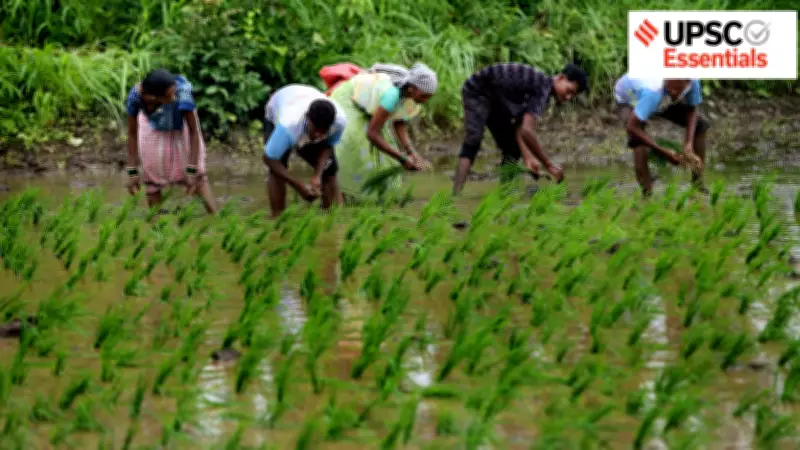
India's Rice Dominance: A Double-Edged Sword for Food Security and Sustainability
India has emerged as the world's largest rice producer, surpassing China in 2024-2025 with a commanding 28 percent share of global production and 40 percent of international trade. This agricultural achievement, however, comes with significant environmental and sustainability concerns that demand urgent attention.
The Water-Intensive Reality of Rice Cultivation
Rice cultivation in India presents a paradox of abundance and scarcity. While the country produces massive quantities of this staple food, the process requires staggering amounts of water – approximately 3,000 to 4,000 liters for every kilogram of rice produced. This water intensity has led to severe groundwater depletion in major rice-growing regions, creating long-term sustainability challenges.
The geographical distribution of rice cultivation reveals how water resources shape agricultural patterns. River basins including the Brahmaputra, Ganga, Mahanadi, Godavari, Krishna, and Cauvery serve as primary rice-producing regions. States like Telangana, Andhra Pradesh, Bihar, Chhattisgarh, and West Bengal dominate production, but their agricultural success comes at the cost of declining water tables.

Historical Context and Government Interventions
Rice cultivation in India dates back to the Indus Valley Civilization, with evidence suggesting parallel domestication alongside China. Today, India boasts approximately 60,000 of the world's 123,000 rice varieties, reflecting remarkable biodiversity.
The government has implemented several key measures to address rice-related challenges:
- The Johl Committee (1986) recommended diversifying at least 20 percent of Punjab's cropping area away from rice to reduce water stress
- The National Food Security Act (2013) legally mandates subsidized food grains for about two-thirds of India's population
- Rice fortification initiatives launched in 2019 address nutritional deficiencies through iron, folic acid, and vitamin B12 enrichment
- Preservation of Subsoil Water Acts in Punjab and Haryana regulate sowing dates to align with monsoon patterns
Export Dynamics and Domestic Consumption
India's rice exports reveal complex market dynamics. Non-basmati varieties constitute 70 percent of export volume but only 48 percent of value due to lower pricing. African nations import substantial quantities of parboiled and non-basmati white rice, while Middle Eastern, European, and American markets favor premium basmati varieties. China imports broken rice primarily for animal feed and ethanol production.
Domestically, approximately 65 percent of Indians depend on rice as a staple food. The government's central pool currently holds 63.06 million metric tonnes of rice stocks – significantly exceeding the 7.61 million metric tonnes buffer requirement and the 37.2 million tonnes needed for annual welfare programs.
Environmental Consequences and Policy Challenges
The paddy-wheat cropping cycle, intensified during the Green Revolution, has created multiple environmental issues. Delayed rice cultivation in northern states leaves minimal time between crops, forcing farmers to burn crop residue and contributing to severe seasonal air pollution.
Productivity remains another concern. India's average rice yield of 2,929 kg/hectare lags significantly behind China's 7,100 kg/hectare. Small and marginal farmers, who control 90 percent of agricultural land, face economic barriers to mechanization that could improve yields.
Toward Sustainable Rice Production
Recent initiatives demonstrate growing awareness of sustainability challenges. The Punjab government's 2025 pilot program offers financial assistance for paddy-to-maize diversification across six districts. However, crop diversification faces practical hurdles as alternative crops often yield lower returns per hectare.
Experts emphasize several pathways forward:

- Promoting water-efficient techniques like Direct Seeded Rice (DSR)
- Incentivizing climate-resilient cropping patterns
- Encouraging nutrient-rich alternatives including pulses and millets
- Balancing export policies with domestic food security needs
The 2023 export restrictions on non-basmati rice, triggered by weak monsoons and domestic demand, highlighted how climate vulnerability can disrupt global markets. As climate change intensifies weather unpredictability in South and Southeast Asia, India must develop more resilient agricultural systems.
India's rice sector stands at a critical juncture where food security, farmer livelihoods, export revenues, and environmental sustainability intersect. The nation's ability to balance these competing priorities will determine not only its agricultural future but also its role in global food systems. Strategic investments in sustainable practices, coupled with thoughtful policy interventions, can help transform rice production from an environmental liability to a model of sustainable agriculture.





