

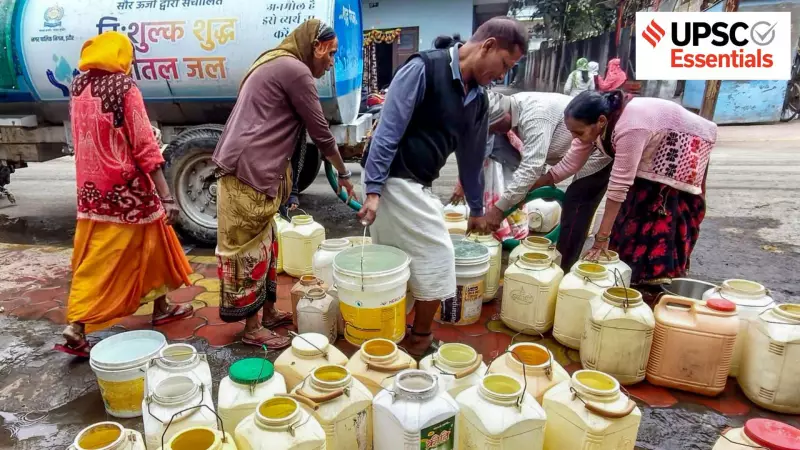
Indore's Water Tragedy Reveals National Groundwater Crisis
More than a dozen people have died in Indore's Bhagirathpura locality. Several others remain hospitalized after consuming contaminated water. The city faced a severe public health emergency when sewage leakage allegedly caused widespread vomiting and diarrhea outbreaks.
This tragic incident brings India's groundwater crisis to the surface. Groundwater depletion and quality degradation now threaten safe drinking water, agriculture, industry, and public health across the nation.
India's Groundwater Reality Check
India stands as the world's largest consumer of groundwater. The country extracts approximately 230 cubic kilometers annually. This staggering amount represents more than one-fourth of global groundwater extraction.

Groundwater fulfills 45 percent of urban water supply needs. It meets 85 percent of rural water requirements. More than 60 percent of agricultural irrigation depends on groundwater sources.
The Central Ground Water Board and State Governments assess India's dynamic groundwater resources annually. Their 2025 report reveals a total annual groundwater recharge of 448.52 billion cubic meters. Extraction reached 247.22 billion cubic meters during the same period.
Regional Stress Patterns Emerge
Analysis of 6,762 assessment units shows concerning patterns:
- 730 units are classified as 'Over-exploited' with extraction exceeding 100%
- 201 units fall into the 'Critical' category with 90-100% extraction
- 758 units are 'Semi-critical' with 70-90% extraction
- 4,946 units remain 'Safe' at 73.14% of total units
- 127 units contain saline water unsuitable for consumption
Several states show alarming groundwater stress. Haryana, Punjab, and Rajasthan appear over-exploited. Delhi falls into the critical category. Tamil Nadu and Puducherry register as semi-critical.
Nine states and union territories have more than one-fourth of their assessment units exceeding safe limits. These include Haryana, Karnataka, Madhya Pradesh, Punjab, Rajasthan, Tamil Nadu, Uttar Pradesh, Delhi, and Puducherry.
Root Causes of Water Stress
Multiple factors drive India's groundwater crisis:
- Rapid urbanization increases water demand beyond sustainable limits
- Population growth puts additional pressure on existing resources
- Industrial expansion requires substantial water volumes
- Unsustainable farming practices deplete aquifers faster than recharge
The Indo-Gangetic-Brahmaputra plains contain 60 percent of India's groundwater reserves. These regions cover only 20 percent of the country's geographical area. Unfortunately, indiscriminate withdrawal for water-intensive crops like rice and sugarcane causes over-exploitation.
Central and southern India face particular challenges. Hard-rock aquifers in these regions prove difficult to replenish. Coastal areas struggle with seawater intrusion despite having thick alluvial deposits.
Pollution Compounds the Problem
Groundwater quality deteriorates across India. The Central Ground Water Board's 2024 Annual Groundwater Quality Report reveals contamination in over 440 districts. Major pollutants include:
- Nitrates from agricultural chemicals
- Fluoride occurring naturally in some regions
- Arsenic present in alluvial plains
- Uranium detected in several states
- Heavy metals from industrial waste
Uranium contamination appears in Rajasthan, Punjab, Haryana, Andhra Pradesh, and Telangana. Lead contamination localizes in Assam, Karnataka, Madhya Pradesh, Uttar Pradesh, Punjab, and Rajasthan. Arsenic concentrates mainly in the Indo-Gangetic and Brahmaputra alluvial plains.
Health and Ecological Consequences
Contaminated drinking water causes serious health implications:

- Cardiovascular complications from excessive chloride
- Gastrointestinal discomfort from various contaminants
- Dental and skeletal fluorosis from fluoride exceedances
- Methemoglobinemia (blue baby syndrome) in infants from nitrates
- Neurological effects from lead exposure
- Carcinogenic potential from arsenic and uranium
- Kidney toxicity from heavy metals
Beyond human health, groundwater depletion affects ecosystems:
- Soil salinization reduces crop yields and degrades soil health
- Reduced groundwater discharge alters river hydrology
- Aquatic habitats suffer from changing water patterns
- Fish migration patterns disrupt
- River nutrient cycles change
- Land subsidence occurs in some over-extracted regions
Government Initiatives and Gaps
Water management remains primarily a state responsibility. However, the Central Government has launched several schemes:
- Ground Water Management & Regulation
- Jal Shakti Abhiyan
- Jal Sanchay Jan Bhagidari
- Atal Bhujal Yojana
These policies focus on enhancing water availability and promoting groundwater recharge. Yet significant gaps remain in national surveillance of groundwater contamination and extraction.
Urgent Actions Required
Several measures could address India's groundwater crisis:
- Strengthen continuous monitoring of groundwater quality and extraction rates
- Invest in large-scale water treatment plants nationwide
- Prevent urban sewage from flowing directly into rivers
- Implement strict extraction limits in over-exploited zones
- Incentivize water-efficient agricultural practices
- Promote crop diversification away from water-intensive varieties
- Expand rainwater harvesting and groundwater recharge methods
- Focus subsidies on sustainable water management practices
Prime Minister Narendra Modi's call for 'Reduce, Reuse, Recharge, and Recycle' offers a framework for action. Institutionalizing sustainable groundwater management at the national level becomes increasingly urgent.
The Indore tragedy serves as a stark warning. Groundwater depletion and quality degradation threaten India's water security. Immediate, coordinated action across government levels and society can help secure the nation's water future.
