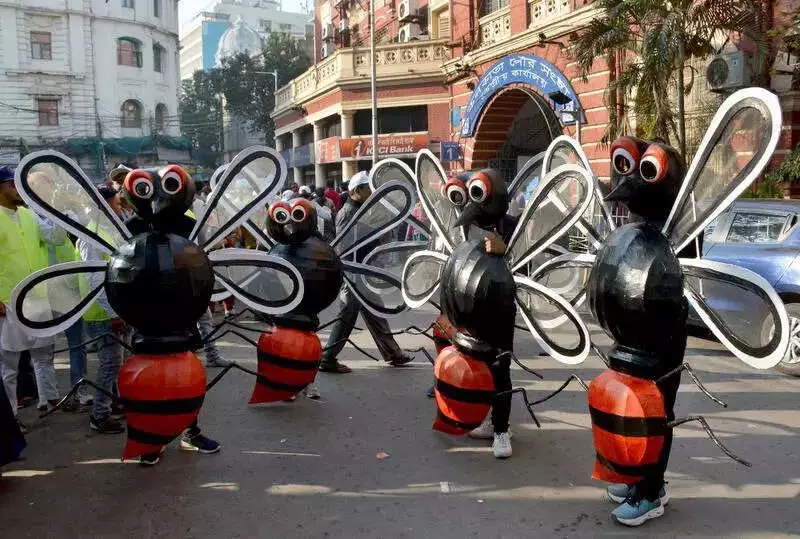
Kerala's Waste Piles Become Mosquito Breeding Grounds, Study Confirms
Residents like Remani K C in Pachalam, Ernakulam, wake up each morning to a distressing sight. Instead of fresh air, they face piles of solid waste dumped overnight near their homes. The garbage emits a foul stench and quickly turns into a breeding ground for mosquitoes.
"I come from North Paravoor village where we don't see such littering," Remani explains. "Here, mosquitoes keep us awake at night. I constantly worry that my family might contract serious illnesses from this environment."
Scientific Study Validates Residents' Fears
A comprehensive study published recently in Springer Nature has confirmed what residents like Remani experience daily. Conducted across five Kerala districts—Ernakulam, Thiruvananthapuram, Pathanamthitta, Idukki and Wayanad—the research involved multiple institutions including ICMR-Vector Control Research Centre and National Institute of Malaria Research.

The study titled Diversity and Spatiotemporal Distribution of Mosquitoes with Emphasis on Disease Vectors Across Agroecological Areas of Kerala reveals alarming findings. Researchers identified 14 different vector species thriving in the state.
Artificial habitats created by human waste showed 77.7% mosquito species diversity, compared to just 22.3% in natural habitats. Discarded plastic containers, tires, and latex collection cups emerged as primary contributors to this dangerous diversity.
Disease Vectors Adapting to Human Environments
Particularly concerning is the behavior of Stegomyia albopicta, a vector capable of transmitting dengue, chikungunya and Zika viruses. The study found this species predominantly breeds in discarded tires (20.8%), latex collection cups (10.57%) and tree holes (10.9%).
Dr. Alex Eapen, senior grade deputy director at National Institute of Malaria Research and study participant, emphasizes the public health implications. "High mosquito diversity increases public health risk significantly," he warns. "More mosquito species mean greater potential for emerging infectious diseases and more complex transmission patterns."
Former health department entomology expert Dr. Sasi M S notes a troubling trend. "Vector species like Aedes were once confined to forest environments. Widespread deforestation and urban expansion have pushed them into human settlements, forcing adaptation to new habitats."
Waste Management Failures Compound the Problem
Kerala generates approximately 3,011.23 tonnes of solid waste daily, according to 2024-25 data. Local bodies collect only 1,290.12 tonnes, leaving massive quantities improperly managed. Much of this uncollected waste ends up in public spaces, water bodies and drains.
Justice A V Ramakrishna Pillai, former chairman of Kerala's solid waste management monitoring committee, points to civic responsibility gaps. "Many people keep their own premises clean by illegally dumping waste elsewhere," he observes. "We have laws, but implementation requires individual social responsibility."
A senior health department official highlights how even small items become dangerous. "An discarded eggshell can harbor around 1,000 mosquito larvae. We need intensive source reduction starting from every household."
Climate Change Intensifies the Challenge
Kerala's tropical climate with high humidity already creates favorable conditions for vector-borne diseases. Official data shows the state reported 12,886 confirmed cases, 82 deaths and approximately 30,000 suspected cases from seven vector-borne diseases last year alone.
Climate change is making control efforts increasingly difficult. "We can no longer predict rainfall patterns," explains a health department officer. "Warmer temperatures, changing rainfall and prolonged humidity will expand mosquito breeding habitats and survival rates."
Dr. Eapen warns that these environmental changes will allow more mosquito species to spread into new areas. He advocates for public-private partnerships to address the growing challenge.
Immediate Actions and Future Concerns
The Kerala government plans to direct local bodies to identify vector-borne disease hotspots and implement control measures. However, experts stress that interventions must consider vector biology to avoid enhancing their adaptive capacity.

The study underscores a looming threat: even low-density vector populations can maintain pathogen transmission under favorable conditions. Seasonal rainfall, temperature fluctuations and land-use changes can trigger sudden population increases and unexpected disease outbreaks.
As Remani and countless other Kerala residents face sleepless nights and health anxieties, the connection between waste management and public health becomes increasingly clear. The solution requires both systemic improvements and individual responsibility to break the cycle of waste breeding disease.