

Kolkata Nipah Virus Investigation: Antibodies Detected in Bat During Sero-Surveillance
In a significant development in the ongoing investigation into the Nipah virus outbreak in West Bengal, health authorities have conducted a detailed sero-surveillance study in the Barasat area of Kolkata. While no active Nipah virus was discovered in bats during this comprehensive survey, experts made a crucial finding: antibodies were detected in one bat, indicating a past infection. This discovery sheds light on the historical presence of the virus in the region, even as current tests show no active threat.
Comprehensive Survey Launched by Health and Forest Departments
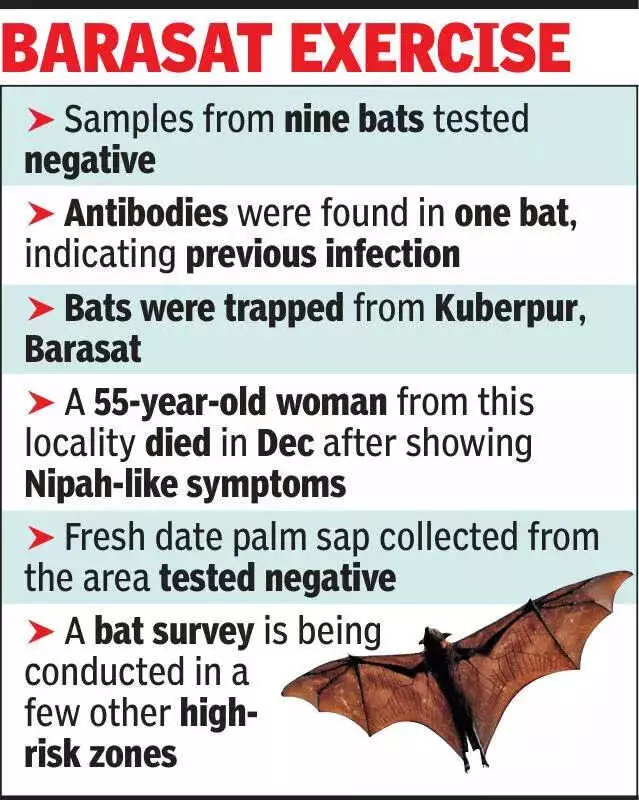
A collaborative effort involving teams from the health department, forest department, and the National Institute of Virology (NIV) in Pune was initiated to trace the origin of the recent Nipah spread. The survey focused on bats in a Barasat locality, aiming to understand the transmission dynamics and prevent future outbreaks. According to a health department official, the team began by capturing nine bats from Kuberpur in Madhyamgram. From each bat, three different types of swab samples were meticulously collected and tested using RT-PCR methods. All these samples returned negative results, confirming the absence of active Nipah virus at the time of testing.
However, the blood analysis revealed antibodies in one bat, suggesting that it had been exposed to the Nipah virus in the past. This finding is critical as it points to a historical infection cycle, even though no current active infection was present. The official emphasized that this indicates past exposure without posing an immediate risk of transmission.

Investigation into Past Cases and Transmission Routes
Earlier in the investigation, the team visited the home of a 55-year-old woman from Barasat's Kazipara who died in December after developing Nipah-like symptoms. Tragically, she passed away before a confirmatory test could be conducted, leaving her case unverified. During the visit, family members disclosed that the deceased had consumed raw date palm sap before falling ill, a known transmission route for the Nipah virus. Sources indicated that two Nipah-infected nurses were involved in her treatment, highlighting the potential for human-to-human spread in healthcare settings.
To further investigate, the team from the National Institute of One Health utilized geo-location data to trap nine bats near the woman's residence. While antibodies were detected in one bat, all 24 date palm sap samples collected from the surrounding area tested negative for the virus. Experts explained that fruit bats are the most common natural reservoir of the Nipah virus, typically transmitting the infection to humans through contaminated fresh date palm sap or fruits. They underscored the importance of such surveys in mapping virus hotspots and implementing preventive measures to avert future outbreaks.
Addressing Concerns and Broader Implications
Earlier concerns had emerged suggesting that the origin of the outbreak might be linked to Gugragachhi in Krishnaganj, Nadia, where a 25-year-old Nipah-infected female nurse had stayed to attend a wedding. This highlights the complex transmission web involving travel and social gatherings. The sero-surveillance results from Barasat provide valuable data, but experts caution that continuous monitoring is essential. The detection of antibodies without active virus underscores the need for ongoing surveillance to track virus evolution and prevent resurgence.
This investigation not only clarifies the current status of the Nipah virus in Kolkata but also reinforces the critical role of interdisciplinary teams in public health responses. By combining field surveys with advanced laboratory techniques, authorities aim to build a robust defense against potential future threats, ensuring community safety through proactive measures.

