

Maharashtra Government Implements Fee Structure for Hospital Services, Ending Free Healthcare Era
The Maharashtra government has issued a groundbreaking resolution that will fundamentally alter healthcare accessibility across the state. A government resolution dated January 16, 2024, mandates that all state-run hospitals will now charge patients for services that were either completely free or minimally priced over the past two years.
Comprehensive Rate Card Introduced for Medical Procedures
The newly announced rate card establishes specific charges for virtually every medical service provided at government healthcare facilities. This includes district hospitals, rural hospitals, sub-district hospitals, and women's hospitals throughout Maharashtra. The pricing structure ranges from nominal amounts for basic services to significant sums for complex procedures.
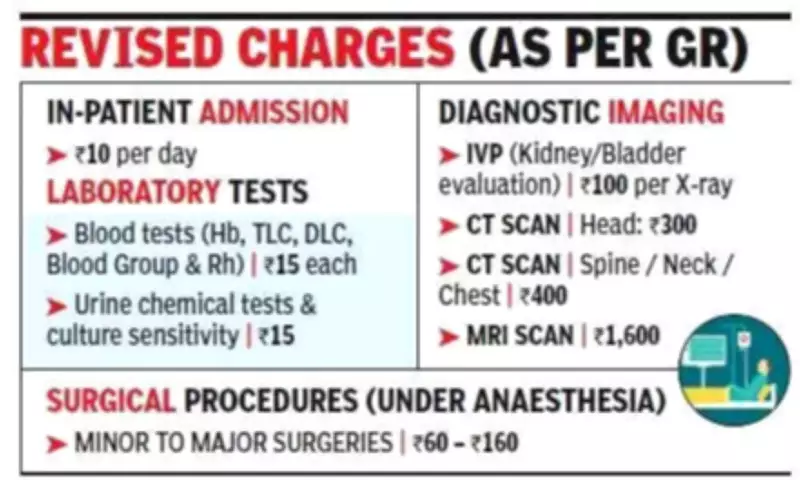
Basic registration and consultation fees will now cost patients Rs5 for outdoor patient department case paper registration. Daily admission charges for in-patient department patients have been set at Rs10 per day. Diagnostic services will also carry specific price tags: blood tests including haemoglobin, TLC, DLC, blood group and Rh testing will cost Rs15 each, while urine chemical tests and culture sensitivity tests follow the same pricing.

Imaging and Surgical Procedure Costs Detailed
The resolution provides detailed pricing for various medical imaging and surgical interventions. An intravenous pyelogram to evaluate kidneys and bladder will cost Rs100 per X-ray scan. CT scans have been categorized with head CT scans priced at Rs300, while spinal, neck and chest CT scans will cost Rs400 each. MRI scans carry a significantly higher price point of Rs1,600 per procedure.
Surgical procedures under anesthesia have been divided into major and minor categories, with costs ranging from Rs60 to Rs160. The most expensive procedure listed in the rate card is joint replacement surgery, which will now cost patients Rs40,000 at government hospitals.
Maternity Care and Hospital Accommodation Charges
The government resolution introduces a tiered system for maternity services. While the first delivery for pregnant women remains free, subsequent deliveries will incur charges: Rs50 for the second delivery and Rs250 for the third and subsequent deliveries. Hospital accommodation costs have also been standardized, with AC rooms in government nursing homes priced at Rs150 per day and non-AC rooms at Rs75 per day.
Critical care services will now carry specific charges: ICU stays cost Rs100 per day, while a single hemodialysis session is priced at Rs150. The resolution also establishes rates for various certificates and specialized services, including Rs1,500 for embalming bodies provided to private institutions.
Ambulance Services and Implementation Challenges
Emergency medical transportation will now carry standardized charges as well. Ambulance services will cost Rs5 per kilometer, with additional waiting charges of Rs30 per hour for waits exceeding eight hours. Despite the detailed rate card, implementation has not yet begun at ground level, creating confusion among hospital administrators across the state.
Dr. Kailash Pawar, civil surgeon in Thane district, expressed his confusion about the new regulations. "We are confused. The government had issued a GR in 2023 mentioning that all services — including those provided under PPP basis — would be completely free. I need further clarifications. The previous GR was also issued by the same government, so there is some confusion."
Dr. Kamlalkar Mudkhedkar, civil surgeon in Chatrapati Sambhajinagar, confirmed the delayed implementation, stating, "We are yet to implement the rules of the GR, which I received just two days ago."
Exemptions and Activist Concerns
The government resolution does specify exemptions for certain population segments who will continue to receive free treatment. This includes government employees and their dependents, medical officers and nursing staff of government hospitals, students in medical and paramedical colleges, people detained under court orders, freedom fighters and their family members, prisoners under judicial inquiry, and several other categories.

Notably, the exemption list also includes MLAs, MPs, ministers, speakers, former legislative members, and judges. This particular exemption has drawn criticism from health activists who question its necessity.
Health activist Sharad Shetty voiced strong concerns about the new fee structure: "The charges may seem nominal on the face of it. However, people who approach government hospitals are either desperate and need treatment or belong to the lowest strata of society. Often a day's wages is more important to them than treatment. The government charging money would be a huge deterrent to those availing such healthcare services. The irony is that the GR mentions free treatment for MPs, MLAs and judges who never come to government hospitals for treatment. The decision must be analysed again. Health must be completely free for all in government hospitals."
The resolution emphasizes that no patient's treatment should be delayed due to the new fee structure and requires clear display of treating doctors' names. Attempts to reach Health Minister Prakashrao Abitkar for clarification were unsuccessful at the time of reporting.





