Nagpur's Mankapur Area Plunged into Public Health Emergency
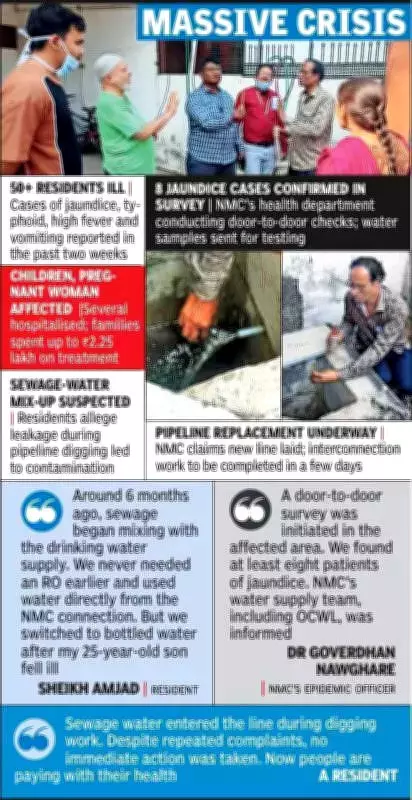
The Mankapur locality in Nagpur has been gripped by a severe public health crisis following the contamination of drinking water with sewage, resulting in over 50 residents being hospitalized with jaundice, high fever, and severe infections. What began as complaints about a foul odor has escalated into a full-blown emergency, exposing critical failures in civic oversight during ongoing pipeline work in the area.
Symptoms and Hospitalizations Mount
Residents across the neighborhood reported alarming symptoms including jaundice, persistent vomiting, high fever, and extreme weakness after consuming tap water. Anushri Parasar, a local resident, described how her two children, aged 19 and 29, were hospitalized for nearly two weeks after being diagnosed with jaundice.
"Their bilirubin levels rose alarmingly high," Parasar said. "Doctors immediately suspected contaminated water as the cause. We have already spent nearly ₹1 lakh on treatment, and one of my children is still suffering from liver swelling."

She emphasized that the crisis extends far beyond her family, noting that a four-month pregnant woman from the area has been admitted to a private hospital with similar symptoms. Additionally, a 2.5-year-old child and three daughters from another household have fallen ill, with residents recalling yellowish tap water and a "very bad smell" days before people began getting sick.
Longstanding Complaints Ignored
Sheikh Amjad, who operates a printing business in Mankapur, revealed that he had been flagging poor water quality issues for nearly a year. "Around six months ago, sewage began mixing with the drinking water supply," he explained. "We never needed a water purifier earlier and used water directly from the Nagpur Municipal Corporation connection. But we switched to bottled water after my 25-year-old son fell ill."
His son first contracted typhoid and later developed jaundice, requiring five days of hospitalization that cost the family approximately ₹60,000. Amjad added that the tap water had turned visibly yellow and emitted a foul odor, clear indicators of contamination.
Another resident, Mohammad Asif, claimed that civic workers took nearly two months to detect the leakage source. "They finally started laying a new pipeline and the water quality has improved now, but until recently almost every other household had a jaundice patient," he stated.
Delayed Response and Ongoing Work
During a recent visit to the locality, several lanes were found dug up or recently repaired, with major pipeline work near a local mosque still underway. This has left many residents dependent on packaged water or alternative drinking sources.
Residents maintained that complaints were raised as soon as the foul odor was noticed, but corrective measures were significantly delayed. "Sewage water entered the pipeline during digging work. Despite repeated complaints, no immediate action was taken. Now people are paying with their health," a resident alleged.
Official Confirmation and Medical Assessment
Dr. Goverdhan Nawghare, Nagpur Municipal Corporation's epidemic officer, confirmed that the health department received multiple complaints of residents falling ill after consuming contaminated tap water. "A door-to-door survey was initiated in the affected area. We found at least eight confirmed cases of jaundice. NMC's water supply team, including the Orange City Water Limited, was immediately informed," he said.
Dr. Nitin Wadaskar, a physician treating several patients, confirmed that symptoms are consistent with hepatitis A, which is commonly caused by contaminated water sources.
Civic Authority's Response
Responding to the allegations, NMC executive engineer for water supply, Shrikant Waikar, attributed the problem to a damaged pipeline. "We have laid a new pipeline and interconnection work will be completed in a couple of days, which will permanently resolve the contamination issue," he claimed, though residents question why action wasn't taken sooner given the prolonged complaints.

The incident has sparked widespread concern about water safety protocols and civic accountability in Nagpur, with calls for stricter monitoring during infrastructure projects to prevent such public health disasters in the future.