

Scientific Breakthrough: Ocean Signals Could Enable 3-Day Earlier Cyclone Forecasts
In a development poised to transform cyclone early-warning capabilities, groundbreaking research indicates that cyclones forming over the Bay of Bengal could potentially be predicted up to three full days earlier than existing methods allow. This significant advance stems from an innovative forecasting approach that merges traditional atmospheric monitoring with critical subsurface ocean signals, revealing that the ocean frequently provides clear precursors to cyclone formation well before atmospheric conditions become apparent.
Limitations of Current Atmospheric-Only Models
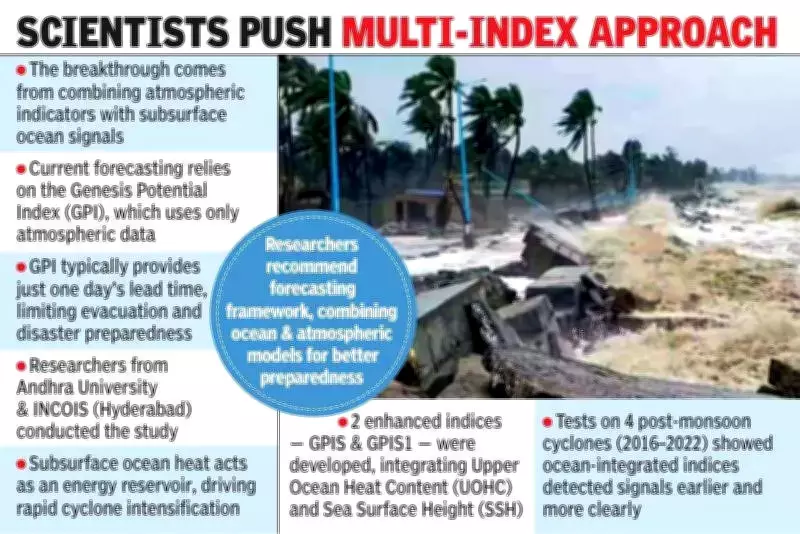
Presently, cyclone genesis over the North Indian Ocean is tracked using a Genesis Potential Index (GPI) that depends primarily on atmospheric indicators. These include wind circulation patterns, humidity levels, vertical wind shear, and temperature instability. While functional, this conventional method typically offers only about one day of lead time—sufficient for short-range alerts but critically inadequate for large-scale evacuations and comprehensive disaster preparedness in densely populated coastal regions.
The Crucial Role of Subsurface Ocean Heat
The study, conducted collaboratively by researchers from Andhra University in Visakhapatnam and the Indian National Centre for Ocean Information Services (INCOIS) in Hyderabad, identifies a fundamental limitation in existing models: the under-representation of oceanic drivers. The Bay of Bengal, which generates nearly 80 percent of North Indian Ocean cyclones, is profoundly influenced by heat stored beneath the sea surface. This subsurface heat acts as a sustained energy reservoir, enabling rapid cyclone intensification once atmospheric conditions become favorable.

Enhanced Forecasting Indices: GPIS and GPIS1
The research team—comprising Dr. P. Suneeta, Dr. TVS Udaya Bhaskar, and Dr. E. Pattabhi Rama Rao from INCOIS, along with Prof. SSVS Ramakrishna and Prof. CV Naidu from Andhra University—developed and rigorously tested two enhanced versions of the traditional GPI. While the conventional index, known as GPIK, relies solely on atmospheric parameters, the new versions—GPIS and GPIS1—integrate Upper Ocean Heat Content (UOHC) and Sea Surface Height (SSH).
UOHC measures the total thermal energy stored in the upper ocean layers, not merely at the surface. SSH rises when warm water expands, indicating deeper and more energetic warm pools beneath the surface, which are crucial for cyclone development.
Analysis of Recent Cyclones Reveals Consistent Pattern
Dr. Suneeta explained that the study analyzed four post-monsoon cyclones formed between 2016 and 2022—Kyant, Bulbul, Burevi, and Mandous—to evaluate how ocean parameters improve forecasting accuracy. Each cyclone was monitored for five days prior to its official genesis, enabling a direct comparison of how early different indices detected favorable conditions.
A consistent pattern emerged across all four cyclones. The traditional atmospheric-only index was often delayed or inconsistent, whereas the ocean-integrated indices detected early warning signals significantly sooner and with greater clarity.
"Incorporating ocean parameters into cyclone genesis forecasting represents a major leap forward for the Bay of Bengal region," stated Dr. Suneeta. "With further testing and operational integration, this approach could help India transition from short-notice cyclone alerts to earlier, anticipatory preparedness, substantially reducing both human casualties and economic losses in one of the world's most cyclone-prone regions."Methodological Advancements and Superior Performance
The study's robust methodology is central to its findings. Utilizing high-resolution atmospheric data (ERA5) and ocean data (AVISO/CMEMS), indices were calculated hourly, providing far greater accuracy than older, coarser models. GPIS enhances the traditional GPIK by adding UOHC, while GPIS1 goes a step further by including squared SSH to better capture subsurface heat effects.

Testing demonstrated that GPIS1 consistently performed best, exhibiting lower errors and stronger correlations, particularly in cyclones like Kyant and Mandous. The researchers emphasize that ocean metrics such as D26 depth, UOHC, and SSH often provide earlier signals than atmospheric indicators, especially during the post-monsoon season.
Recommendations for a Multi-Index Forecasting Framework
Cyclones are complex systems influenced by both atmospheric and oceanic processes. The study notes that some storms respond more strongly to subsurface heat, while others depend more on atmospheric instability and wind patterns. Due to this inherent variability, the researchers advocate for a multi-index forecasting framework. In this model, ocean-enhanced indices would complement existing operational models rather than replace them, creating a more resilient and accurate early-warning system.
This research marks a pivotal step toward safeguarding vulnerable coastal communities through advanced, science-driven disaster management strategies.





