

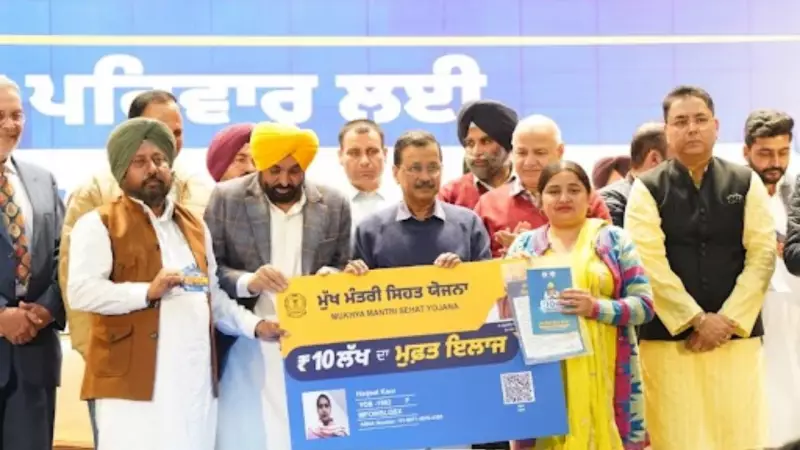
AAP Government Unveils Landmark Universal Healthcare Scheme in Punjab
In a significant development for public health infrastructure, the Aam Aadmi Party (AAP) government in Punjab has officially launched its ambitious Mukh Mantri Sehat Yojna. This universal healthcare initiative promises to provide comprehensive medical coverage to every family across the state, marking a transformative step in India's healthcare landscape.
Comprehensive Coverage for All Residents
The scheme guarantees free cashless medical treatment of up to ₹10 lakh per family, encompassing a wide range of healthcare services. Eligibility is straightforward: any resident of Punjab possessing both an Aadhaar card and a voter card can avail of these benefits. This inclusive approach ensures that approximately 65 lakh families—the entire population of the state—will be covered under this program.
Medical procedures covered under the scheme are extensive, with over 2,500 treatments included. These services will be accessible at both government hospitals and select private healthcare facilities, providing patients with flexibility and choice in their medical care.

Historic Launch Event in Mohali
The scheme was formally rolled out in Mohali on Thursday by AAP supremo Arvind Kejriwal and Punjab Chief Minister Bhagwant Mann. Addressing a gathering during the launch ceremony, Kejriwal described the occasion as "historic not only for Punjab but for the whole country." He emphasized that this initiative represents a departure from past governments, which he claimed made tall promises but failed to deliver substantial healthcare improvements over the past 75 years.
Kejriwal praised the Bhagwant Mann-led administration, stating that the "period of the past four years will be written in golden letters in Punjab's history." He highlighted the government's achievements in the healthcare sector, contrasting them with what he described as inadequate progress under previous regimes.
Expanding Healthcare Infrastructure
In his address, Kejriwal detailed the AAP government's efforts to strengthen Punjab's medical infrastructure. He reported that around 1,000 'mohalla' clinics have been established across the state in the past four years, with plans to add 500 more in the near future. Additionally, the government aims to set up 2,500 'pind clinics' in every village, significantly enhancing rural healthcare access.
Kejriwal contrasted these developments with historical data, noting that only 400 primary health centres were built in Punjab over 75 years prior to AAP's governance. He asserted that "the AAP government in the past four years did 10 times more than what the previous government had done for the state in 75 years."
Further bolstering the healthcare workforce, the government has recruited 1,100 doctors and specialists, effectively addressing previous shortages in government hospitals. Kejriwal confirmed that "now there is no shortage of doctors in government hospitals," ensuring better service delivery for patients.
Political Support and Future Vision
Chief Minister Bhagwant Mann echoed Kejriwal's sentiments, declaring the launch day as a "historic day for Punjab in the healthcare sector." He characterized the Mukh Mantri Sehat Yojna as "the biggest health scheme since independence," underscoring its scale and potential impact on public welfare.
The event was attended by prominent AAP leaders, including Manish Sisodia and Satyendar Jain, along with Punjab ministers Aman Arora and Harpal Singh Cheema. Their presence highlighted the party's unified commitment to this healthcare initiative, which is poised to set a new benchmark for state-led medical coverage in India.
As the scheme rolls out, it promises to alleviate financial burdens on families during medical emergencies, promote preventive healthcare, and improve overall health outcomes in Punjab. This move aligns with broader national goals of universal health coverage and demonstrates the AAP government's focus on welfare-oriented governance.

