

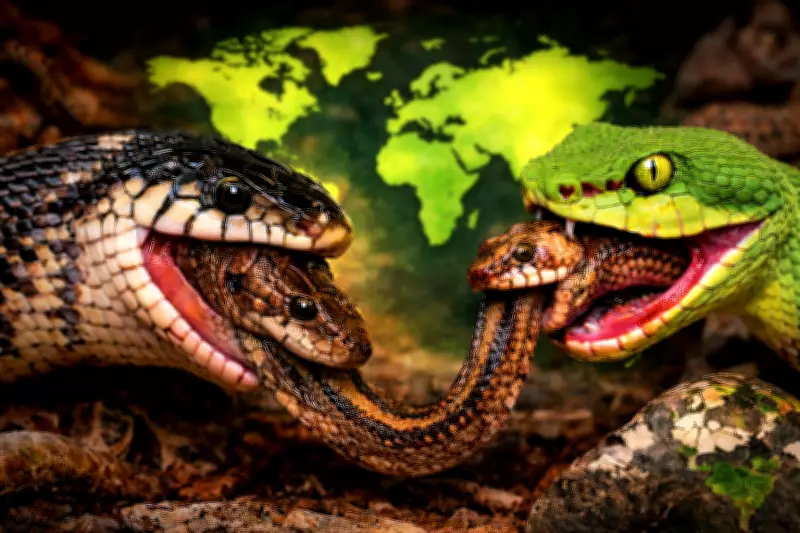
Snake Cannibalism: A Global Phenomenon Revealed by Century of Data
For decades, cannibalism in snakes has been treated as a curious footnote—mentioned in old field notebooks, brief case reports, or unexpected moments in captivity. Each individual record seemed unusual, an anomaly in reptile behavior. However, a groundbreaking large-scale review has transformed this perception by compiling observations spanning more than a century from across the globe.
Widespread Occurrence Across Continents and Families
The study documents more than 500 cannibalism events involving over 200 snake species from 15 different families. These records come from every continent where snakes are found, from tropical rainforests to temperate zones. The species involved include well-known and widely studied groups such as colubrids, vipers, and elapids.
This geographical and taxonomic breadth suggests cannibalism is not tied to any specific environment but appears wherever snakes live and feed. While nearly half of the cases occurred in captivity—where such encounters are easier to witness—a substantial number were recorded in wild settings, confirming this is not merely an artifact of artificial conditions.

Opportunistic Feeding Dominates Snake Cannibalism
In most documented cases, researchers found no clear trigger for cannibalistic behavior. The consuming snake was not guarding eggs, competing for territory, or engaging in mating rituals. Instead, it simply encountered another snake and consumed it.
These opportunistic events form the majority of records, suggesting cannibalism often represents ordinary feeding behavior extended to a familiar body shape rather than a special behavioral adaptation. When a snake can overpower another snake of suitable size, it may do so without much distinction from its regular prey choices.
Anatomical and Ecological Factors Shape Cannibal Behavior
The review reveals several key factors that influence when and how cannibalism occurs:
- Body size matters significantly—larger snakes tend to consume larger conspecifics rather than targeting only juveniles, mirroring patterns seen in other prey choices where bigger prey offers more energy but also more risk.
- Jaw structure creates a biological boundary—all confirmed cases involved snakes with highly flexible jaws capable of swallowing large prey. No cases were recorded in lineages with reduced jaw movement, such as blind snakes.
- Venom and specialized diets increase likelihood—elapids stood out particularly, where consuming another snake may not differ greatly from consuming any other elongated prey, and venom may reduce the danger of attacking a similar-sized animal.
Captivity Amplifies But Doesn't Create the Behavior
While many cannibalism events were recorded in captivity—often under conditions of stress, limited space, or food restriction—these factors likely lower the threshold for such behavior rather than creating it entirely. The same patterns occur in the wild, suggesting enclosures make the behavior easier to observe but don't fully explain its presence.
Rare Cases of Reproductive and Early Life Cannibalism
The study found that cannibalism involving offspring or reproductive contexts remains uncommon. A small number of cases involved mothers or siblings, mostly in boas and pythons, but these situations sit at the edges of the dataset rather than defining the overall phenomenon.
A Complex Behavior Without Single Explanation
Cannibalism in snakes doesn't resolve into a neat, singular explanation. Instead, it appears unevenly across species and situations, shaped by anatomy, feeding ecology, and chance encounters. It is neither exceptional nor universal—it simply occurs where conditions allow, quietly integrated into the broader patterns of snake feeding behavior.
This comprehensive review transforms our understanding from viewing snake cannibalism as anomalous to recognizing it as a widespread phenomenon that follows predictable ecological and anatomical constraints, providing valuable insights into reptile behavior and predator-prey dynamics.






