Nitish Kumar Submits Rajya Sabha Nomination Papers, Igniting Political Transition in Bihar
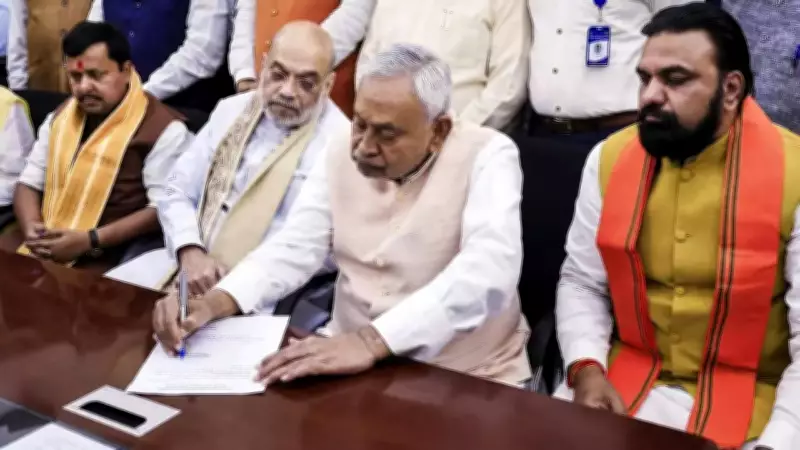
In a move that has sent shockwaves through Bihar's political landscape, Chief Minister Nitish Kumar filed his nomination papers for the Rajya Sabha on Thursday. This decision, made in the face of strong objections from his family members and significant unrest within his own Janata Dal (United) party, is widely interpreted as a clear signal that his record-breaking tenure as Bihar's chief minister is approaching its conclusion.
Family Resistance and Internal Party Turmoil
The filing process was not without its dramatic backdrop. JD(U) functionaries and close relatives revealed that the 75-year-old party president encountered intense resistance at home prior to proceeding. "Not only his son Nishant but the entire family tried to convince Nitishji right through the night so that he does not go to Rajya Sabha at this juncture, but he remained adamant on his decision," stated Nitish Kumar's brother-in-law, Anil Kumar. This familial opposition underscores the gravity of the political shift.
Simultaneously, the decision triggered immediate turmoil within the JD(U). Party workers expressed their fury by vandalizing the JD(U) office in Patna, openly accusing the BJP of orchestrating a "conspiracy" with assistance from "traitors within the party." Demonstrations and sit-in protests spread across various parts of Bihar, with supporters urging Nitish Kumar to reverse his monumental decision.
Amit Shah's Presence and Nitish's Statement
The nomination filing was a high-profile event, with Union Home Minister Amit Shah flying in from New Delhi to accompany Nitish Kumar. Shah offered glowing praise for the Bihar leader, stating, "Throughout his political journey serving as MLA, MP, CM and Union minister, Nitish Kumar has maintained an unblemished public life," and described his tenure as transformative for the state.
Approximately an hour before arriving at the assembly secretariat to submit his papers, Nitish Kumar confirmed his intent through a message on social media platform X. He expressed a long-held personal ambition, writing, "Since the beginning of my parliamentary life, I had a desire in my heart that I become a member of both Houses of the Bihar legislature as well as both Houses of Parliament. In this sequence, in the elections being held this time, I wish to become a member of the Rajya Sabha."
The Path Forward: Succession and Political Fallout
While Nitish Kumar has not yet formally resigned as Chief Minister, political circles widely expect that step to follow once the parliamentary formalities are complete. This points directly to a likely transition of power in Patna, potentially paving the way for a BJP-led government in the state.
Attention within the JD(U) has now sharply turned to Nitish Kumar's son, Nishant Kumar. Party sources indicate that Nishant is expected to formally join the JD(U) on March 8, after which his future political role will be determined. Within the ruling National Democratic Alliance (NDA), discussions have already commenced regarding the succession plan for Patna. Sources suggest that Nitish Kumar has proposed projecting a dalit face as the next Chief Minister or appointing a senior JD(U) functionary to the position of Deputy Chief Minister.
The opposition Rashtriya Janata Dal (RJD) was quick to criticize both Nitish Kumar and the BJP. RJD working president Tejashwi Prasad Yadav accused the BJP of having "done a Maharashtra in Bihar," referencing previous political maneuvers. He placed partial blame on Nitish Kumar himself, recalling, "But Nitish Kumar has only himself to blame. While in alliance, we supported him as CM despite having more MLAs, but he chose to walk away on two occasions."
In his public remarks, Nitish Kumar thanked the people of Bihar for their sustained trust and support over his nearly two-decade-long chief ministerial career, which includes ten terms beginning with his first full five-year tenure from 2005 to 2010 in alliance with the BJP. He asserted that Bihar now presents "a new dimension of development and respect." This pivotal moment marks a significant chapter in Bihar's political history, setting the stage for a new era of leadership and alliance dynamics.