

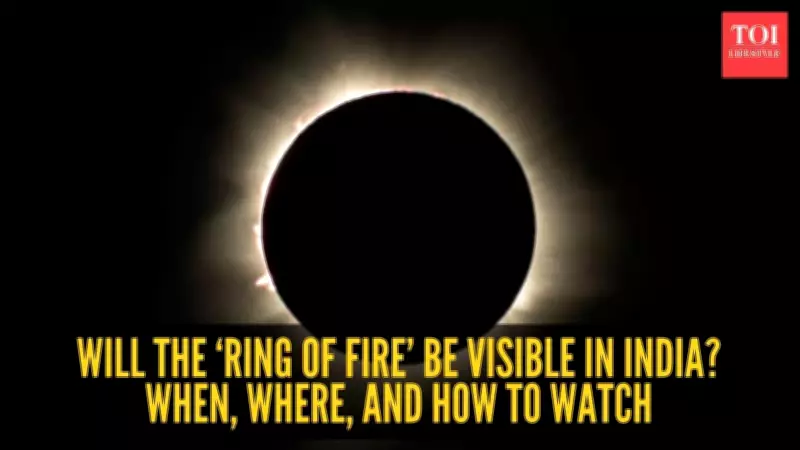
Solar Eclipse 2026: A Rare Celestial Event Sparks Widespread Curiosity
On February 17, 2026, the first solar eclipse of the year captured global attention, with online searches for terms like "Ring of Fire solar eclipse," "February 17 solar eclipse time," and "Will solar eclipse be visible in India" surging significantly. Many individuals ventured outdoors early in the day, hoping to witness this astronomical phenomenon. However, a pressing question emerged: can India observe this annular solar eclipse?
Understanding Today's Solar Eclipse
The solar eclipse on February 17, 2026, is an annular solar eclipse, a rare occurrence where the Moon passes between the Earth and the Sun but does not completely obscure the Sun, leaving a bright outer ring known as the Ring of Fire. The event commenced at 09:56 UTC, peaked at 12:12 UTC, and concluded at 07:57 PM Indian Standard Time, starting at 03:26 PM. According to a report by the Economic Times, this eclipse coincides with the Amavasya Tithi of Krishna Paksha in the month of Phalguna, falling on a Tuesday.
Visibility in India: A Clear Negative
The straightforward answer is that India will not witness this annular solar eclipse. The country lies entirely outside the Moon's shadow path, meaning no part of the eclipse, not even a partial phase, will be visible from Indian skies. Solar eclipse visibility is determined by the alignment of the Moon's shadow on Earth, and in this instance, the configuration favors the Southern Hemisphere, excluding the Indian region.

Where Can the Eclipse Be Seen?
The full annular phase of the February 17 solar eclipse is visible exclusively in Antarctica. Additionally, a partial solar eclipse can be observed in select areas of Africa and South America, as well as over extensive regions of the Pacific Ocean, Atlantic Ocean, and Indian Ocean. Unfortunately, India does not fall within any of these visibility zones.
Why Is It Called an Annular Solar Eclipse?
An annular solar eclipse differs from a total solar eclipse in a key aspect: the Moon's position blocks the Sun only partially, resulting in a luminous circle of sunlight surrounding the Moon. This distinctive feature, often referred to as the Ring of Fire, creates a stunning visual effect that captivates observers worldwide.
A Rare Event in a Remote Location
This particular annular solar eclipse presents a challenge for direct viewing, as the primary path traverses Antarctica, a remote and inaccessible region. Eclipse meteorologist Jay Anderson noted on Eclipsophile.com that "It's possible that only a few people will view this eclipse from within the annular zone... It's a challenge to reach, and there are only two inhabited locations within the annular shadow, neither of which is set up to welcome tourists." This highlights the limited opportunities for experiencing the full annular phase firsthand.
How Indians Can Follow the Eclipse
Despite the lack of direct visibility in India, enthusiasts can still engage with the solar eclipse 2026 through online platforms. Space agencies like NASA offer live streams, allowing viewers to safely watch the event from their homes, fostering digital participation and educational outreach.
Final Thoughts on the February 17 Solar Eclipse
The February 17 annular solar eclipse marks a significant astronomical milestone as the first of 2026. While the much-anticipated Ring of Fire remains invisible in India, the event continues to generate curiosity and discussion among astronomy fans. For Indian skywatchers, this day emphasizes digital engagement over direct observation, underscoring the enduring fascination with celestial phenomena across the nation.






