

Centre Proposes Major Healthcare Reforms to Kerala Government
The Central government's deregulation cell, operating under the cabinet secretariat, has formally presented two significant health-sector reform proposals to the Kerala state government. These proposals are part of Phase II of the 'Compliance Reduction and Deregulation' initiative, which is a key component of the broader ease of doing business framework.
Proposal One: Simplifying Interstate Practice for Medical Professionals
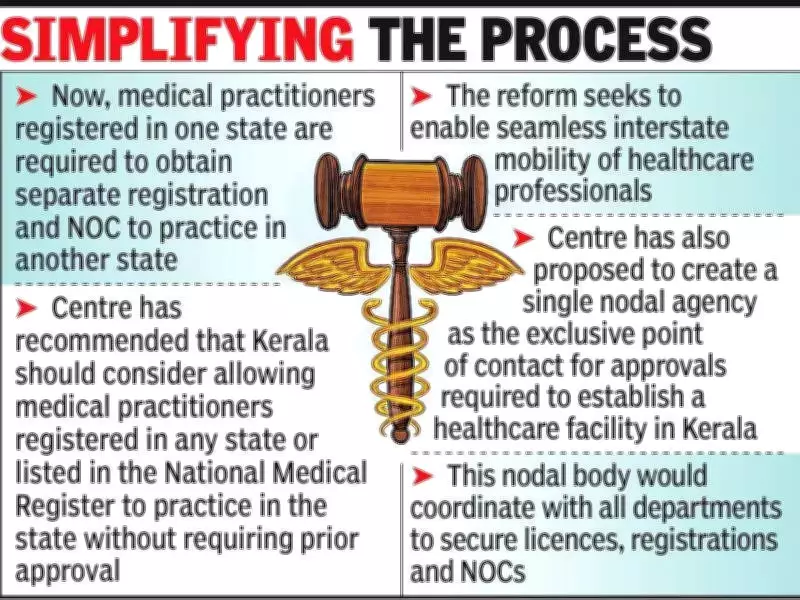
The first proposal focuses on eliminating barriers for medical professionals who wish to practice across state lines. Currently, doctors, nurses, and paramedical technicians registered in one state must undergo a cumbersome process to work in another state. In Kerala, this involves obtaining separate registration and often a No Objection Certificate (NOC) from their original state.
Kerala's existing regulatory framework includes:

- The Kerala State Medical Practitioners Act, 2021, which governs modern medicine, Indian Systems of Medicine (ISM), and homeopathy practitioners.
- The Kerala Nurses and Midwives Act, 1953, requiring registration through the Kerala Nursing Council.
- Registration for paramedical technicians through the Kerala Paramedical Council.
The Centre's recommendation is straightforward: allow medical practitioners who are registered in any state medical council or listed in the National Medical Register (NMR) to practice in Kerala without needing fresh registration or prior approval. This arrangement could operate on a self-certification basis, eliminating the need for NOCs from previous states.
This reform aims to leverage the National Medical Register framework under the National Medical Commission (NMC) to enable seamless interstate mobility of healthcare professionals.
Dr. Jobin Joseph, General Secretary of the Kerala Government Medical Officers' Association (KGMOA), expressed strong support for this proposal. He stated, "The proposal to make registration in one state valid in another can help address the critical shortage of doctors, particularly in rural and border districts. In areas such as Idukki, Palakkad, and Wayanad, it could attract more doctors registered in neighboring states. Since registrations elsewhere are granted after due diligence, there is no reason to doubt their credibility."
Implementing this change would require a policy decision by the state government and potential amendments to relevant Acts and Rules governing medical registration. Any move to eliminate the dual-registration requirement would involve legislative changes and procedural adjustments by the respective councils.
Proposal Two: Streamlining Licensing for Healthcare Establishments
The second proposal addresses the complex web of licenses required to establish and operate healthcare facilities in Kerala. Currently, healthcare establishments must navigate approvals under multiple laws and regulatory regimes, creating significant administrative burdens.
Key approvals currently required include:
- The Kerala Clinical Establishments Act
- The Drugs and Cosmetics Act
- The Biomedical Waste Management Rules
- The Pre-Conception and Pre-Natal Diagnostic Techniques (PCPNDT) Act
- The Surrogacy (Regulation) Act, 2021 and Rules, 2022
- The Assisted Reproductive Technology (ART) (Regulation) Act, 2021 and Rules, 2022
- The Food Safety and Standards Act for hospital kitchens
- Fire and safety NOCs
- Pollution control board consent
- Local self-government trade licenses
Even a standalone radiology centre may need to secure numerous clearances from different departments within and outside the health department.
To address this complexity, the Centre has proposed creating a single nodal agency within the Health and Family Welfare Department. This agency would serve as the exclusive point of contact for all healthcare-specific approvals, coordinating with relevant departments to secure licenses, registrations, and NOCs on behalf of investors.
The proposal also includes the option of onboarding a third-party private entity to manage coordination functions, with fees paid by the healthcare establishment.

Dr. Joseph added, "Creating a single nodal agency for establishing hospitals or clinics can certainly ease procedures and encourage the setting up of new clinics and smaller hospitals. This is particularly important at a time when the healthcare sector is witnessing a significant influx of corporate players."
Implementation Challenges and Next Steps
Both proposals represent significant departures from current practices and would require careful implementation. The interstate practice reform would need alignment with national frameworks while respecting state autonomy. The single licensing agency would require substantial inter-departmental coordination and possibly new administrative structures.
These reforms come at a crucial time for Kerala's healthcare sector, which faces both opportunities for growth and challenges in service delivery, particularly in underserved areas. The state government's response to these proposals will be closely watched by healthcare professionals, investors, and patients alike.





