

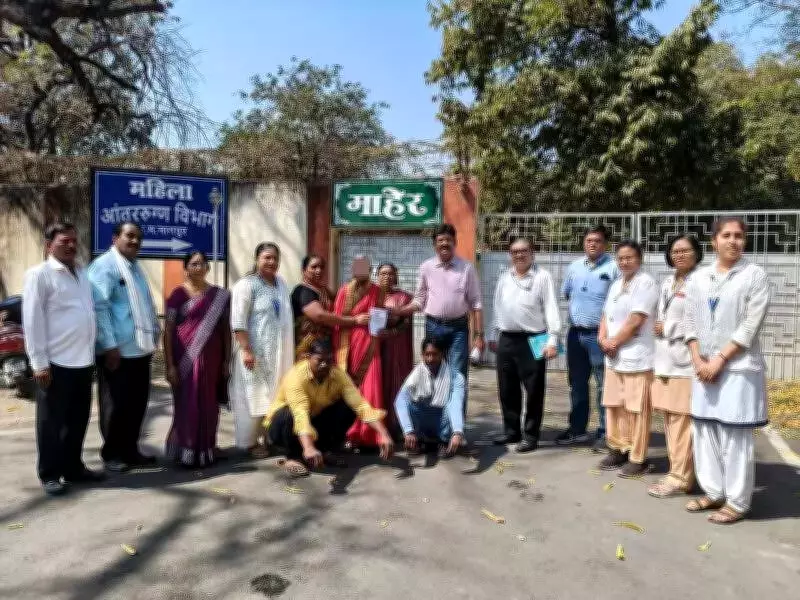
Mother Reunited with Family After 26 Years at Nagpur Mental Hospital
In a profoundly emotional scene that unfolded two days after Valentine's Day, a mother who disappeared twenty-six years ago while on her way to the Regional Mental Hospital (RMH) in Nagpur was finally reunited with her family at the very same institution. Her son, who was merely an infant when she vanished, embraced her as tears flowed freely, bringing closure to decades of agonizing uncertainty for relatives who had long feared she was dead.
The Disappearance and Decades of Uncertainty
Approximately twenty-six years ago, the woman—then a young mother—was traveling with her late husband and other relatives to RMH Nagpur for treatment when she inexplicably went missing midway through the journey. Her husband immediately filed a police complaint and conducted an exhaustive two-day search across Nagpur, but she remained completely untraceable. With no leads emerging, the family gradually lost hope over the years.
Her children were raised by relatives and eventually married, all while the haunting mystery of her disappearance lingered unresolved. The emotional toll was immense, compounded by the death of her husband fifteen years ago, who reportedly could not bear the distress of her absence.

Discovery and Identification Process
On September 17 last year, Bhandara police, acting on court orders from the chief judicial magistrate after she was produced by Warathi police station, admitted an unidentified woman—documented as an "unknown female"—to RMH Nagpur. She was in a severely deteriorated state: malnourished, physically frail, extremely disturbed, and non-communicative, often responding aggressively to questioning.
Under the care of psychiatrist Dr. Pankaj Bagde, a comprehensive treatment regimen began, including psychiatric medication, nutritional support, and round-the-clock monitoring. Social service superintendent Kunda Katekhaye Bidkar worked tirelessly to build trust with the patient through gentle, persistent interactions.
After days of effort, the woman softly uttered her name as "Koma" (name changed) and gradually shared fragments of information: "Gopiwaada, Bhandara," her parents' names, caste, and village. This breakthrough initiated a coordinated search effort.
Coordinated Search and Breakthrough
On November 13, senior police inspector Bhimaji Patil of Jawahar Nagar police station in Bhandara was contacted, but initial village enquiries yielded no results. The woman later mentioned "Barshi Takli, district Bhandara," though records indicated it actually falls in Akola district, prompting renewed efforts.
Psychiatric social worker Ashok Jadhav from Akola's district mental health programme joined the search, coordinating with local ASHA workers. Despite circulating her photograph and receiving early negative responses, persistence eventually paid off when her details were shared across the entire taluka ASHA WhatsApp group.
On February 14, a critical breakthrough occurred. Her brother contacted Katekhaye Bidkar, stating, "Madam, I am the brother of that patient. My sister went missing 26 years ago…" Within a day, relatives confirmed her identity, linking her maternal home in Barshi Takli and marital home in Akola.
Emotional Reunion and Official Reactions
On February 16, her sister, brother, son, and other relatives arrived at RMH Nagpur for the long-awaited reunion. The event took place in the presence of medical superintendent Dr. Satish Humne, deputy medical superintendent Dr. Mohbe, psychiatrist Dr. Bagde, social service superintendent Bidkar Katekhaye, matron Pratibha Mankar, and other staff members.
Dr. Humne remarked, "This is not just one patient's reunion but a reinforcement of society's trust in the mental health system. Through coordination between the judiciary, police, and health services, the impossible became possible."
Bidkar Katekhaye added, "Reuniting a mother lost for 26 years with her family is beyond words. Every patient has a family, a story, and a long wait."
Her sister expressed overwhelming gratitude, saying, "We lost hope she was alive. Seeing her after 26 years feels like a divine miracle. We are deeply grateful to RMH."

This extraordinary case highlights the critical importance of inter-agency collaboration and dedicated mental health care in resolving long-standing personal tragedies, offering a beacon of hope for other families facing similar uncertainties.





