Rajasthan's Organ Transplant Gap: Awards vs. Reality in Healthcare
Jaipur: Rajasthan has earned national recognition for its efforts in organ donation awareness, securing two prestigious awards in 2025. However, this acclaim starkly contrasts with the state's sluggish progress in improving actual transplant outcomes, revealing a significant gap between policy intentions and practical implementation.
Limited Donations Despite Recognition
Since 2025, Rajasthan has recorded a mere 12 cadaver organ donations, with only two reported in 2026. This minimal activity underscores the challenges in translating awareness campaigns into tangible results. The state's public health system has not expanded its transplant capacity meaningfully, relying heavily on limited facilities.
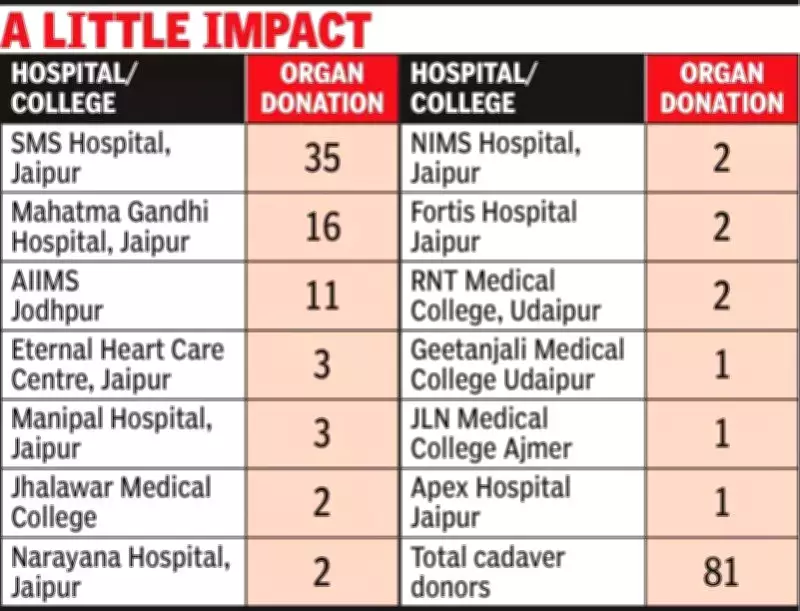
SMS Hospital in Jaipur remains the only government hospital in Rajasthan with a comprehensive cadaver organ donation and transplantation program, alongside AIIMS Jodhpur. Other government medical colleges have yet to contribute significantly, despite having available doctors. The state government has not adequately prepared these institutions, hindering both organ retrieval and timely transplantation.

Historical Data and Current Bottlenecks
Since February 5, 2015, Rajasthan has reported 81 cadaveric organ donations, yielding 286 organs and tissues. These include:
- Kidneys for 150 patients with chronic kidney disease
- 70 liver transplants
- 35 heart transplants
- 9 lung transplants
- 2 heart valves
- 2 pancreas transplants
- Corneas for 18 patients
A senior health department official stated, "We are taking measures to develop more centres for cadaver organ donation beyond Jaipur." Medical colleges in Ajmer, Kota, Udaipur, Jodhpur, and Bikaner have been developed for organ retrieval. However, retrieval alone is insufficient without transplant infrastructure.
Infrastructure Deficiencies Hamper Progress
Currently, apart from private hospitals, only SMS Hospital in Jaipur and AIIMS Jodhpur have the necessary facilities for cadaver transplants. No other government hospitals are fully equipped, creating a major bottleneck. Required infrastructure includes:
- Modular interconnected operation theatres with HEPA filters
- A separate emergency operation theatre plus two transplant theatres
- High dependency units and ICU support
- Specialised equipment and laboratory facilities
In 2025, the Centre requested detailed information from Rajasthan on transplant infrastructure and practices, including data on hospitals capable of multi-organ transplants like liver, kidney, heart, lungs, and pancreas. This highlights ongoing scrutiny of the state's healthcare capabilities.
The disparity between award-winning awareness and limited transplant outcomes calls for urgent action to bridge this gap and enhance Rajasthan's organ donation ecosystem.