

Bengaluru Oncologist's Innovation Aims to Transform Tracheostomy Care After Rural Tragedy
A preventable death in rural Karnataka has sparked a medical innovation that could save countless lives across India and other resource-limited regions. The tragic case involved a throat cancer patient from Chikkamagaluru district who suffocated in 2019 while awaiting radiation therapy, not because treatment was unavailable, but because a basic tracheostomy tube became blocked without proper suction equipment.
The Incident That Changed Everything
Dr. Vishal Rao, group director of head and neck surgical oncology and robotic surgery at HCG Cancer Centre in Bengaluru, recalls the heartbreaking case that became his turning point. The patient presented with stage 2 cancer that was completely curable through standard treatment protocols. After undergoing a routine tracheostomy procedure to address breathlessness caused by a tumor in the voice box, the patient returned home while applying for radiation therapy under the Ayushman Bharat scheme.
"A week later, when doctors called him back after the sanction came through, we were told he had died," Dr. Rao explained. The patient developed breathlessness at home when secretions thickened in his tracheostomy tube. The suction machine at the nearby primary healthcare center was non-functional, and attempts at home suctioning failed. He died during transportation to a better-equipped facility.

Exposing Critical Gaps in Rural Healthcare
This incident highlighted a devastating reality: many rural primary healthcare centers across India lack functional suction machines, making tracheostomy care nearly impossible outside tertiary hospitals. Traditional tracheostomy tubes require intensive upkeep, often needing hourly suctioning to prevent secretions from drying and forming life-threatening blockages.
"Families are typically trained to clean the tube and asked to purchase suction machines costing around Rs 5,000," Dr. Rao noted. When these machines fail or are unavailable, patients face immediate danger. The problem extends beyond India's borders, representing what Dr. Rao calls "a global challenge for low-resource regions."
Dhwani: The Indian Solution to a Global Problem
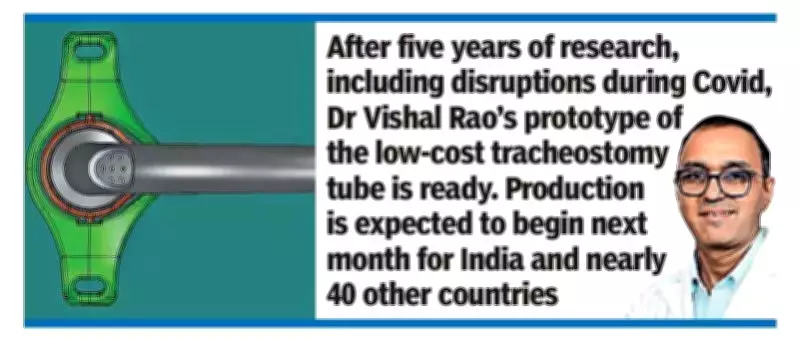
Driven by this tragedy, Dr. Rao and his team have developed Dhwani, a patented, low-cost tracheostomy tube designed specifically for Indian conditions and other similar healthcare environments. After five years of research, including disruptions during the COVID-19 pandemic, the prototype is now ready, with production expected to begin next month for distribution in India and nearly 40 other countries.
The innovation addresses multiple challenges simultaneously:
- Double-lumen design allows the inner tube to be removed and cleaned without compromising the airway
- Super-hydrophobic materials prevent secretions from sticking, eliminating the need for frequent suctioning
- Integrated speaking valve enables patients to communicate, addressing a significant quality-of-life issue
- Universal sizing developed through AI analysis of thousands of patient datasets
Affordability and Accessibility at the Core
While advanced European tracheostomy tubes exist, they cost over Rs 10,000 and create dependency on imports even in larger medical centers. "That's when we asked — why can't we design tubes suited for Indian patients?" Dr. Rao said.
The team focused on creating a solution that would be affordable, scalable, and usable in village settings. "Our aim was to make a tube that costs less than a suction machine," Dr. Rao emphasized. The economic accessibility combined with reduced maintenance requirements could transform tracheostomy care across rural India.
Speech restoration represents another crucial breakthrough, as most tracheostomy patients lose their ability to communicate. "Speech restoration has a huge impact on mental health and recovery," Dr. Rao explained, noting this feature is unique to the Dhwani invention.

Looking Toward Implementation and Impact
As production prepares to begin, the Dhwani tracheostomy tube represents more than just medical innovation—it embodies a shift toward context-appropriate healthcare solutions. By addressing the specific challenges faced in rural and low-resource settings, this Bengaluru-born invention could prevent similar tragedies while improving quality of life for throat cancer patients nationwide.
The story of Dhwani demonstrates how local challenges can inspire global solutions when approached with innovation, determination, and deep understanding of ground realities. As India continues to strengthen its healthcare infrastructure, such homegrown innovations will play a crucial role in bridging the urban-rural divide in medical care accessibility.





