Ahmedabad Dentist Completes Epic Five-Year Study of India's Dental Diversity
In a remarkable scientific endeavor spanning five years and 37,000 kilometers across 23 Indian states, a dentist from Ahmedabad has accomplished what no one has before: creating a systematic map of how teeth vary across India and what these variations reveal about a person's identity and origins.
Building India's First Comprehensive Forensic Dental Database
Dr. Jayasankar P Pillai of the Government Dental College and Hospital in Ahmedabad analyzed an astonishing 2.23 lakh teeth to construct what may be India's most comprehensive forensic dental morphology database. This groundbreaking work recently earned him a PhD from the National Forensic Sciences University and has the potential to revolutionize how India identifies victims in disasters and criminal investigations.
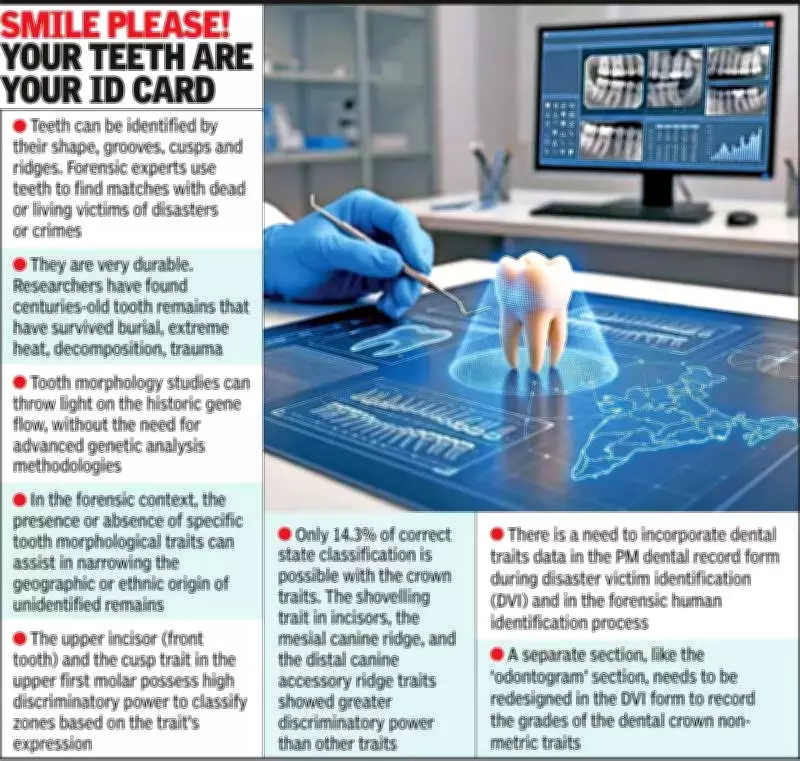
The current forensic applications of Dr. Pillai's classification method are already impressive, achieving a 36% success rate in identifying a person's specific region of origin and a 63% success rate in determining gender from dental samples alone. The researcher believes both figures can be improved significantly through the integration of artificial intelligence and an expanded database.

Addressing a Critical Gap in Indian Forensic Science
Dr. Pillai's work addresses a significant deficiency in India's forensic capabilities. Compared to many Western nations, India maintains a poor dental records database, which complicates forensic identification efforts. Investigators sometimes must resort to examining photographs of people smiling to match against dental evidence, highlighting the urgent need for more systematic approaches.
Dr. J M Vyas, vice-chancellor of NFSU and Dr. Pillai's doctoral guide, emphasized the invaluable role of teeth in disaster victim identification. "Teeth can survive for decades and centuries and serve as a reliable identification marker. Efforts are underway to establish a national dental registry," he explained, underscoring the importance of Dr. Pillai's research in this context.
Revealing Genetic Signatures in Dental Morphology
The patterns discovered by Dr. Pillai—a senior faculty member at the dental college's department of oral and maxillo-facial pathology—are both striking and scientifically significant. His research revealed that in several northeastern and northern states, people tend to have shovel-shaped incisors: front teeth whose backs feature ridges resembling the inside of a shovel.
Moving toward Gujarat and the west-south direction, molar teeth tend to exhibit more cusps—the raised parts of teeth—often reaching six or seven. These are not random variations but rather genetic signatures, markers of ancestry encoded in enamel and dentine that tell stories of migration and population history.
Methodology and International Correlations
Dr. Pillai detailed his extensive methodology: "I have worked extensively on the forensic applications of odontology over the decades and thus decided to do a systematic profiling of teeth for India. From 2020 to 2025, I collected samples from 23 states and six different geographic zones. The total analysis included 2.23 lakh teeth for their morphological traits."
The researcher assessed each sample across 15 parameters using established international dental anthropology standards, including the ASUDAS/Turner-Scott system. Some findings aligned precisely with international classifications. "The tooth morphology depends on multiple factors, but in my study, it was focused on the genetic traits. For different gene pools, we found distinct characteristics. Several also matched with the international classification," he noted.
For instance, the Cusp of Carabelli—a feature typically found on the maxillary first or second upper molar in Caucasian populations—appeared in parts of India as well. His samples also demonstrated correlations with Central Asian and Western European genetic populations, leading Dr. Pillai to observe that "our genetic history is thus etched in our teeth."

Future Applications and Database Expansion
Looking ahead, Dr. Pillai intends to continue expanding his database with the ultimate goal of making it available to agencies involved in identifying unidentified persons. This ongoing work promises to enhance India's forensic capabilities significantly, providing law enforcement and disaster response teams with more reliable tools for victim identification.
The implications extend beyond forensic science to anthropology, genetics, and public health, offering new insights into India's diverse population history while addressing practical challenges in identification that have long plagued investigators. As the database grows and incorporates AI analysis, its accuracy and utility are expected to increase substantially, potentially setting new standards for forensic dentistry worldwide.