

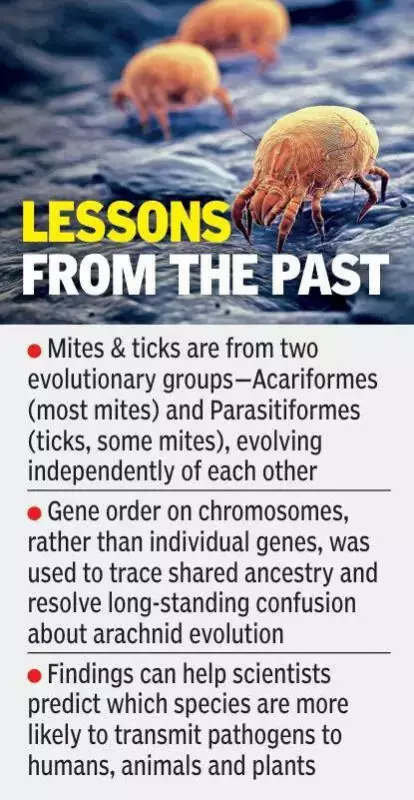
A groundbreaking genomic study conducted in Hyderabad has provided unprecedented insights into the evolutionary journey of mites and ticks. By analyzing the genetic blueprints of 90 different arachnid species, scientists have uncovered crucial patterns that explain how these organisms diversified over millions of years and developed traits that cause diseases in humans, animals, and plants.
Decoding Arachnid Ancestry Through Gene Order
The research, led by Dr. Siddharth Kulkarni, a Ramanujan faculty member at the CSIR–Centre for Cellular and Molecular Biology (CCMB) in Hyderabad, took a novel approach. Instead of examining individual genes in isolation, the team, which included three undergraduate students from the Indian Institute of Science Education and Research (IISER), Thiruvananthapuram, focused on the order of genes on chromosomes. This method, studying how gene arrangements changed over time, acted like an evolutionary clock, helping trace shared ancestry between species.
Two Distinct Evolutionary Paths Uncovered
The analysis led to a significant clarification in arachnid classification. The study confirmed that mites and ticks belong to two evolutionarily distinct groups that evolved independently from different ancestors. The first group, Acariformes, includes most mites. The second, Parasitiformes, includes ticks and some other mites. This finding resolves long-standing confusion about the relationships among these ubiquitous creatures, which are arachnids, not insects, and inhabit nearly every environment on Earth.

Implications for Predicting and Tracking Disease
While many mite and tick species are harmless, others are notorious for causing scabies, lumpy skin disease, and significant crop damage. The study's insights are vital because closely related species often carry similar pathogens. Understanding these evolutionary links allows scientists to better predict which species are likely to transmit diseases. This knowledge can enhance the tracking of disease risks, help identify potential new vectors, and ultimately strengthen early warning systems for public health, veterinary science, and agriculture.
The research underscores the power of genomics in unraveling natural history and provides a new framework for understanding the origins of parasitic behavior, offering tools to mitigate future threats posed by these tiny but impactful organisms.






