

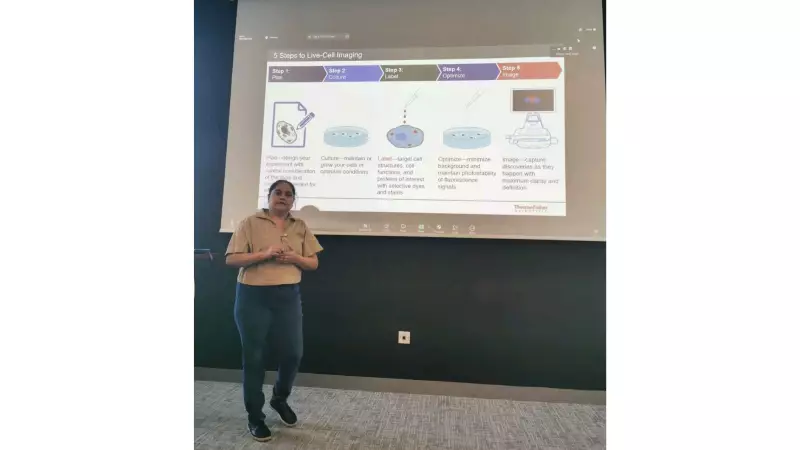
A high-level knowledge-exchange programme in Tromsø, Norway, has spotlighted the potential for cutting-edge Arctic medical technology to address critical healthcare challenges in India. The event, hosted by ProTromsø, featured a compelling presentation by Professor Krishna Agarwal, founder and CEO of Spermotile and a professor at UiT The Arctic University of Norway.
Young Indian Parliamentarians Engage with Arctic Innovation
The session gathered a significant delegation from India, including five young Members of Parliament. They were joined by representatives from UN Women and the Royal Norwegian Embassy in New Delhi. The visiting Indian MPs were Anup Sanjay Dhotre, Putta Mahesh Kumar, Sirgapoor Niranjan Reddy, Gowaal Kagada Padavi, and Priya Saroj—who, at 26, is India's youngest MP. Their visit aimed to study Norway's models in education, healthcare innovation, MSME development, and governance, with Tromsø serving as a prime example of excellence in Arctic-led innovation.
Showcasing a World-Class Medtech Research Ecosystem
UiT The Arctic University of Norway used the platform to display its rapidly growing research and innovation landscape. As a leader in medtech, Prof. Agarwal presented groundbreaking work from her lab on AI-driven optical imaging and diagnostic technologies. Her award-winning startup, Spermotile, particularly captured the delegation's attention.

The device employs AI-guided motion analysis and microfluidic engineering to revolutionize sperm selection for IVF and ICSI procedures. The Indian MPs recognized its immense potential to bridge major gaps in India's expanding fertility care sector.
An Inspiring Journey from IIT Dhanbad to the Arctic
Prof. Agarwal also shared her remarkable academic and professional path, which began with a Gold Medal from IIT (ISM) Dhanbad in 2003. She then earned a PhD from the National University of Singapore and completed a prestigious postdoctoral fellowship at the Singapore–MIT Alliance. These global experiences forged her multidisciplinary approach and led her to establish a thriving medtech research hub in the Arctic.
Today, her laboratory supports 20 researchers and has secured over €23 million in competitive grants from Norwegian and European sources—a feat applauded by the delegation. Her distinguished career includes numerous honours:
- Distinguished Alumnus Award (2020) from IIT (ISM) Dhanbad
- Marie Skłodowska-Curie Fellowship (2017–2019)
- AURORA Outstanding Fellow recognition by the Tromsø Research Foundation
- URSI Young Scientist Award (2011)
- President’s Graduate Fellowship from NUS (2008–2010)
Prior to her work in Norway, she served as a scientist at India's Defence Research and Development Organisation (DRDO), contributing to advanced active phased-array radar systems.
Strengthening Indo-Norwegian Ties in Science and Technology
The programme underscored the deepening collaboration between India and Norway in science, technology, gender equity, and sustainable development. Prof. Agarwal's interaction with India's young political leaders highlighted the value of global academic exposure and cross-border innovation. Her story powerfully demonstrated how supportive ecosystems like Tromsø's can catalyze breakthrough technologies with worldwide impact.
As India continues to scale its medtech capabilities and digital health infrastructure, such exchanges are poised to strengthen Indo-Norwegian cooperation further. They open doors for future research partnerships, technology transfer, and a sustained exchange of innovative ideas.






