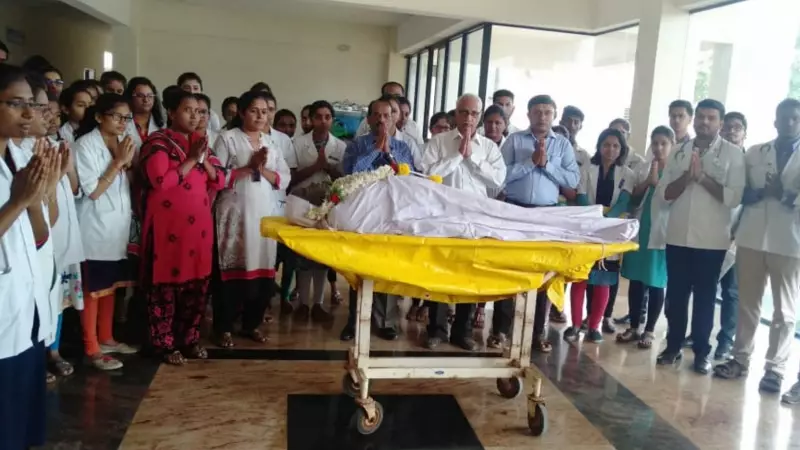
In a story of profound personal sacrifice transforming into a statewide mission, a Belagavi-based anatomy professor has become the torchbearer for body donation awareness in Karnataka. Dr. Mahantesh B Ramannavar, who made global headlines in 2010 for dissecting his own father's body to honour his last wish, has since dedicated his life to breaking down the cultural, religious, and systemic barriers that hinder such donations in India.
A Father's Will and a Son's Resolve
The journey began on November 13, 2010, when the small town of Belagavi captured international attention. Dr. Mahantesh B Ramannavar, an anatomy professor and head of the department at BM Kankanwadi Ayurveda Mahavidyalaya under KLE University, performed the dissection of his father's body. This extraordinary act was carried out in strict adherence to his father's final wishes.
"Following my father's death and his wish, I found my purpose in life – which is to create awareness about body donation," Dr. Ramannavar stated. He faced immense opposition, with only his mother's support. "Other than my mother and me, no one was in a situation to digest the fact that a son would be dissecting the body of his father. There were religious beliefs and social stigma around it," he recounted. Inspired by English physician William Harvey, who had dissected his sister's body, Dr. Ramannavar approached the task professionally, stating, "the moment I entered the dissection room, it was just another dead body."

Bridging the Critical Gap in Medical Education
Dr. Ramannavar's mission is rooted in his own struggles as a Bachelor of Ayurveda, Medicine and Surgery (BAMS) student. He recalled a severe shortage of cadavers for practical dissection. "During those days, we were forced to conduct dissections of those bodies that had already been dissected by seniors. There was little awareness among the public about body donation," he explained.
This scarcity had led to a disturbing grey market. Handlers would supply unclaimed bodies from cities like Hyderabad or Mumbai to medical colleges, demanding exorbitant sums of Rs 1.5-2 lakh over the government fee. This experience cemented his understanding of the critical need for ethical and accessible body donations for medical teaching and research.
Today, the Dr Ramannavar Charitable Trust, which he heads, stands as a testament to his efforts. The trust has successfully registered over 5,000 body donations and facilitated the transfer of more than 200 bodies to medical colleges across Karnataka.
Overcoming Stigma with Spiritual Support
Understanding the deep-seated "cultural and religious beliefs, systemic challenges, fear and mistrust" that deter donations, Dr. Ramannavar adopted a unique strategy. He sought the help of heads of various mutts (monastic institutions). "As body donation has a cultural and religious baggage, I sought the help of the mutts. During a discourse, they provided me the opportunity to speak about body donation. Thereafter, the registrations for body donations increased in the state," he said.
This outreach yielded remarkable results. In one standout instance in 2017, an entire village showed overwhelming support. 108 people from Shegunasi village in Athani Taluk of Belagavi district registered for the body donation program with his Trust. "Among those registered, about 20 people have died, and their bodies were donated promptly to the medical college," Dr. Ramannavar noted.
The Trust ensures every donated body is treated with utmost respect and dignity. Medical students are required to garland the donor and hold a special prayer session before taking the body to the dissection hall, a rule that helps alleviate families' concerns.
A Call for Systemic Government Intervention
Despite the successes, Dr. Ramannavar highlights persistent systemic flaws. He points out the lack of a coordinated network. "The body of the deceased person must be handed over within six hours of the death, and there is no guidance from anyone. Even those who are willing to donate their bodies don't know whom to approach. There is no bridge between them and the hospitals," he explained.

He appeals for larger government involvement to create a streamlined system. "If there are excess bodies in a medical college, it refuses to take more bodies, but there might be a shortage in some other medical colleges. The government needs to bridge the gap," he urged. His Trust currently acts as this vital bridge, helping families of registered donors connect with medical colleges in need.
From a personal act of fulfilling a father's will, Dr. Mahantesh B Ramannavar's crusade has ignited a movement, transforming societal attitudes and saving medical education in Karnataka from a critical shortage, one pledged body at a time.