

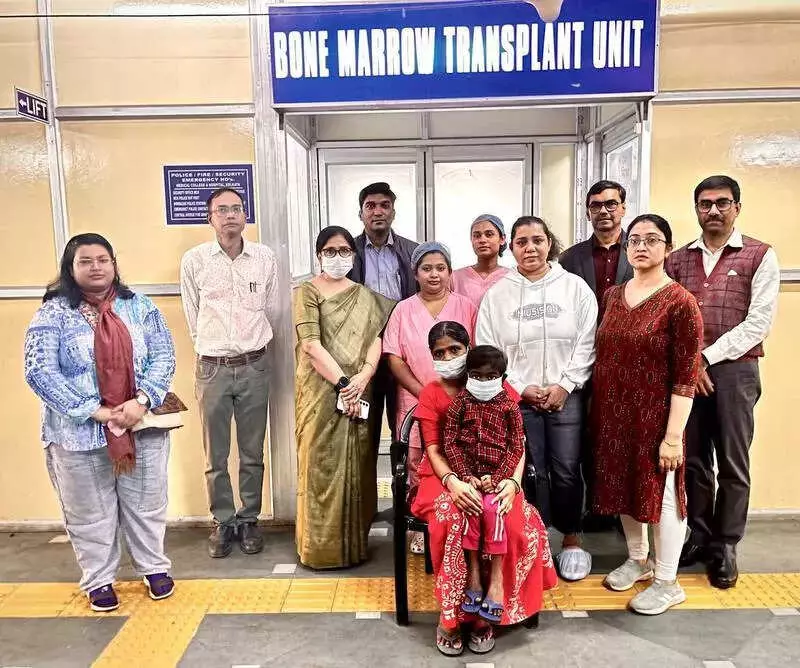
Kolkata Hospital Achieves Breakthrough with First Half-Matched Stem Cell Transplant for Thalassaemia
In a significant medical milestone, the Medical College Hospital Kolkata (MCH) has successfully performed a haploidentical haematopoietic stem cell transplantation on a 4-year-old boy suffering from thalassaemia. This groundbreaking procedure, conducted at the state-run medical college's Institute of Haematology and Transfusion Medicine (IHTM), marks the first such half-matched transplant for a thalassaemia patient at the institution.
Patient's Journey and Medical Challenge
The young patient, hailing from a village in Kulpi, was diagnosed with transfusion-dependent thalassaemia when he was just six months old. This condition necessitated monthly blood transfusions, creating a continuous ordeal for the child and his family. While a fully matched stem cell transplant is typically preferred for curative treatment, doctors at IHTM faced a critical challenge: the boy had no sibling who could serve as a matched donor.
In this situation, the boy's father stepped forward as a donor. Although only half HLA-matched, his willingness to donate stem cells provided the crucial opportunity for the life-changing procedure. This approach demonstrates how haploidentical transplants can expand access to curative treatments for patients who lack fully matched sibling or unrelated donors.

Complex Medical Procedure and Multidisciplinary Team
Haploidentical transplants are notably more complex than procedures using stem cells from fully matched donors. To ensure success, MCH assembled a dedicated multidisciplinary team comprising experts from various medical specialties. The team included doctors Maitreyee Bhattacharyya, Sumit Mitra, Habeeb Naseem, and Kajori Nandy from the department of clinical haematology; Prasun Bhattacharya and Chikam Maity from transfusion medicine; and Subrata Chatterjee and Sattwik Basu from radiotherapy, supported by comprehensive nursing and care staff.
The transplant procedure was conducted a little over three months ago, after which the medical team maintained careful monitoring of the patient's progress. Doctors reported successful engraftment with stable blood counts and no further transfusion requirements, indicating the procedure's effectiveness in ending the child's dependence on regular blood transfusions.
Significance and Accessibility of Treatment
This successful haploidentical transplant represents an important advancement for thalassaemia patients without matched donors. A medical professional involved in the case emphasized that this approach significantly expands access to transplantation, as stem cells can be donated by either parent when fully matched siblings or unrelated donors are unavailable.
The achievement also reflects MCH's growing expertise in advanced stem cell transplant techniques and its robust supportive care infrastructure. Currently, MCH and NRS Medical College are the only two government hospitals in West Bengal equipped with bone marrow transplant units. While NRS Medical College was the first to establish such a unit and has conducted half-matched transplants previously, IHTM has now performed approximately 150 stem cell transplants overall.
Financial Accessibility and Future Implications
Notably, the procedure was provided free of cost at MCH, with government funding covering the expenses. This stands in stark contrast to private sector hospitals, where similar treatments can cost around Rs 50 lakh. The patient's father, a farmer by profession, would have faced insurmountable financial barriers in the private healthcare system.
Medical authorities view this successful case as reinforcing their mission to make curative therapies both accessible and safe for all patients. IHTM has committed to continuing the strengthening of its stem cell transplant programme, with particular focus on thalassaemia treatment, offering renewed hope to patients and families seeking definitive medical solutions.
The young patient is now fit to return home, weeks after the transplant, while his father had been discharged earlier. This medical breakthrough not only transforms one child's life but also establishes a new treatment pathway for countless thalassaemia patients across the region who previously had limited options for curative care.






