

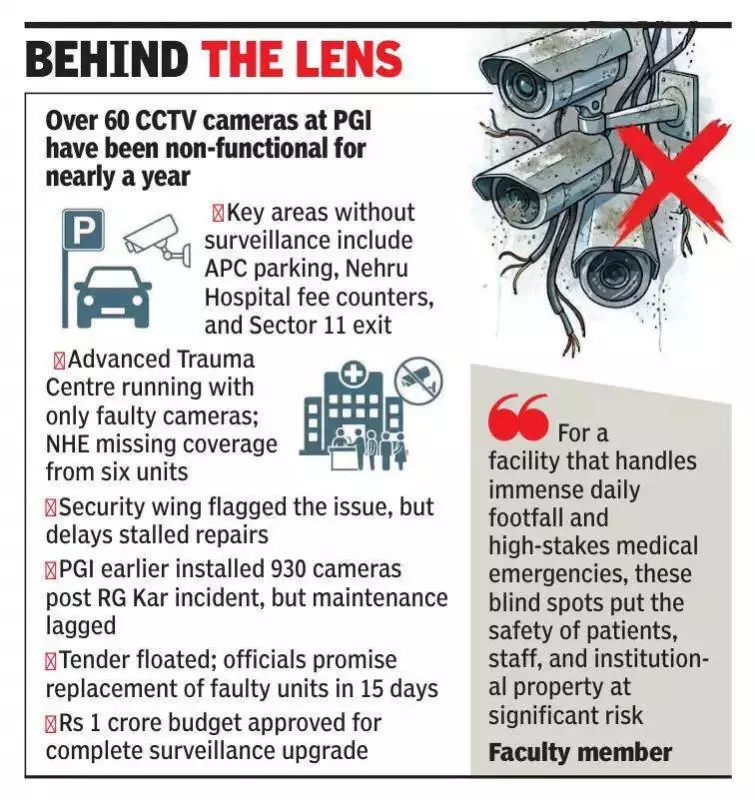
The security infrastructure at the prestigious Post Graduate Institute of Medical Education and Research (PGI) in Chandigarh has suffered a major breakdown. For nearly a year, more than 60 CCTV cameras have been completely non-functional, plunging critical areas of the hospital campus into a surveillance blackout. This alarming lapse persists despite repeated warnings and poses a direct threat to the safety of patients, staff, and valuable hospital property.
Key Areas Left Unmonitored in High-Footfall Zones
The list of locations now operating as surveillance blind spots is deeply concerning. The parking area of the Advanced Pediatric Centre (APC), the busy fee counters at Nehru Hospital, and the crucial Sector 11 exit point are all without any camera coverage. The situation is equally dire at the Advanced Trauma Centre, which is limping along with only eight cameras, all of which are reportedly faulty. Furthermore, the constantly active Nehru Hospital Extension is missing surveillance from six camera units.
These are not back-office corridors; these are zones with some of the highest patient and visitor footfall in the institute. "For a facility that handles immense daily footfall and high-stakes medical emergencies, these blind spots put the safety of patients, staff, and institutional property at significant risk," a concerned faculty member highlighted, speaking on the condition of anonymity.

A Tragic History and Bureaucratic Delays
This security failure is a chilling echo of a past tragedy. In late 2023, a 24-year-old woman admitted to the gynaecology ward died after an imposter posing as a nurse injected her with a toxic substance. The investigation into that horrific case was severely hampered because the ward's CCTV cameras were not working, having malfunctioned after a fire.
Following that incident and a similar brutal case at RG Kar Medical College in Kolkata, PGI had pledged a major overhaul of its electronic surveillance. A total of 930 high-resolution cameras were installed initially, but the momentum for maintenance quickly fizzled out. The security wing had urgently flagged the current breakdown to the hospital's engineering department, but bureaucratic delays have allowed the critical gaps to persist for over twelve months.
Promises of Repair and Questions of Accountability
Facing scrutiny, PGI officials now state that a tender has been floated to address the issue. They promise that the faulty cameras will be replaced within the next 15 days. In a broader move, the administration has also approved a budget of Rs 1 crore for a complete upgrade of the entire surveillance network.
However, these assurances ring hollow for many within the institution who have witnessed the year-long inertia. "The year-long delay in addressing basic security infrastructure raises serious questions about accountability and whether the administration has truly learned any lessons from the tragedies of the past," remarked another faculty member.
The prolonged neglect of such a fundamental safety system in a premier medical institute underscores a dangerous gap between policy and implementation. While funds are now being allocated, the real test will be in sustained maintenance and a genuine institutional commitment to never again allow such security voids to endanger lives.






