

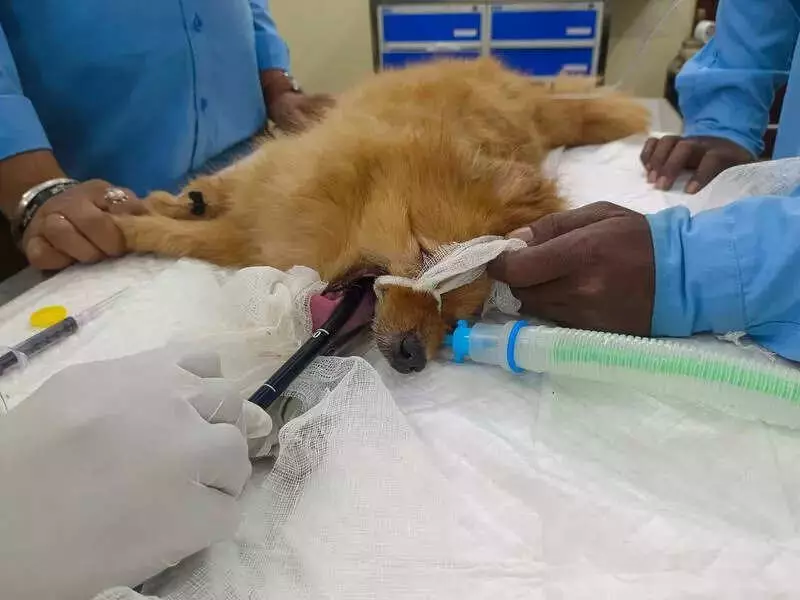
A beloved 10-year-old Pomeranian dog in Kolkata faced a life-threatening situation after a fish bone got stuck in its throat for nearly a full day. The pet, named Dodo, underwent a successful non-invasive surgical procedure to remove the obstruction, bringing relief to its worried family.
A Family's Agonizing Wait
Subhankar Chakraborty, a resident of Dum Dum, was feeding his pet dog Dodo cooked Catla fish when the incident occurred. The dog gulped down a part of the central bone, which became lodged in its throat. Dodo immediately faced difficulty eating and was clearly in pain. "We waited for a day, hoping the bone would descend into her stomach," said Chakraborty. However, their hopes were dashed when the bone remained stuck.
The family, who adopted Dodo when she was just 40 days old in 2015, grew increasingly concerned. "Dodo is agile and playful by nature, but she became very quiet," Chakraborty recounted. The strong bond they shared made the situation distressing. "She is our family member, and we were worried as she struggled to eat or drink water." The next day, they rushed Dodo to the government veterinary hospital in Belgachhia.

Medical Decision for a Senior Pet
At the state-run hospital, doctors first conducted an X-ray to confirm the issue. Their initial attempt involved removing the bone using a prong-line instrument without surgery. However, Dodo, given her age, was treated with the care of a 'senior citizen'—a crucial consideration as the typical lifespan for a Pomeranian is 12 to 16 years, with some even living up to 20.
"The dog was refusing to keep its mouth open for long, so we advised surgical removal," explained a doctor from the hospital. While the facility conducts general surgery, the team was concerned about the risks associated with stitches and post-operative care for an older pet. This led them to opt for a safer, advanced alternative.
The Non-Invasive Solution
To minimize risk and ensure a smoother recovery, the vets decided on an endoscopic foreign body removal procedure. This non-invasive technique was performed at a private facility in south Kolkata. A surgeon from the Animal Health Pathology Lab detailed the process: "We applied gas to make the pet senseless and then inserted a tube to remove the bone. The entire procedure took about half an hour."
The choice of endoscopy proved to be the right one. It allowed for a precise removal without the need for major incisions or the complications that can follow traditional surgery. The successful operation meant Dodo could avoid a prolonged and painful recovery period.
A Happy Ending and Historical Breed
The outcome was a tremendous relief for Dodo's family. "Dodo is fine after the surgery and has resumed eating fish," Chakraborty happily reported. The incident highlights the advanced veterinary care available for pets in urban India and the deep emotional connection families share with their animal companions.
Interestingly, the Pomeranian breed, a descendant of the German Spitz with a history tracing back to the 18th century, has long been favored by royalty. Experts note that even Queen Victoria owned a small Pomeranian, a testament to the breed's enduring appeal as a companion animal.






