

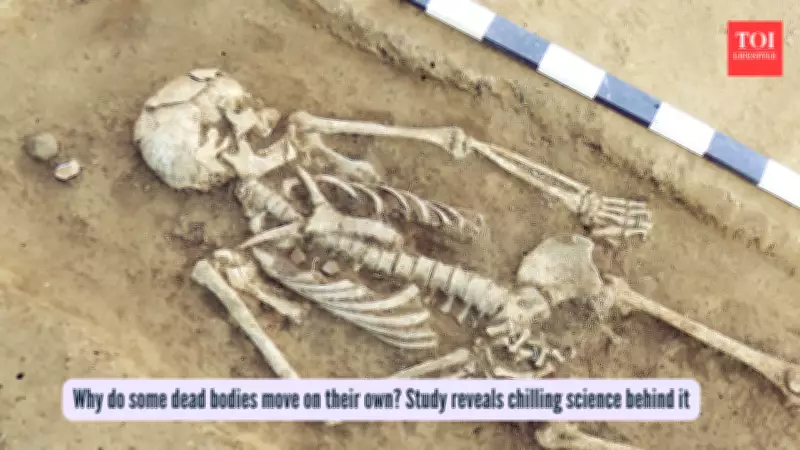
Groundbreaking Study Reveals Human Bodies Can Move After Death During Decomposition
Death has consistently ignited humanity's most profound curiosities. What truly occurs when the heart ceases to beat? Research continues to peel back layers of this enduring mystery, revealing that the human body may not be entirely inert after its final breath.
Bodies Move After Death: Study Challenges Forensic Assumptions
Researchers have made a startling discovery that human remains can shift positions autonomously during the decomposition process, even without interference from animals or people. This finding directly challenges the common forensic assumption that a body's discovered pose matches its position during the final stages of life.
Alyson Wilson from Central Queensland University led this pioneering study, published in Forensic Science International: Synergy. The research utilized time-lapse imaging at Australia's AFTER body farm, where scientists tracked the complete breakdown of a donated mature male body over seventeen months. The team meticulously ruled out external factors by protecting the site from scavengers.

What the Findings Reveal About Post-Mortem Movement
The body initially rested with arms positioned by its sides, but researchers observed the arms swinging outward dramatically as decomposition progressed. "We believe these movements relate directly to the decomposition process, as the body mummifies and ligaments gradually dry out," Wilson explained to Agence France-Presse.
The natural shifts occur at specific decay stages when drying tissues and relaxing ligaments create these unexpected movements. This phenomenon represents a significant breakthrough in understanding post-mortem physiology.
How This Discovery Transforms Forensic Investigations
This research dramatically improves estimates of how long ago death occurred, which proves crucial for solving crimes. Investigators traditionally sketch crime scenes, document body positions, and analyze nearby evidence to reconstruct events. "They map the crime scene, the victim's body position, and any physical evidence found to understand the cause of death," Wilson elaborated.
Recognizing movements caused by natural decay helps forensic teams avoid misinterpreting them as evidence of struggle or attack. This prevents critical investigative errors that could derail criminal cases.
The Importance and Applications of This Phenomenon
Facilities like the AFTER body farm systematically examine how bodies decompose in various environments to enhance real-world forensic practices. This study connects directly to Wilson's time-lapse research aimed at achieving more precise time-of-death estimates.
The research team believes this represents the first study to directly link body position changes to specific decomposition stages. These subtle pieces of information empower forensic teams to distinguish natural post-mortem changes from those caused by external interference.
Investigators now possess improved methodologies to avoid common mistakes, such as interpreting flung arms as evidence of physical conflict. As Wilson emphasizes, connecting these positional shifts to decay timelines makes criminal investigations significantly sharper and more reliable.
The implications extend beyond crime scene analysis to broader forensic science applications, potentially influencing how death investigations are conducted worldwide. This research represents a paradigm shift in our understanding of what happens to the human body after death, providing investigators with more accurate tools for reconstructing events and delivering justice.






