Mental Health Experts Applaud NIMHANS Expansion But Flag Critical Gaps in National Programme
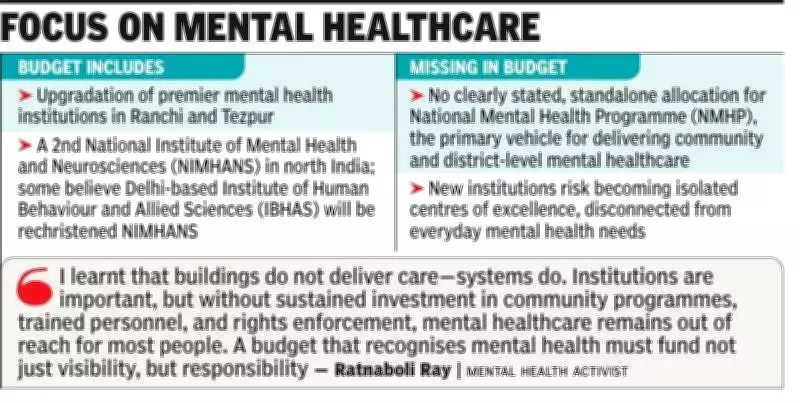
Mental health professionals in Kolkata have expressed a mixed reaction to recent budgetary proposals concerning mental healthcare infrastructure in India. While they appreciate the planned establishment of a National Institute of Mental Health and Neurosciences (NIMHANS) in north India and the infrastructure upgrades for facilities in Tezpur and Ranchi, they have raised significant concerns about the absence of a strengthened national and district-level mental health programme to address grassroots issues.
Risk of Isolated Excellence
Clinical psychologist and mental health activist Ratnaboli Ray issued a stark warning. She cautioned that these new and upgraded institutions risk becoming isolated centres of excellence, disconnected from the everyday mental health needs of the population. This danger, she emphasized, stems from the lack of a standalone, substantial allocation for the National Mental Health Programme (NMHP), which is the primary framework for delivering community and district-level mental healthcare across the country.
"For most Indians, mental healthcare does not begin at national institutes. It begins at primary health centres, district hospitals, and community services," Ray pointed out, highlighting the foundational gap in the current approach.

Call for a Balanced Approach
Echoing this need for a comprehensive strategy, psychiatrist Aniruddha Deb stressed the importance of equilibrium. "One needs a fine balance between developing centres of excellence and setting up district-level clinics for people suffering from mental health issues," he stated. This sentiment underscores the experts' view that high-level institutes must be complemented by accessible local services to create a truly effective mental healthcare ecosystem.
The High Cost of Neglect
Prasanta Roy, an assistant professor at the Institute of Psychiatry, provided a sobering economic and social perspective. He pointed out that if one studies the number of productive years lost due to mental health issues in India, it would rank higher than most other ailments. "For severe mental illness, the productivity loss is long-term. There is scope to prevent mental illness, but most of the stress is on treatment post-illness," he explained, advocating for a greater focus on preventive measures within the healthcare framework.
Societal and Governance Implications
The experts collectively noted that weak community mental healthcare has profound societal repercussions. It shifts the burden of care onto families, with women disproportionately affected, leading to increased unpaid care work and a reduction in female labour force participation.
Furthermore, there is a critical governance dimension to this funding preference. Capital expenditure for building institutions is highly visible and finite. In contrast, programme expenditure for ongoing community services is less visible, requires continuous funding, and demands greater accountability. Ratnaboli Ray added a pointed observation on this dynamic: "Prioritising institutions over programmes shifts responsibility to states and families, while limiting the Centre's exposure to rights-based scrutiny under existing laws."
In summary, while the budgetary moves to establish new institutes are seen as a positive step, mental health advocates from Kolkata argue that without parallel, robust investment in the National Mental Health Programme to strengthen district and community-level care, the overall strategy remains incomplete and risks failing to meet the nation's vast mental health needs at the most crucial point of access.