

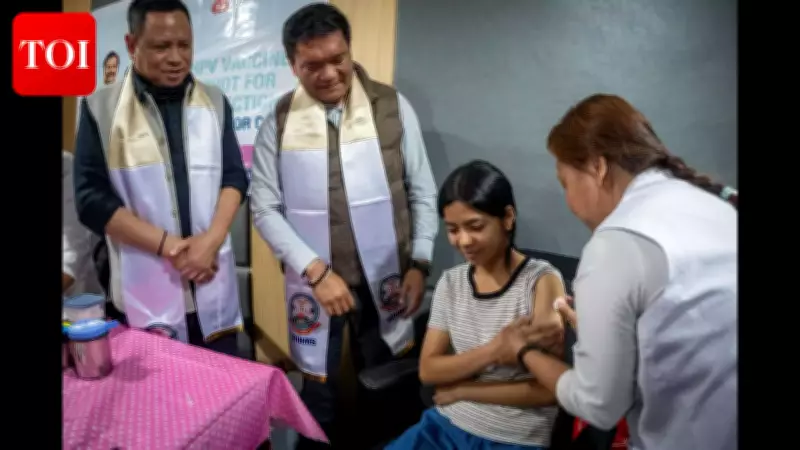
Arunachal Pradesh and Nagaland Join National HPV Vaccination Drive
In a significant public health initiative, Arunachal Pradesh and Nagaland have officially launched the Human Papillomavirus (HPV) vaccination program, aligning with Prime Minister Narendra Modi's nationwide rollout from Rajasthan. The program aims to protect adolescent girls from cervical cancer, a leading cause of cancer-related deaths among women in India.
Arunachal Pradesh Inaugurates Vaccination at Tomo Riba Institute
On Saturday, Arunachal Pradesh Chief Minister Pema Khandu, accompanied by Health Minister Biyuram Wahge and senior officials from the Health and Family Welfare Department, inaugurated the state-level vaccination drive at the Tomo Riba Institute of Health and Medical Sciences. The event marked the formal commencement of the program targeting girls aged 14 to 15 years.
In his address, CM Khandu hailed the initiative as "a very significant programme" and "another milestone under PM's leadership." He extended heartfelt congratulations to the women and girls of Arunachal Pradesh, stating, "Today's launch marks an important step towards securing their health and future."

Khandu highlighted the severe impact of cervical cancer, citing 2024 statistics that show nearly 78,500 new cases and 42,000 deaths annually in India. He emphasized, "These were not just statistics. They were mothers, sisters and daughters," noting that 99.7% of cases result from persistent HPV infection.
Reassuring participants about vaccine safety, Khandu shared a personal anecdote: "There is no need to be nervous. I too have a daughter, and she has already taken the HPV vaccine. It is absolutely safe." The state has set a target to vaccinate 19,500 girls in this initial phase within three months to ensure prompt central funding.
Nagaland Conducts Virtual Launch in Kohima
Simultaneously, Nagaland Chief Minister Neiphiu Rio led a state-level virtual launch of the HPV vaccination program against cervical cancer at the Naga Hospital Authority in Kohima. This coordinated effort underscores the regional commitment to combating this preventable disease through vaccination.
The program is part of a broader national strategy to reduce cervical cancer incidence, leveraging vaccination as a key preventive measure. Health officials in both states are mobilizing resources to ensure widespread awareness and accessibility for eligible girls.
With cervical cancer being highly preventable through timely vaccination, these launches represent a proactive step towards improving women's health outcomes in northeastern India. The initiatives are expected to pave the way for similar programs across other states, contributing to national health goals.






