

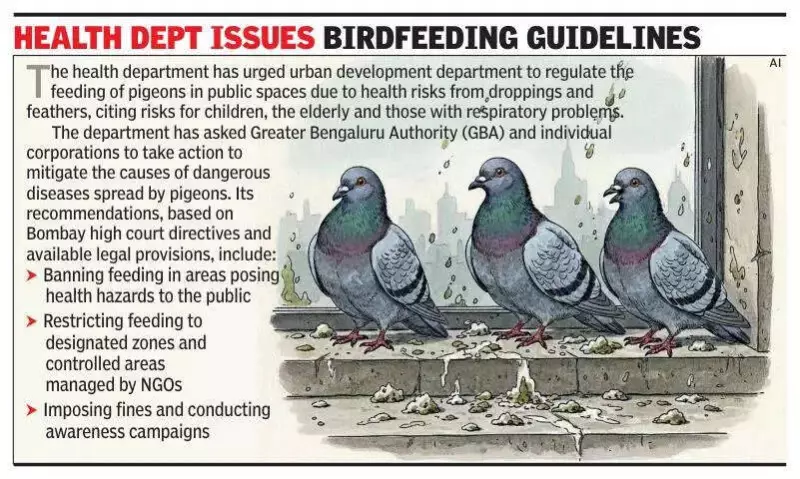
In Bengaluru, a stark contradiction is unfolding between official government statements and the grim reality witnessed in medical clinics regarding the city's pervasive pigeon population and its impact on public health.
Government Denies Any Recorded Pigeon-Linked Infections
Deputy Chief Minister and Bengaluru Development Minister DK Shivakumar recently addressed the issue in the ongoing legislature session. In his reply to a query, he stated that no reports of respiratory diseases related to pigeons have been recorded among the public within the limits of Bengaluru's municipal corporations. He further clarified that the civic bodies do not provide food to pigeons and that the government has no plans to emulate cities like Mumbai, Pune, and Thane by banning the feeding of pigeons in parks and public spaces.
Doctors Paint a Very Different Clinical Picture
Contrary to the government's stance, pulmonologists across Bengaluru are reporting a significant and worrying increase in pigeon-related respiratory illnesses. Dr. Anusha CM, Consultant in Respiratory Medicine at Manipal Hospital, Malleswaram, revealed that cases which were rare just two years ago have now become routine in her practice.

"Patients with long-standing frequent coughing, breathing difficulties, and chest congestion often test positive for pigeon-related illnesses," Dr. Anusha explained. She noted that specific blood tests show antigens or antibodies against such infections, and skin prick tests confirm pigeon-related allergies. Apartment dwellers and office-goers in high-rise buildings are particularly susceptible, as these structures tend to host larger pigeon populations.
Severe Health Consequences and a Case Study
The initial symptoms often mimic common ailments like cough, allergic rhinitis, or asthma. However, doctors warn that prolonged exposure to pigeon feathers and droppings can lead to a severe lung condition called hypersensitivity pneumonitis. This can progress to lung fibrosis, where the lungs stiffen and shrink, severely impairing breathing function.
"Treatment often requires long-term care, and some patients may eventually need home oxygen support," said Dr. Pragati Rao D, HOD & Consultant in Pulmonology at Ramaiah Memorial Hospital.
Illustrating the critical link, Dr. Sachin Kumar, Director of Pulmonology & Critical Care Medicine at Sakra World Hospital, shared a recent case. A 35-year-old man living in an apartment complex developed a persistent cough and shortness of breath, which worsened when he worked from home. The building had a pigeon infestation on its vacant upper floors. A CT scan revealed interstitial lung disease. Significant improvement only occurred after identifying the source, thoroughly cleaning the areas, and taking steps to prevent pigeon nesting.
Doctors also emphasize that the risk is not limited to those living near infestations. Even individuals who voluntarily feed pigeons are at risk of developing these infections and allergies.






