

For countless families in Bhopal, the simple act of turning on a tap is a gamble with their health. Officials have admitted a shocking reality: in many parts of Madhya Pradesh's capital, there is no proper system to keep sewage away from the pipelines that carry clean drinking water. This fundamental failure in urban planning has created a persistent public health hazard.
A Design Mandate Impossible to Implement
Udit Garg, the City Engineer of Bhopal Municipal Corporation (BMC), outlined the ideal solution. As per standards set by the Central Public Health and Environmental Engineering Organization (CPHEEO), sewer lines should run down the middle of roads with drinking water lines on the sides, maintaining a minimum separation of 300 mm. However, Garg concedes that in numerous older areas of the city, implementation is now impossible. "In many areas where drinking water pipelines run, there's simply no space to separate them from sewers," he stated. The civic body's current strategy relies on monitoring water quality and responding urgently to leaks.
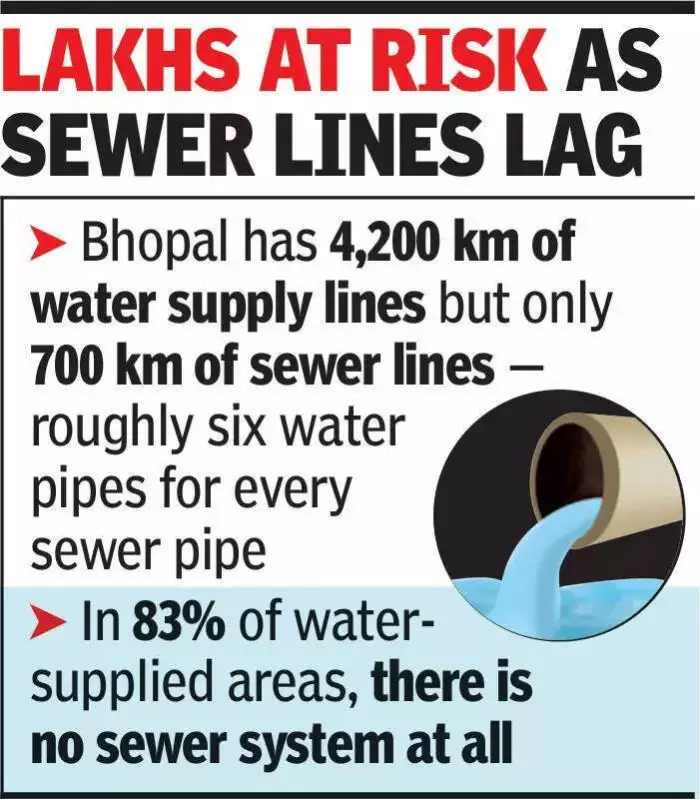
The scale of the problem is staggering. Bhopal boasts an extensive network of approximately 4,200 kilometers of water supply lines, reaching nearly every household. In stark contrast, the city has only about 700 kilometers of sewer lines. This translates to a ratio of six water pipes for every single sewer pipe. The consequence is dire: in 83% of the water-supplied areas in Bhopal, there is no sewer system whatsoever.

Broken Coordination and Expanding Slums
The administrative response to contamination events is fragmented and ineffective. When drains overflow or sewers clog, the water supply department lacks the authority to act. The responsibility falls to BMC's civil engineering wing, which coordinates with the Swachh health department for cleanup. Permanent fixes for sewer blockages are rare. Crucially, after repairs are completed, the civil wing does not synchronize with water testing laboratories to verify if the water quality has been restored, leaving residents wholly dependent on the diligence of contractors.
This crisis is rooted in decades of unplanned expansion. Bhopal has grown for almost 30 years without an updated master plan. A study by Barkatullah University documented the direct consequence: in slums across BMC zones 1, 2, 3, 7, and 14, "the drainage system and water supply system are passing through the same channel." This makes around 6 lakh (600,000) slum residents particularly vulnerable to waterborne diseases.
AMRUT 2.0: A Partial Solution to a Vast Deficit
Hope is pinned on the central government's AMRUT 2.0 scheme, which has sanctioned projects worth Rs 831 crore for Bhopal. The plan includes adding 700 km of new water pipes and about 666 km of sewer lines. While this is a significant investment, experts point out it will still leave a massive sewerage deficit of 2,534 km. Even after this expansion, the sewer network will cover only 27.9% of the water network's length, far short of the ideal 40-60% sewage coverage required for a safe city.
Officials acknowledge that until the infrastructure gap is closed, constant vigilance is the only interim measure, and the problem is poised to worsen with the city's growth. For now, the water flowing into Bhopal's homes remains under a constant shadow of contamination, a daily risk born from years of infrastructural neglect.






