

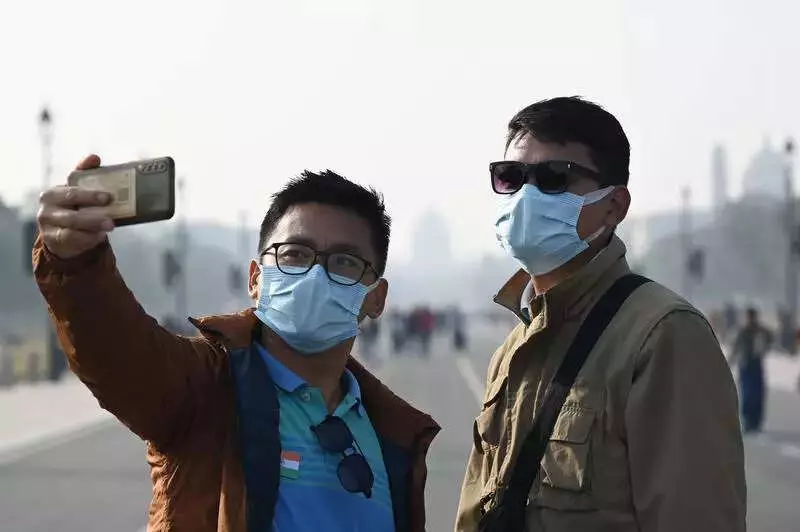
Delhi's air quality continued to pose a serious health risk on Sunday, stubbornly remaining in the 'very poor' category. A persistent haze of toxic pollutants blanketed the national capital, with only marginal fluctuations recorded throughout the day.
AQI Deteriorates Through the Day
The city's Air Quality Index (AQI) was recorded at 302 at 10 am. However, instead of improving, it worsened as the day progressed, climbing to 308 by 4 pm and further to 317 by 8 pm. This indicates a consistent, very poor level of air pollution. For context, the AQI a day earlier, at 4 pm on Saturday, was even higher at 330.
Meteorological experts see little hope for immediate, significant improvement. Mahesh Palawat, Vice President at Skymet, stated that no major change in weather conditions is likely until December 10. He explained that while winds may pick up briefly, they will not be strong enough for the complete dispersion of pollutants. Forecasts suggest Delhi's air quality will stay in the 'very poor' range throughout the coming week.

Temperature Trends: A Brief Respite from the Chill
Meanwhile, Delhi residents experienced a slight rise in the minimum temperature on Sunday, driven by a prevailing western disturbance. The minimum settled at 8°C, which is two notches below the seasonal normal but higher than the previous days. It was 6.8°C on Saturday and had plunged to a season's low of 5.6°C on Friday.
The India Meteorological Department (IMD) attributes the rise to an increase in moisture, leading to partially cloudy skies that trap heat at night. The IMD has forecast the minimum temperature to rise further on Monday, likely hovering between 9-11°C.
What's Next for Delhi's Weather?
An IMD official provided a detailed outlook, stating, "It will remain between 8-11°C till Wednesday, before possibly hovering around 6-8°C on Thursday and Friday." The official added that strong winds of 15-20 km/hr may be seen briefly during the day on Monday, but wind speeds will dip again during the early hours and at night.
The forecast indicates that a dip in the minimum temperature is only expected from December 11. Earlier, the IMD had predicted isolated cold wave conditions in parts of northwest India until December 5, due to cold northwesterly winds blowing from the snow-clad mountains.
This winter, Delhi's air quality has largely stayed in the 'very poor' zone, with a particularly bad spell of three consecutive severe air quality days between November 11 and 13. The current meteorological conditions offer little promise of a clean breath of air for the capital's residents in the immediate future.






