

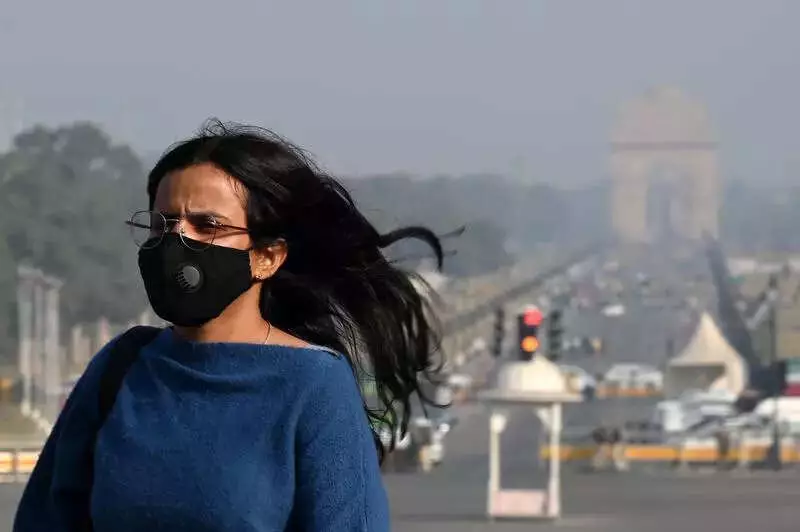
For the second consecutive day, the national capital grappled with 'Very Poor' air quality on Wednesday. While strong winds provided a marginal improvement, a persistent layer of fog trapped pollutants, leading to significant disruptions in air travel and a grim forecast for the coming days.
Marginal Improvement But No Real Relief
The overall Air Quality Index (AQI) for Delhi settled at 334, showing a slight improvement from Tuesday's reading of 354. This minor respite was attributed to westerly winds blowing at speeds of 8-10 kilometers per hour during the day. However, officials from the India Meteorological Department (IMD) reported that a shallow fog layer prevented the effective dispersion of harmful particles.
The Air Quality Early Warning System for Delhi predicts that the air quality will likely remain in the 'Very Poor' category until December 20. Alarmingly, the forecast indicates a potential deterioration to the 'Severe' category in the final week of December.

Identifying the Major Pollution Sources
Data from the Decision Support System, which analyzes the contribution of local and regional sources to Delhi's pollution, revealed key culprits. On Wednesday, emissions from Haryana's Jhajjar district were the largest single contributor, accounting for 16.53% of the pollutants. This was closely followed by Delhi's own vehicular emissions at 16.32%.
Industrial units within the city and its surrounding areas were responsible for just over 8% of the pollution load. This breakdown highlights the significant role of regional factors alongside the capital's internal sources in the ongoing air quality crisis.
Flight Chaos Continues Amid Reduced Visibility
The shallow fog continued to wreak havoc on flight schedules at the Indira Gandhi International (IGI) Airport. While visibility was relatively better than previous days—recorded at 800 meters in Palam and 700 meters in Safdarjung in the morning—it was still insufficient for smooth operations.
A total of 24 flights were cancelled and more than 200 were delayed on Wednesday. Officials stated that some cancellations were pre-emptive, while others resulted from low visibility conditions at other airports affecting connecting flights.
This disruption follows severe travel chaos earlier in the week. On Tuesday, over 500 flights were delayed and more than 100 were cancelled. The situation was even worse on Monday, with delays affecting over 800 flights, cancellations exceeding 200, and five flights being diverted to other airports.
The IMD has forecast that shallow fog will persist in the region until December 20, with moderate fog expected in isolated areas. The department has also issued a yellow alert for moderate to dense fog on December 21 and 22, signaling likely continued travel troubles.
On the weather front, Delhi recorded a maximum temperature of 24.7 degrees Celsius, which is three degrees above the seasonal average. The minimum temperature was 10.4 degrees Celsius, two notches above normal.






